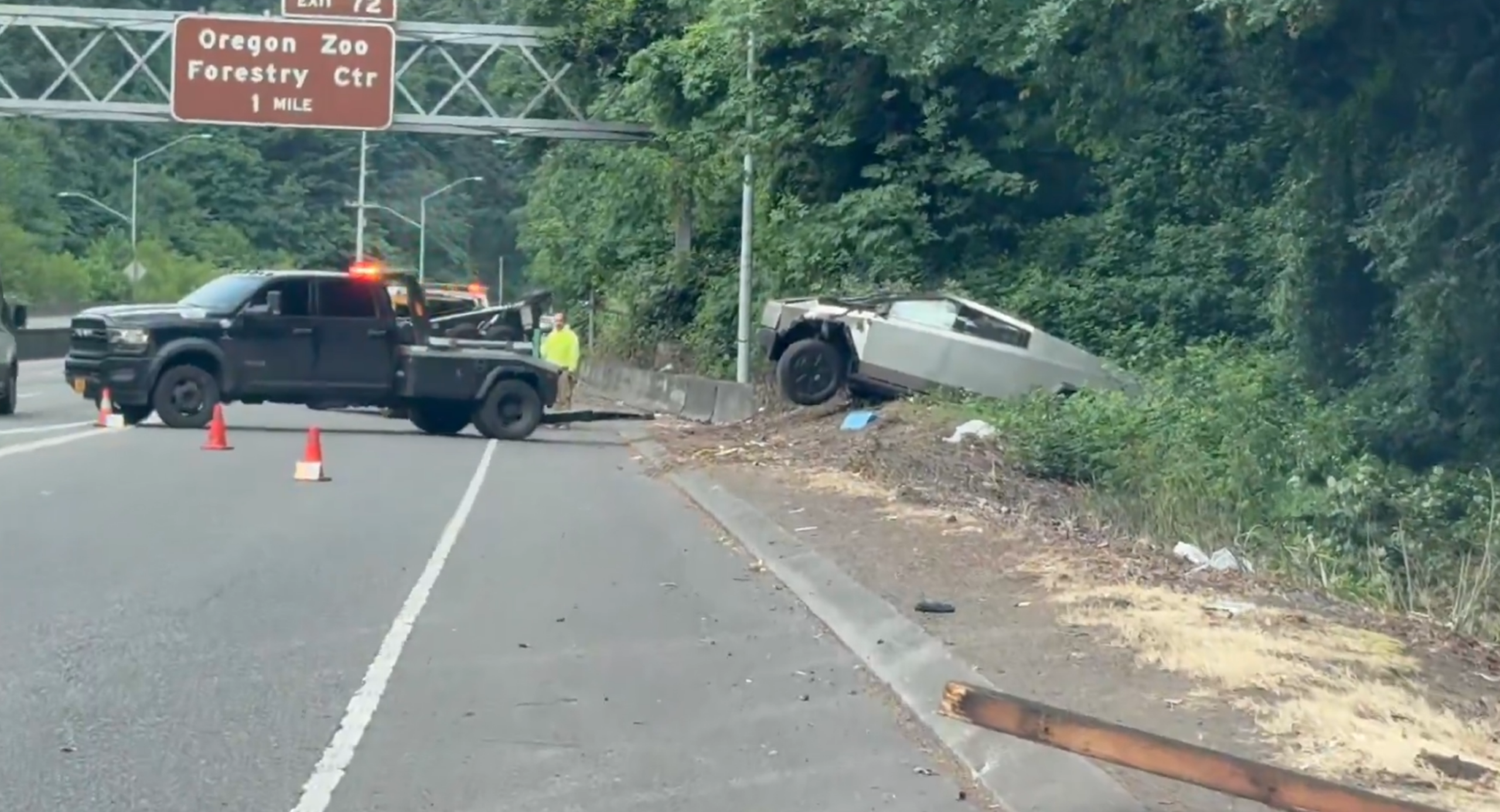
A Tesla Cybertruck crashed off Highway 26 near the Jefferson Street on-ramp in Portland, Oregon, on Monday morning, leaving the vehicle buried in roadside bushes and requiring two tow trucks to recover it.
Under normal circumstances, the incident likely would have remained a local traffic story. Instead, a tweet from KATU traffic reporter Mike Warner quickly attracted attention far beyond Oregon and sparked a debate less about the crash itself than about how it was being described.
Warner shared video of the recovery operation and noted “significant damage” to the Cybertruck, calling it an “indestructible” vehicle. The comment appeared to reference years of bold durability claims Tesla CEO Elon Musk made about the truck.
No injuries were reported, according to Warner. The truck, however, appeared to have sustained substantial damage and required a lengthy recovery effort that partially blocked the on-ramp during the morning commute.
The Tweet Quickly Became the Story
CYBER CRASH… someone crashed their Cybertruck along Hwy 26 westbound at the Jefferson St on-ramp in #Portland. It’s taken two tow trucks to pull this thing out, partially blocking the ramp this morning. No word on injuries, but significant damage to the ‘indestructible’… pic.twitter.com/7e6LQFAHIE
— Mike Warner (@MikeKATU) May 25, 2026
Warner later responded to criticism from commenters who argued the damage was being exaggerated and that the station was unfairly singling out Tesla.
Embedded media follows. Please allow a moment for it to load.
— Mike Warner (@MikeKATU) May 25, 2026
Warner’s post drew thousands of views and a long comment thread. Some readers treated the footage as little more than another amusing vehicle recovery. “You can’t park there,” one commenter joked. “It’ll buff out,” another wrote.
Others focused less on the crash itself and more on Warner’s description of the Cybertruck. Several commenters accused the reporter and KATU of unfairly singling out Tesla, while others argued that identifying the vehicle involved was simply part of accurately describing the incident.
One commenter asked how many pickup trucks end up in ditches and questioned whether Cybertrucks receive more attention than other vehicles. Another argued the damage appeared relatively minor, prompting Warner to respond that the passenger side had sustained significant damage and that the vehicle was ultimately towed from the scene.
As the discussion continued, the comments increasingly shifted away from the circumstances of the crash and toward larger debates involving Tesla, Elon Musk, media coverage, and politics.
Why a Local Crash Drew National Attention
Vehicle crashes happen every day. What made this one different was the vehicle involved.
The Cybertruck occupies a strange place in modern car culture. It is almost impossible to discuss the truck without eventually stumbling into an argument about Tesla, Elon Musk, politics, media bias, electric vehicles, or some combination of all four. Judging by the reaction to Warner’s tweet, that happened here almost immediately.
To be fair, there probably are times when people bring politics into vehicle coverage. But not every mention of a make and model is some carefully crafted political statement.
Recently, we covered a Florida case in which law enforcement was seeking reports of a suspect driving a gray Tesla. The make and color of the vehicle were critical details because investigators specifically wanted the public to look for that vehicle. Even then, some readers accused the coverage of being politically motivated simply because the word “Tesla” appeared in the headline.
The reality is often much simpler: the vehicle is part of the story.
If a Dodge Hellcat gets clocked at 172 MPH, readers expect the article to mention it was a Hellcat. If a Waymo robotaxi gets stuck somewhere unusual, readers want to know it was a Waymo. And when a stainless-steel wedge-shaped truck that looks like it escaped from a science fiction movie ends up buried in Oregon bushes, people are probably going to mention that it was a Cybertruck.
The Cybertruck Carries More Baggage Than Most Trucks
The Cybertruck also carries baggage that few other vehicles do.
Since its unveiling, buyers have been promised everything from extraordinary durability to the ability to briefly serve as a boat. Those claims helped make the truck one of the most talked-about vehicles in America, but they also guaranteed that every unusual Cybertruck story would receive far more attention than a typical pickup truck mishap.
Some owners have attempted to test those claims in ways that generated headlines of their own. One owner famously drove a Cybertruck into a lake while attempting to test Wade Mode. In California, another Cybertruck generated headlines after becoming stuck in a puddle, prompting a response from the California Highway Patrol. Another viral incident showed a Cybertruck being pulled from the beach sand by a Toyota Sienna minivan after it became stranded.
Fair or not, those stories helped turn the Cybertruck into something more than just another pickup truck. It became one of the internet’s favorite vehicles for debate, mockery, defense, and argument. That helps explain why a crash that might otherwise have remained a local Portland traffic story suddenly attracted thousands of comments.
The Durability Debate Is Nothing New
Part of the reason Warner’s use of the word “indestructible” generated such a reaction is that Tesla and Musk have spent years making ambitious claims about the Cybertruck’s toughness.
At the truck’s unveiling in 2019, Tesla demonstrated what it described as an ultra-hard stainless steel exoskeleton. Musk also promoted the truck’s durability during numerous public appearances and social media posts.
Since deliveries began, however, the Cybertruck has repeatedly become the subject of online debates involving its real-world performance. Owners and supporters frequently point to strong crash-test results and safety ratings. Critics often point to incidents involving recalls, off-road recoveries, and highly publicized breakdowns.
The Portland crash immediately became another entry in that ongoing discussion.
A Crash, a Tweet, and a Familiar Argument
The Portland incident itself was relatively straightforward. A Cybertruck left the roadway, ended up in roadside vegetation, and required two tow trucks to recover it. No injuries were reported.
What transformed the story into a national conversation was everything that followed. For some viewers, the video was simply another example of a vehicle crash generating internet jokes. For others, it became another chapter in the ongoing debate surrounding Tesla and the Cybertruck.
Whether readers viewed the incident as evidence of overhyped marketing, media bias, or simply an unfortunate crash largely depended on what they already thought about the vehicle before they clicked on the video.
One thing was clear from the reaction: the conversation quickly became much bigger than a truck stuck in some bushes along a Portland highway.