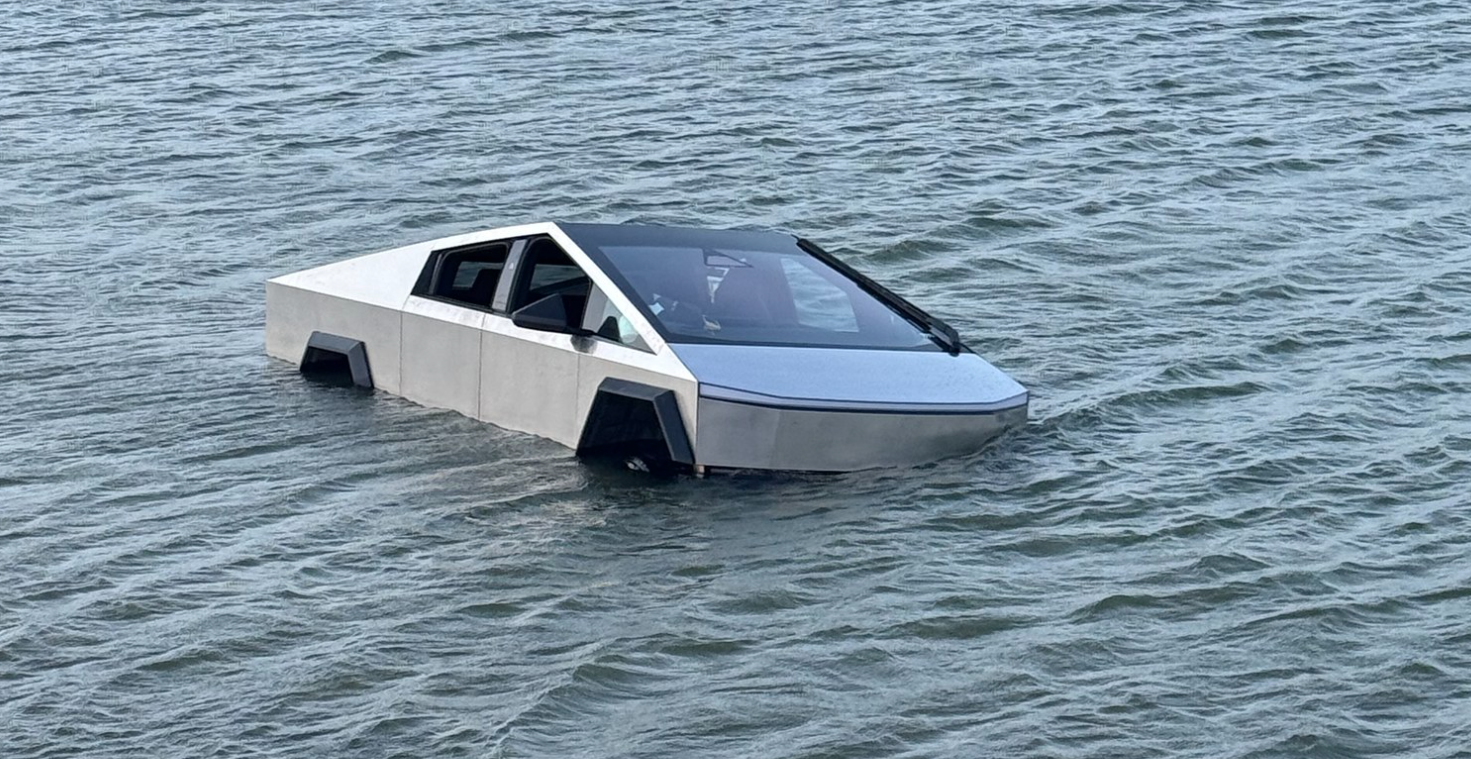
A Texas man found himself in handcuffs this week after deciding that a public boat ramp was the perfect place to test one of the Tesla Cybertruck’s most talked-about features. According to the Grapevine Police Department, patrol officers were dispatched to Katie’s Woods Park Boat Ramp, where a Cybertruck had gone into the lake near the shoreline. The driver openly admitted the whole thing was intentional — he had driven into the water specifically to activate the truck’s “Wade Mode” capability.
Things did not go according to plan. The Cybertruck became disabled, took on water, and the driver and passengers had to abandon the vehicle before it could be recovered. The Grapevine Fire Department Water Rescue Team had to step in to pull the truck out of the lake. What started as an experiment ended with an arrest.
The driver was charged with operating a vehicle in a closed section of a park and lake, along with multiple water safety equipment violations. The Grapevine Police Department used the incident as an opportunity to remind drivers that just because a vehicle is physically capable of entering shallow freshwater does not mean doing so is legal or safe under Texas law. The reminder, it turns out, was very much needed.
This incident is far from an isolated moment of bad judgment. It is the latest chapter in what is becoming a very long and very expensive saga of Cybertruck owners pushing their trucks into terrain the vehicles were not truly built for — often with Elon Musk’s own words ringing in their ears.
What Elon Musk Actually Said About the Cybertruck and Water
Let’s go back to where a lot of this started. Ahead of the Cybertruck’s production launch, Musk posted on X that the truck would be “waterproof enough to serve briefly as a boat, so it can cross rivers, lakes, and even seas that aren’t too choppy.” He went further, saying his goal was for a Cybertruck to be able to cross the channel between SpaceX’s Starbase in Boca Chica and South Padre Island — a stretch of water that, according to the U.S. Army Corps of Engineers, reaches depths of over 40 feet.
Tesla’s own vice president of vehicle engineering, Lars Moravy, explained on Jay Leno’s Garage that the Wade Mode system pressurizes the battery pack using air suspension and is capable of handling just over two and a half feet of water without any getting into the cabin. He then floated the idea, perhaps a bit too casually, that with some creativity and an outboard motor plugged into the truck’s outlet, you could “go boating.”
Musk and his team clearly had some fun imagining the Cybertruck as an amphibious machine. The problem is that physics had other ideas.
Why a 6,600-Pound Truck Is Not a Boat
Here is the part where the dream meets the driveway. The Cybertruck weighs approximately 6,600 pounds — more than three tons of stainless steel. For context, that is roughly the weight of a small rhinoceros. Objects that weigh that much do not float gracefully. They sink, especially when they are designed primarily for land.
Wade Mode was built to handle shallow freshwater crossings, not open-water navigation. The system lifts the suspension and pressurizes the battery to protect components in water up to roughly 31 inches deep. That’s a shallow creek, not a lake. The moment a Cybertruck ventures past those limits, it stops being a truck attempting a crossing and starts being a very expensive anchor.
Tesla’s own warranty tells a different story than Musk’s social media posts. Water-related damage is not covered. Off-road damage is not covered. That means every owner who takes those bold claims at face value and ends up stuck or submerged will be paying the bill out of pocket — and those bills are not small. Repair costs for the stainless steel truck are notoriously high.
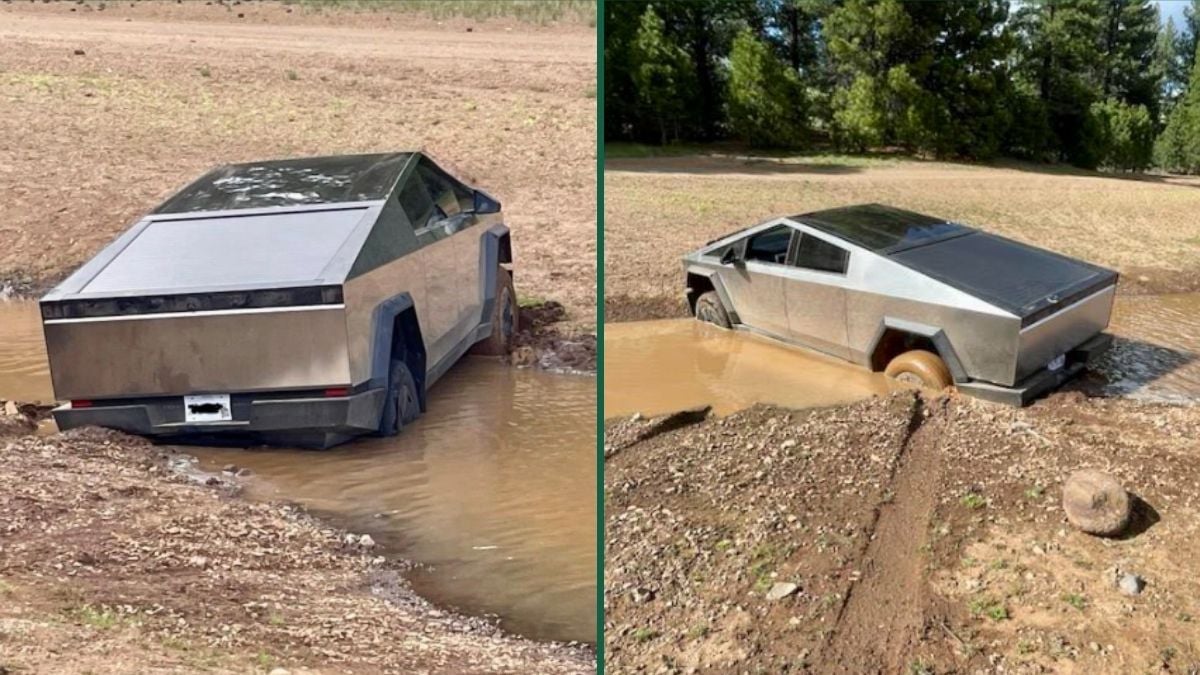
The California Highway Patrol already had to deliver this reality check once before, when a Truckee-area Cybertruck owner activated Wade Mode and got stuck in the mud after attempting a water crossing. The CHP’s response was pointed: “Wade Mode isn’t Submarine Mode.”
The Sienna Heard ‘Round the Internet
While the Grapevine incident involves water, the Cybertruck’s off-road credibility has been taking hits on dry land too. Just days before this Texas arrest made news, a video went viral showing a Tesla Cybertruck thoroughly beached in soft sand — wheels spinning, going absolutely nowhere. Four people pushed from behind. Someone slid wood panels under the rear tires for traction. None of it helped.
What did help was a Toyota Sienna. A minivan. The family vehicle of school pickups and airport runs walked up, hooked a tow strap to the Cybertruck, and pulled it out without apparent difficulty. The internet, understandably, had a great time with this.
The physics behind it are pretty simple. The Cybertruck weighs between 6,600 and 6,800 pounds depending on the trim, making it one of the heaviest trucks on the market. Sand driving punishes heavy vehicles. The more mass a vehicle carries, the deeper it sinks, the more resistance it generates, and the harder it becomes to recover. The Cybertruck’s wedge-shaped body design also results in a relatively narrow footprint for its weight, which is not an asset in loose terrain. Air suspension and all-wheel drive help — up to a point. Past that point, physics wins.
This was not a one-off situation. Just days after the Sienna video went viral, another Cybertruck got stuck in a muddy puddle during an off-road outing. The California Highway Patrol, commenting on yet another Cybertruck recovery, put it well: “Nothing says Sunday Funday quite like testing your limits and finding out the mud had other plans.”
What We Can All Learn From This Pattern
There are a few lessons here that go beyond laughing at expensive trucks stuck in sand.
First, marketing is not engineering. Musk’s claims about the Cybertruck have often been aspirational at best and misleading at worst. The same man who promised a million robotaxis on the road by 2020 and a Roadster that still has not reached production also promised an amphibious truck that could cross open water. Manufacturers’ warranties, not press releases, reflect what a vehicle is actually designed to do.
Second, off-road capability is not universal. A truck can perform well on hardpack trails or tow heavy loads on pavement while still struggling in sand, mud, or water. The Cybertruck has genuine strengths in some conditions. Shallow freshwater wading in controlled situations is one of them. Open lakes are not.
Third, and most immediately relevant to the Grapevine incident: driving a vehicle into a closed section of a park or public lake is illegal in Texas regardless of what the vehicle can theoretically handle. The driver was not arrested because Wade Mode failed — he was arrested because he drove into a restricted area and violated water safety laws. The truck’s capabilities, real or imagined, were irrelevant to the legal outcome.
Finally, if a feature sounds like it requires a Coast Guard permit to use safely, it is probably worth reading the owner’s manual before testing it at a public boat ramp. The Grapevine Fire Department Water Rescue Team is very good at their jobs, but they would probably prefer not to spend their afternoon rescuing a stainless steel electric truck from a lake because someone wanted to see what would happen.
The Cybertruck is not a boat. Texas law enforcement, California highway patrol, and at least one heavily waterlogged vehicle have now all confirmed this. Hopefully, the message is starting to get through.