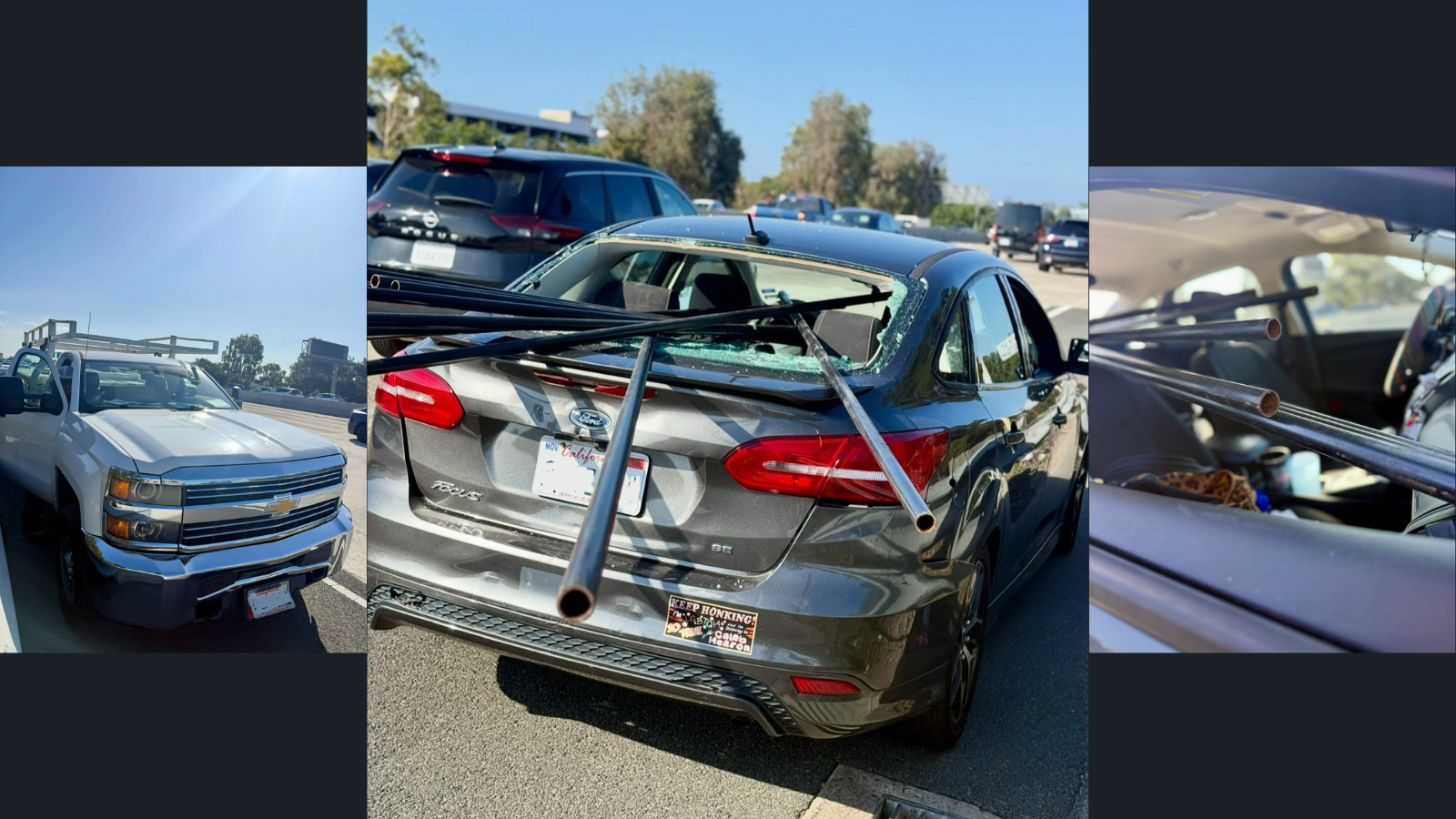
A gray Ford sedan in California was struck from behind by a pickup truck carrying a load of long metal pipes. The initial collision was serious enough, but what happened next turned an ordinary rear-end crash into the type of scene drivers usually associate with a horror movie.
According to the California Highway Patrol’s Santa Ana office, the impact sent the pickup’s unsecured pipes hurtling forward. The pipes punched through the sedan’s rear window and continued into the passenger compartment.
Photos shared by CHP show multiple pipes resting inside the car, with several extending through the shattered rear glass. Despite the wreck’s frightening appearance, authorities said only minor injuries were reported.
The photos immediately drew comparisons to the Final Destination movies, but they also highlighted a serious road hazard that extends beyond drivers following overloaded pickup trucks. In this case, the sedan was traveling in front of the vehicle carrying the pipes.
Metal Pipes Were Propelled Into the Sedan
Authorities said the white pickup struck the gray sedan, causing the metal pipes loaded above the truck bed to shoot forward and penetrate the sedan’s rear window. CHP did not provide the exact location, the speed of either vehicle, or details about how the load had been secured before the collision.
The agency described the pipes as unsecured and warned that the consequences could have been much more serious. “Had this crash resulted in a fatality, the driver of the truck could have faced charges for manslaughter,” CHP wrote.
CHP did not announce any criminal charges. The agency was emphasizing that an unsecured load can carry serious legal consequences when a crash turns deadly.
The Car Was in Front of the Pickup
Many people initially assumed the sedan had been traveling behind the pickup, partly because crashes involving cargo falling from trucks typically affect motorists following them.
Commenters quickly pointed out that this incident happened differently. The pickup rear-ended the sedan, and the impact sent the pipes forward into the car. That detail prompted one reader to describe the wreck as a “Final Destination uno reverse card.”
Others said the incident created an entirely new fear. Drivers may already leave additional space when traveling behind trucks carrying ladders, furniture, construction materials, or scrap. This crash showed that being in front of the load does not necessarily remove the danger.
Readers Shared Their Own Unsecured-Load Stories
The Facebook post quickly filled with stories from drivers who had experienced similar close calls involving objects falling from pickup trucks and trailers.
Among the responses was one from a driver who recalled watching a refrigerator begin to topple from a truck after it had been secured with a strap wrapped around part of the box. Another commenter described a mattress bouncing off a pickup and nearly striking their vehicle.
Others shared encounters with everything from kiddie pools and traffic cones to barbecue parts, ladders, buckets, and even a Volkswagen Beetle engine sitting in the roadway.
A separate commenter said they had watched a ladder fall from a truck on Interstate 5 earlier that same morning. The vehicle behind it reportedly swerved just in time, allowing the ladder to slide harmlessly into the center divider.
Several readers argued that commercial and construction vehicles carrying long or heavy materials should face additional inspections. Some also pointed out that tie-down straps alone may not always be enough to restrain heavy steel pipes during a severe collision.
Another suggestion that gained support was requiring physical barriers at both the front and rear of loads like these to help prevent the materials from sliding forward, even when they are properly strapped down.
Securing a Load Requires More Than One Loose Strap
CHP reminded drivers that unsecured cargo causes crashes every year, leading to hundreds of deaths and thousands of injuries nationwide.
The agency recommended tying down cargo with rope, netting, bungee cords, or straps. Drivers should also use a sturdy tarp or cargo net when carrying smaller objects or debris that could escape from the bed.
However, the proper equipment depends on the cargo’s size and weight. Lightweight bungee cords suitable for holding down a tarp are not necessarily strong enough to secure long sections of heavy metal pipe.
Cargo should be prevented from moving forward, backward, sideways, or vertically. Long materials may require several independent tie-down points, along with racks, stops, gates, or blocking designed to keep the load from sliding during braking or a collision.
Drivers should also avoid overloading the vehicle, inspect the rack and tie-down points for damage, and stop after traveling a short distance to check whether the load has shifted.
The Traditional “That’s Not Going Anywhere” Test
One of the lighter comments referenced the informal ritual familiar to anyone who has ever loaded furniture, lumber, or equipment into a truck: tightening the straps, slapping the load, and confidently declaring, “That’s not going anywhere.”
Unfortunately, pulling on a strap once is not a substitute for checking the working load rating, inspecting the anchor points, and considering what could happen during hard braking.
A load that feels secure while parked may behave very differently at highway speeds, during sudden steering, over potholes, or under the force of a crash.
This time, the people involved escaped with only minor injuries. Looking at the photos, it is hard not to wonder how close the crash came to ending very differently. It is also a reminder that securing a load is not only about protecting the items in the truck. It is about protecting everyone else sharing the road.