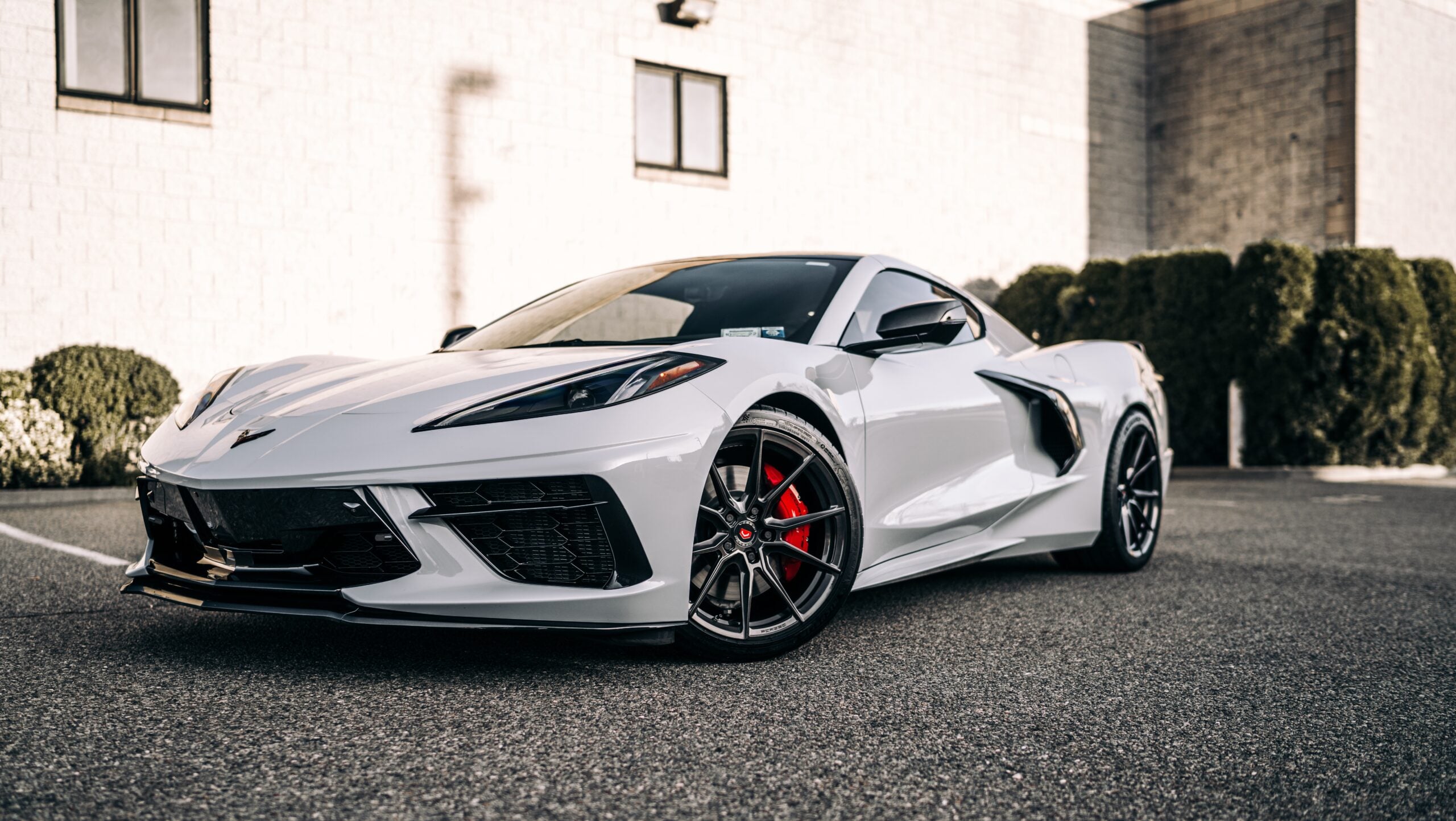
It looks like Suffolk County may be getting a Corvette, but the real story is not the car itself. It is how it surfaced, and why so much of the reaction to it is missing the point.
Photos of a fully wrapped Chevrolet Corvette C8 in Suffolk County Police Department livery did not come from an official announcement. They came from a Facebook post by CMJ Enterprises LLC, a Lindenhurst-based subcontractor that appears to have done exactly what most shops do after finishing a project: show off the work.
“Say hello to our little friend! Check out this Corvette recently wrapped by us for Suffolk PD!” the company wrote, alongside images of the mid-engine sports car outfitted in full department markings.
What started as a routine post quickly turned into something slightly bigger. The images spread fast, and before any official details were available, the conversation had already shifted to questions about taxpayer money, seizures, and whether this was even real.
A Routine Facebook Post That Didn’t Stay Routine
What reads like a simple, even proud post from an outfitter did not stay contained for long. The images quickly spread beyond Facebook, gaining traction before any official comment was made. The post was soon picked up by Newsday, which reported that Suffolk County Police declined to comment on the vehicle’s existence even as the photos continued to circulate.
According to that report, a representative from CMJ confirmed it was a legitimate project but said he was not authorized to speak on the record about the car. That detail suggests this may not have been intended as a public reveal, even as the images were already moving far beyond the original post. This project may have been meant to stay under wraps, before the wrap itself gave it away.
The Detail Everyone Saw, but Few Focused On
What is visible in the photos is hard to miss. The rear window of the Corvette is clearly marked “DWI SEIZURE — Seized Under Suffolk County Local DWI Law.”
That line answers the biggest question people were asking, but it also led to several more.
“Did Taxpayers Pay for This?”
That was easily the most common reaction in the comments, and it is also where the conversation started to drift.
According to Suffolk County’s vehicle seizure guidance, police are required to seize vehicles in certain cases, including repeat DWI offenses, reckless driving with prior convictions, and fleeing police. This is not discretionary. Once the arrest or qualifying charge is made, the vehicle is taken, and the legal process begins.
That’s where a key distinction comes in: a lot of people blur it together. Seizure and forfeiture are not the same thing. Seizure is the act of taking control of the vehicle, while forfeiture is the legal process that can eventually transfer ownership to the government. As outlined in an FBI Law Enforcement Bulletin, forfeiture occurs only after a legal proceeding establishes that the property was tied to a crime.
That means a vehicle like this is not purchased in the traditional sense if it is ultimately forfeited to the county.
At the same time, it is not completely free. Storage, processing, and modifications, such as the wrap, all carry some level of cost. The reality sits in the middle, even if the comments tend to fall on opposite extremes.
“What if the Car Still Has a Loan?”
This came up repeatedly, and it is a fair question.
If the vehicle is financed or leased, the lienholder still has a legal claim. Suffolk County’s process allows lenders or lessors to step in and pursue recovery of the vehicle through documentation and legal agreements. That means not every seized vehicle stays with the county, and some are ultimately returned to financial institutions rather than kept or sold.
So no, a seizure does not simply wipe out a loan or transfer ownership overnight.
“Why Not Just Auction It?”
Suffolk County periodically auctions seized vehicles, which is another reason this situation raised eyebrows.
The county, however, can also retain certain vehicles. When that happens, it is usually tied to visibility rather than practicality. A high-profile car like a Corvette is unlikely to be used as a standard patrol unit. Still, it can serve as a public-facing tool, whether for outreach, recruitment, or messaging tied to impaired driving enforcement.
This Isn’t Unusual—Departments Have Done This Before
Suffolk County would not be the first agency to repurpose a seized performance car this way.
In Ohio, state troopers outfitted a seized Chevrolet Corvette C7 and a fifth-generation Camaro after they were taken during separate criminal investigations, using them primarily for community outreach and safety education rather than patrol duties.
Other departments have taken a slightly different approach. In Michigan, the Saginaw County Sheriff’s Office converted a seized 1981 Camaro Z28 into an active patrol vehicle after it was forfeited during a drug investigation, with the build funded using money confiscated from the same case. According to reporting from Motorious, the goal was both practical and symbolic, turning a vehicle tied to criminal activity into a working tool for law enforcement.
In Florida, the Florida Highway Patrol has also used a seized Camaro as a high-visibility cruiser, appearing at community events while reinforcing traffic enforcement campaigns. Across these examples, the pattern is consistent. Some are used strictly for outreach. Others see limited duty. All of them are meant to be seen.
What This Likely Is—and What It Isn’t
A Corvette may look the part, but it is not built for day-to-day police work. Limited space, low ride height, and basic practicality make it a poor fit for standard patrol duties.
That makes it far more likely this is a promotional or outreach vehicle rather than something responding to calls or conducting traffic stops.
Police often use these seized vehicles as part of community outreach or social media strategies. They help build relationships with the public, remind people that enforcement is present, and, more importantly, reinforce that breaking the law has real consequences.
The Bigger Picture Behind the Reaction
What started as a routine Facebook post from a subcontractor quickly turned into a widely circulated story before the department itself was ready to comment.
In that gap, the conversation filled in the blanks on its own.
The cost to the person who drove under the influence may seem harsh to some, especially when it involves losing a high-value vehicle. But the cost to victims affected by impaired driving is far higher. That is the part that often gets lost in the debate.
If vehicles like this end up at community events or in public campaigns and serve as a visible reminder of those consequences, the value goes beyond the car itself. Maintenance, wraps, and upkeep are part of that equation, but so is the message. In many cases, vehicles like this can also be sold off after their use, potentially retaining much of their value.
The Corvette may be what grabbed attention, but the broader takeaway is simpler. In Suffolk County, under specific conditions, vehicles tied to certain offenses must be seized, and they can be forfeited only after a legal process. What happens next depends on the case, not the comment section.