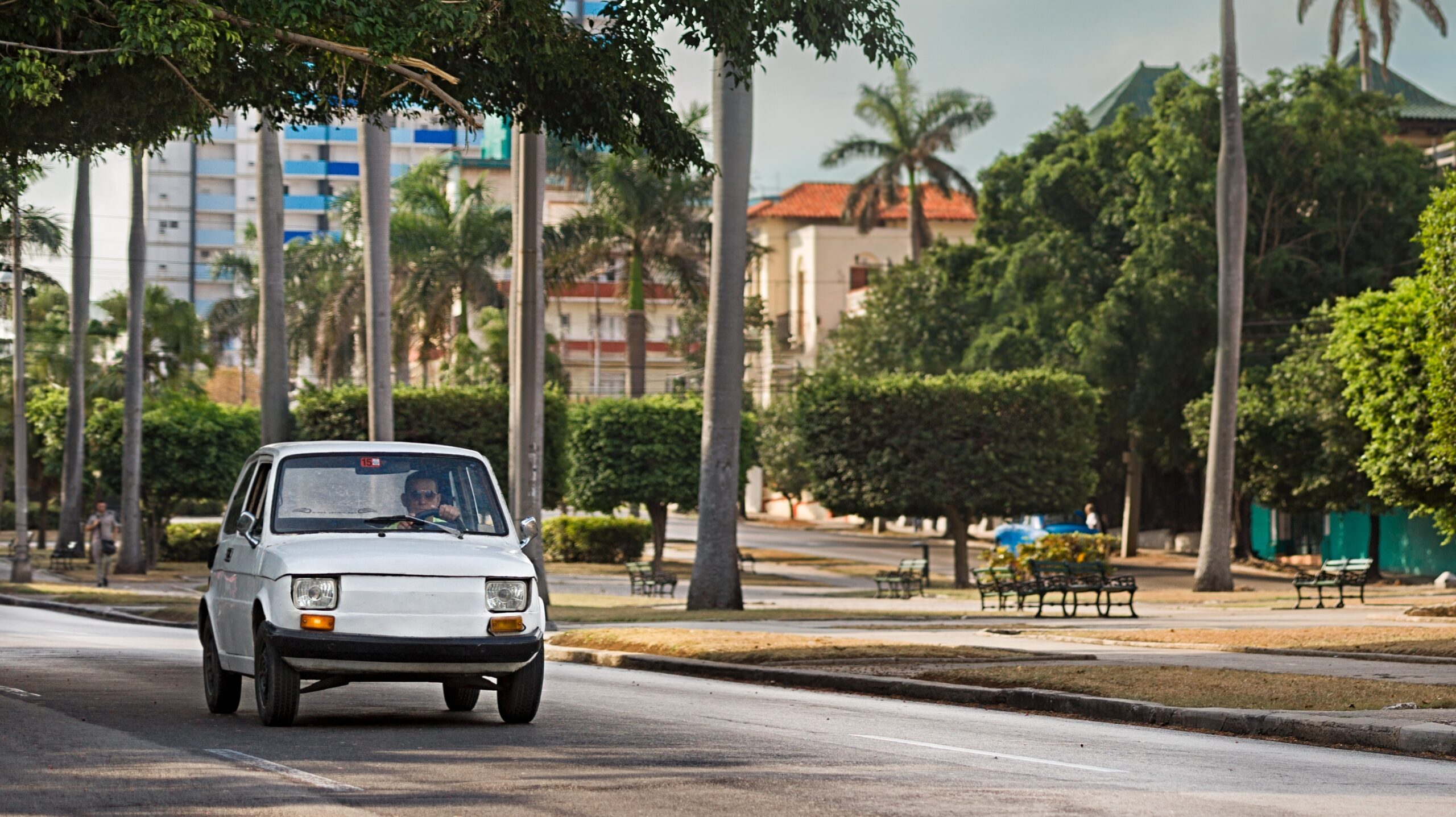
The global auto industry is racing toward EVs, autonomy, and increasingly advanced technology. In parts of Cuba, the solution to getting around is coming from a very different era.
As fuel shortages tighten, some drivers are turning to methods that date back nearly a century, not out of nostalgia, but necessity. Before it made international headlines, one of those builds was already making the rounds online.
On March 7, videos of a charcoal-powered Fiat Polski began circulating on Facebook, showing a Cuban mechanic’s workaround for the country’s worsening gasoline shortage. Early coverage from CiberCuba documented the spread of the build online. The car is credited to Juan Carlos Pino, a 56-year-old mechanic who modified a 1980 Polish-built Fiat to run on gas produced from burning charcoal.
The first clips appear to have been shared on Facebook by his wife, Odalys Almeida. From there, the footage spread across social media and into online discussions, where reactions were anything but unanimous.
Video below — may take a moment to load.
By March 14, the story had already moved beyond the original posts. It was discussed by Los Pichy Boys, a Cuban comedy duo known for blending humor with commentary, in which the charcoal-powered Fiat became part of a broader conversation about life on the island.
The tone of that discussion mirrored what was happening across social media. Some saw ingenuity and resilience. Others saw a workaround that points to deeper problems. Even in a comedic format, the divide was clear. People were not just reacting to how the car works, but what it represents.
A Small Town Build That Got Big Attention
Pino built the car from his workshop in Aguacate, a town of roughly 5,000 people about 45 miles east of Havana. Once supported by a now-closed sugar refinery, the area is now surrounded by farmland and quarries, where daily life has been shaped by ongoing shortages.
His modified Fiat stands out immediately. A large, improvised system is mounted to the rear, where charcoal is burned inside a sealed container and converted into usable gas. The setup was built almost entirely from repurposed materials, including a converted propane tank and a filtration system made from a metal container packed with fabric.
In town, the car has turned Pino into something of a local attraction. Residents gather to watch it move through the streets, some taking photos, others asking if he could build a similar system for them. For Pino, the goal is practical. In a fuel crisis, mobility matters, and being able to move equipment, reach jobs, or even work land has become increasingly difficult as gasoline grows scarce and expensive.
An Old Idea, Reused Out of Necessity
While the build looks unusual today, the underlying technology is not new.
The system relies on gasification, a process that converts solid fuels like charcoal into a combustible gas mixture. Variations of this setup were widely used during World War II, when fuel shortages forced vehicles across Europe to rely on wood- or coal-gas generators to stay on the road.
In simple terms, charcoal is burned with limited oxygen, producing a mix of gases that can be filtered and fed into an internal combustion engine. It works, but it comes with tradeoffs. Systems like this require constant monitoring, reduce engine output, and take up significant space.
Historically, they have been used as stopgap solutions during periods of severe fuel scarcity, not as long-term replacements for conventional fuel systems.
Reaction Is Where the Story Gets Interesting
If the build itself is straightforward, the reaction to it is not.
Comments on the original posts reveal a wide range of perspectives. Some praised the ingenuity behind the build, calling it a powerful example of creativity under pressure. Others pointed out that the technology itself is decades old, arguing the story reflects necessity more than innovation.
Some took a more practical view. It may not be new, but making it work under these conditions still takes skill. If it keeps a car moving, that alone has value. And then there are the critics, who see something else entirely, arguing that the build highlights how severe the situation has become and describing it as a step backward rather than progress.
What This Actually Says
That tension is what gives this story staying power.
On the surface, it is simple. A car that runs on charcoal instead of gasoline. But the reaction around it tells a bigger story. The same build can be seen as resourcefulness or as a sign of how strained things have become.
For some, it is proof that people will always find a way to adapt. For others, it feels like a workaround that shouldn’t have to exist in the first place.
Part of that context comes from ongoing fuel constraints tied to U.S. sanctions and reduced oil shipments to the island, which have contributed to widespread shortages affecting transportation and daily life. Either way, it is hard to ignore.
Before broader international coverage, including Reuters reporting, the story was already circulating online, with people debating not just how it works but what it represents.