
Ferrari is an inspiring car brand in that it inspires us to take on a second job. Born in 1947 from Enzo Ferrari’s determination to fund his racing addiction (sorry, “passion“), the company has been separating car lovers from their life savings ever since. But here’s the thing: nobody complains afterward.
What started as a way to finance racing has become the gold standard for making neighbors simultaneously jealous and concerned about your financial decisions. Ferrari has mastered the art of creating machines that appear to be doing 100 mph while parked in your driveway, assuming you can afford a driveway elegant enough. But these Ferrari models don’t just look fast: they have the performance to match. Taken from the posters on your childhood bedroom wall and dropped onto the track, these Ferraris seem to forget they are beautiful works of art and destroy the competition.
Ferrari 250 GTO
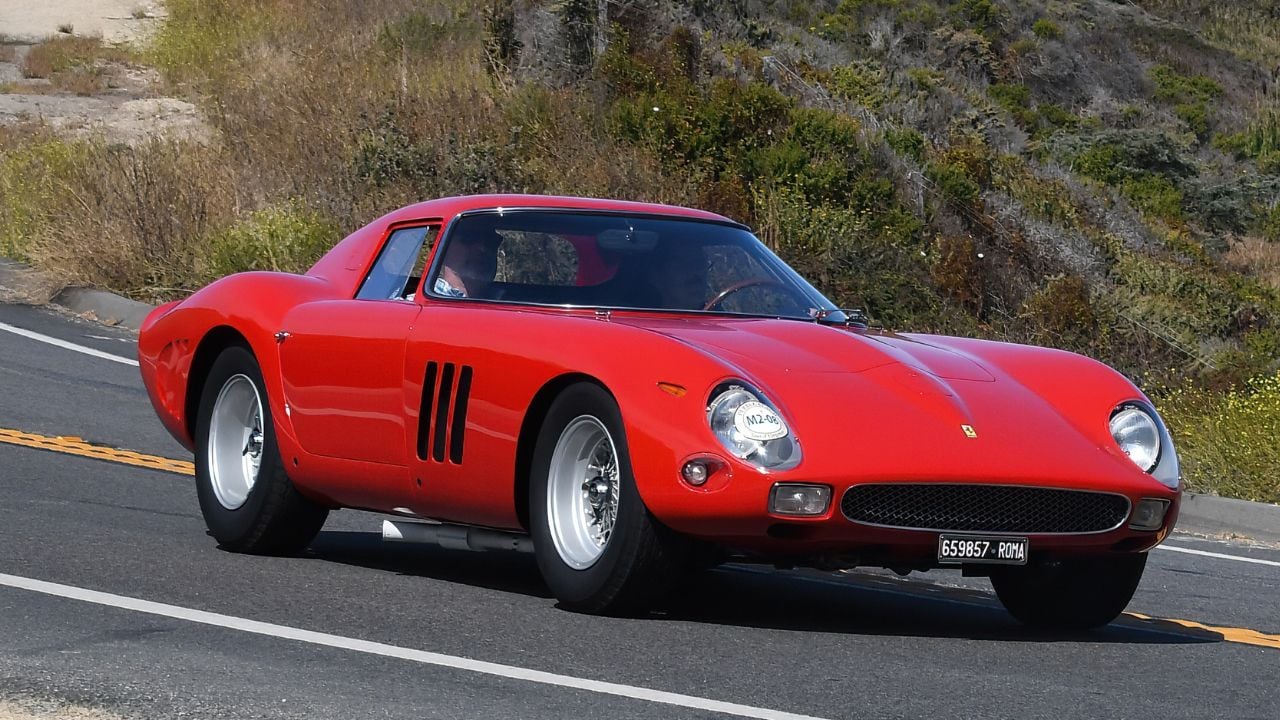
The 250 GTO isn’t just a car – it’s a retirement plan on wheels. With only 39 ever built, finding one is harder than explaining to your spouse why you need “just one more” project car. This item regularly sells for over $40 million at auction, making it the most expensive way to reach 174 mph ever invented.
The Numbers:
- Engine: 3.0L Colombo V12
- Power: 300 hp (302 PS)
- Weight: 2,030 lbs
- 0-60 mph: 5.4 seconds
- Top Speed: 174 mph
- Production: 39 units
Sergio Scaglietti designed the bodywork with the kind of curves that make other cars look like they were drawn by a little kid with a ruler. The long nose houses three air intakes that aren’t just for show: they actually feed the engine and brakes, because even in 1962, Ferrari knew function should be beautiful.
This car dominated GT racing, winning the World Championship for GT Manufacturers for three consecutive years (1962-1964). It conquered Le Mans, Sebring, and essentially every track where wealthy individuals gathered to watch other wealthy individuals go in circles at high speeds.
Today, owning a 250 GTO puts you in an exclusive club of about 39 people who can afford to insure something worth more than a small island. It’s like Ferrari demanded: “Make them gorgeous, make them fast, and make very few of them.”
Ferrari Testarossa

Nothing says “I made questionable financial decisions in the ’80s” quite like a Testarossa. This wide-body wonder became the poster child for cocaine-fueled excess, appearing in more Miami Vice episodes than Don Johnson’s pastel blazers. The side strakes channeled air to the side-mounted radiators, solving the cooling issues that plagued its predecessor while creating one of the most recognizable silhouettes in automotive history.
The Numbers:
- Engine: 4.9L Flat-12
- Power: 390 hp (395 PS)
- Weight: 3,660 lbs
- 0-60 mph: 5.2 seconds
- Top Speed: 181 mph
- Production: 7,177 units (including 512 TR and 512 M variants)
Pininfarina designed this beast to be 78 inches wide – nearly as wide as some garages. The flat-12 engine sat behind the driver, creating a soundtrack that made every tunnel a concert hall. The boxer configuration kept the center of gravity low, which was crucial when piloting something that resembled it could take flight.
The Testarossa’s party trick was being civilized enough for daily driving while still being capable of embarrassing most sports cars. Air conditioning actually worked, the interior had enough room for humans over 5’6″, and the steering didn’t require Olympic-level upper body strength.
Ferrari had to redesign the door mirrors because the original design was too wide for European parking garages. Even Ferrari occasionally acknowledges the real world exists.
Ferrari F40

You’d probably never guess the F40 was fast, not because of any reason other than you’re so busy marveling at its styling that it never crossed your mind. Built to celebrate Ferrari’s 40th anniversary, it was essentially a race car that grudgingly accepted license plates. No power steering, no ABS, no air conditioning – just 478 horsepower of pure, unfiltered intimidation wrapped in carbon fiber and Kevlar.
The Numbers:
- Engine: 2.9L Twin-Turbo V8
- Power: 478 hp (485 PS)
- Weight: 2,976 lbs
- 0-60 mph: 4.1 seconds
- Top Speed: 201 mph
- Production: 1,315 units
This was the first production car to break 200 mph, and it did so with the subtlety of a volcanic eruption. The twin IHI turbochargers delivered boost with the violence of a caffeinated toddler, creating lag that made you question your life choices before delivering acceleration that made you forget your own name.
The interior was stripped to essentials: racing seats, a roll cage, and enough carbon fiber to build a small aircraft. The door pulls were pieces of string. Ferrari literally gave you a string to open the doors and charged supercar money for the privilege. And you know what? I’d get in line.
Driving an F40 required commitment. The clutch was heavy enough to qualify as leg day, the steering demanded constant attention, and the turbo lag meant you either got nothing or everything with very little in between. It was magnificent.
Ferrari 458 Italia

The 458 Italia proved Ferrari could build a supercar that wouldn’t strand you at the grocery store. After years of questionable reliability (looking at you, 355), the 458 was the car that made Ferrari ownership less like an abusive relationship and more like dating someone attractive who also has their life together.
The Numbers:
- Engine: 4.5L Naturally Aspirated V8
- Power: 570 hp (578 PS)
- Weight: 3,274 lbs
- 0-60 mph: 3.4 seconds
- Top Speed: 202 mph
- Production: 20,000+ units
The naturally aspirated V8 was a masterpiece of engineering, revving to 9,000 rpm with a sound that could make grown men weep. Ferrari’s seven-speed dual-clutch transmission shifted faster than your brain could process, and the electronic differential made heroes out of weekend warriors.
Pininfarina’s design was pure sculpture in motion. Every line served an aerodynamic purpose while looking like it was carved by someone who truly understood what “beautiful” meant. The LED headlights were integrated so seamlessly that they looked like the car’s eyes, giving it an almost predatory expression.
The 458 was also the first Ferrari to offer serious everyday usability without sacrificing performance. The ride quality wouldn’t punish you for choosing the scenic route, and the interior was comfortable enough for actual human beings.
Unfortunately, early models had a tendency to catch fire; apparently, the wheelwell adhesive didn’t appreciate track temperatures. Ferrari issued a recall faster than you could say “lawsuit,” proving even Italian passion can’t overcome basic chemistry.
Ferrari 812 Superfast

With 789 hp from its naturally aspirated 6.5-liter V12, the 812 Superfast represents the end of an era. This is likely the last time Ferrari will stuff this much displacement into a naturally aspirated engine, making it the farewell tour for one of the greatest powerplants ever built.
The Numbers:
- Engine: 6.5L Naturally Aspirated V12
- Power: 789 hp (800 PS)
- Weight: 3,593 lbs
- 0-60 mph: 2.9 seconds
- Top Speed: 211 mph
- Production: Still in production (limited)
The engine redlines at 8,900 rpm, creating a soundtrack that makes Formula 1 cars sound modest. Ferrari’s engineers somehow managed to extract more power from this V12 than from the LaFerrari’s hybrid-assisted unit, proving that sometimes, more displacement really is the answer.
The aerodynamics are invisible but effective, generating downforce without the visual drama of wings and splitters. The rear-wheel steering system makes this nearly 16-foot-long car dance like something half its size, while the magnetorheological dampers keep everything composed even when you’re exploring the outer limits of physics and good judgment.
The 812 Superfast is brutally quick in a straight line but surprisingly civilized around town. It’s the kind of car that can embarrass supercars at the track, then take you to dinner without requiring a chiropractor afterward.
Ferrari Roma

The Roma represents Ferrari’s attempt to prove they can build something elegant without sacrificing their soul. Named after Rome (because subtlety is overrated), it’s the most understated Ferrari in decades, which is like saying it’s the quietest AC/DC song.
The Numbers:
- Engine: 3.9L Twin-Turbo V8
- Power: 612 hp (620 PS)
- Weight: 3,245 lbs
- 0-60 mph: 3.4 seconds
- Top Speed: 199 mph
- Production: Ongoing
The design takes inspiration from 1950s and ’60s grand tourers, when Ferrari built cars for crossing continents in style rather than just terrifying apex predators. The proportions are classical – long hood, short deck, minimal overhangs – but the execution is thoroughly modern.
Inside, the Roma ditches Ferrari’s traditional center console screen in favor of a passenger display, because apparently your co-pilot needs to know how fast you’re going too. The 8.4-inch touchscreen controls everything from climate to navigation, although purists might argue that touching a screen isn’t quite the same as turning a physical switch.
The Roma drives like a grand tourer should: comfortable enough for long distances but with the performance to remind you this is still a Ferrari. It’s the car for people who want to arrive relaxed but with their hair perfectly tousled by the wind.
Ferrari LaFerrari

The LaFerrari (don’t worry, “The-The Ferrari” sounds much cooler in Italian) represents Ferrari’s first serious attempt at electrification. Combining a 6.3-liter V12 with an electric motor, it produces a combined 950 hp – enough to make you question the wisdom of giving this much power to people who still struggle with smartphone cameras.
The Numbers:
- Engine: 6.3L V12 + Electric Motor (HY-KERS)
- Combined Power: 950 hp (963 PS)
- Weight: 3,495 lbs
- 0-60 mph: 2.6 seconds
- Top Speed: 217 mph
- Production: 499 units (+210 Aperta models)
The hybrid system wasn’t added for fuel economy; this thing still consumes premium unleaded fuel like a thirsty linebacker drinks Gatorade. Instead, the electric motor fills in the gaps where the V12 might show weakness, providing instant torque and allowing the engine to stay in its sweet spot.
Ferrari’s active aerodynamics adjust constantly, managing airflow to optimize either speed or downforce depending on your current relationship with sanity. The suspension uses magnetorheological dampers that adjust in milliseconds, keeping the car composed even when physics suggests it should be upside down.
Only 499 were built (plus 210 open-top Aperta models), and Ferrari handpicked every buyer. You couldn’t just walk into a dealership with a briefcase full of cash: Ferrari had to approve your application, presumably based on your commitment to making other supercar owners feel inadequate.
Beauty and Brawns

These six Ferraris prove that engineering excellence doesn’t require sacrificing beauty, and that passion projects can still make financial sense; at least for the people selling them. Each represents a different chapter in Ferrari’s story, from the pure racing focus of the 250 GTO to the hybrid future of the LaFerrari.
Sure, ownership means accepting that your mechanic’s children will attend better colleges than yours, and yes, you’ll spend more on maintenance than most people spend on rent. But you’ll also own a piece of automotive history that happens to sound like the gods clearing their throats every time you start it up.
Ferrari continues to prove that in a world increasingly focused on efficiency and practicality, there’s still room for cars that exist purely to make your heart rate spike and your neighbors question your priorities. And honestly, isn’t that worth a second mortgage?
Whether you prefer the raw honesty of the F40 or the sophisticated brutality of the 812 Superfast, each of these cars delivers the same message: life’s too short for boring transportation. Ferrari may not make the most practical cars, but they make the ones that matter most when you want the roads to get wild. In fact, we are looking up “test drives” as we speak.