
The gap between two speeding cars on a crowded highway vanished in an instant, and the result was captured in brutal fashion by a trailing dashcam. A dark-colored subcompact slammed into a slower-moving white sedan after the vehicle it had been aggressively following suddenly darted out of the lane.
The viral clip, reposted on X by automotive account @Horsepower37559, has triggered fierce debate online over whether the crash was simply reckless driving or a deliberate “tailgater trap.” The blurry footage leaves room for interpretation, but not much doubt about the violence of the impact.
Seconds before the collision, the dark hatchback or compact SUV appeared glued to the rear bumper of another white vehicle traveling ahead of it. Traffic flowed tightly across several highway lanes, leaving little room for error and even less time to react.
Then came the decisive moment. The lead vehicle veered left out of the lane, exposing a slower white sedan directly ahead, and the tailgating driver barreled into it with almost no braking distance available.
A Highway Situation Turns Dangerous
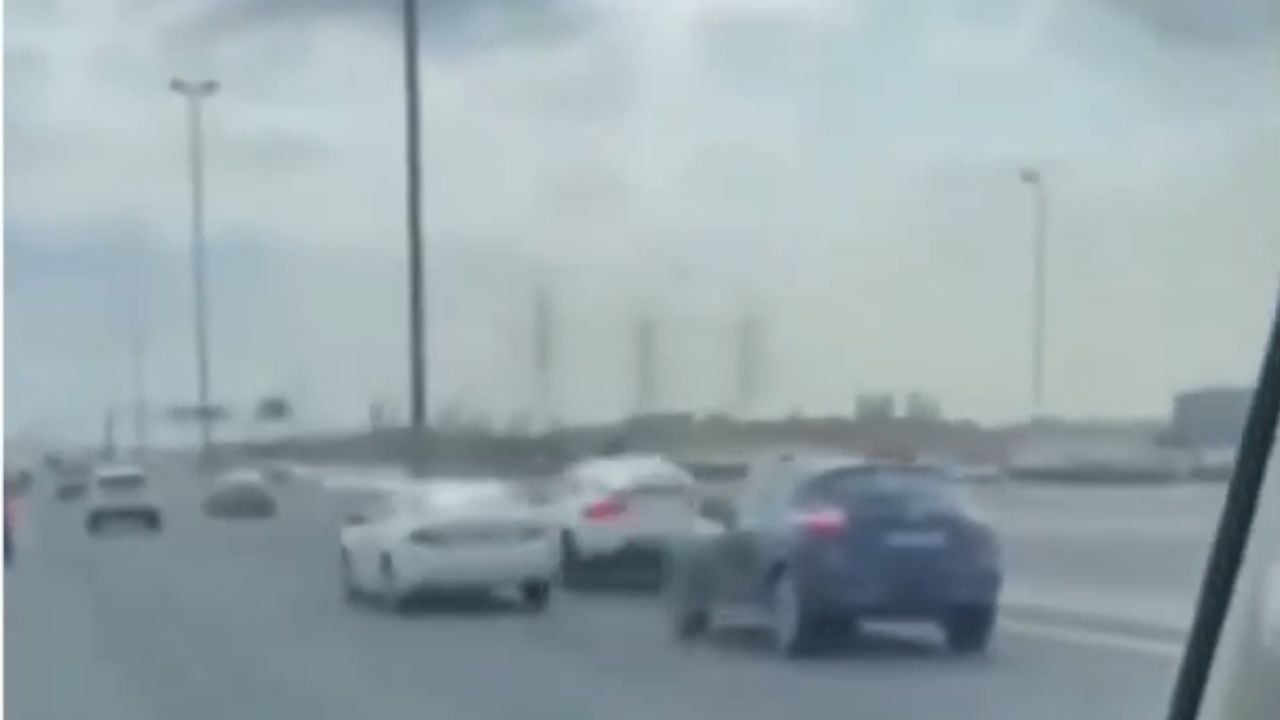
The original clip was first uploaded on May 20, 2026, by X user @_Tiga_b alongside a warning about the dangers of following too closely. Hours later, the repost by @Horsepower37559 reframed the footage with a more provocative question: “Intentional or not? You be the judge.”
That framing changed the conversation entirely. Viewed frame by frame, the sequence appears deceptively simple. A white vehicle occupies the lane ahead while the dark subcompact follows within an unsafe distance, leaving barely enough space for emergency braking if traffic conditions change.
Farther ahead sits another white sedan moving at a slower pace. For several moments, the tailgating driver’s visibility seems partially blocked by the vehicle directly ahead, a situation that traffic safety experts often describe as one of the most dangerous habits on high-speed roads.
When the lead car abruptly shifts left, the slower sedan suddenly fills the subcompact’s windshield. The driver appears caught off guard, and the impact follows almost immediately.
The Split Second That Sealed the Crash
The collision itself looks severe despite the low video quality. The dark-colored vehicle appears to strike the white sedan near its rear quarter or side section, producing a violent jolt that sends both vehicles off their intended paths.
No rollover or chain-reaction pileup can be seen in the footage, but the force involved suggests significant damage was likely. Highway-speed crashes involving short following distances often produce devastating consequences because drivers lose the ability to compensate for unexpected movement ahead. Online viewers remain divided over whether the lead vehicle intentionally created the scenario.
Some argued the driver simply changed lanes to avoid slowing traffic and that the tailgater alone carried responsibility for leaving no stopping distance. Others believed the maneuver looked calculated, claiming the lead vehicle may have intentionally waited until the last possible second to expose the slower sedan ahead.
Without additional footage or police findings, there is no evidence proving deliberate intent. Still, the discussion has tapped into a wider frustration many motorists feel about aggressive highway behavior.
Tailgating and the Psychology of Road Aggression
Tailgating remains one of the most common forms of hostile driving behavior worldwide. Drivers often use it as a pressure tactic, hoping the vehicle ahead will move aside or increase speed.
Intentional or not? You be the judge. https://t.co/HySoZAKPyJ
— Cars&Horsepower (@Horsepower37559) May 20, 2026
The problem is that modern highways leave almost no margin for human reaction time when vehicles travel bumper-to-bumper. At highway speeds, even a one-second delay can translate into dozens of feet traveled before braking begins.
The video also highlights how road aggression can escalate in subtle ways. A driver irritated by being followed too closely may respond with sudden braking, abrupt lane changes, or risky maneuvers designed to “teach a lesson” to the vehicle behind. That dangerous interplay appears to be exactly why this clip exploded across social media.
Whether the lead driver acted maliciously or simply escaped danger by changing lanes, the outcome exposed the same hard truth. Once drivers abandon safe following distances and emotional control, a single lane change can become the difference between an ordinary commute and a violent collision.