
When we started renovating our kitchen, we quickly realized we didn’t want something off the shelf. As car enthusiasts, our home is filled with nods to motorsports, fabrication, and function-over-form design—so why should the kitchen be any different? After looking at endless samples of granite, quartz, butcher block, and tile, nothing quite clicked. Everything either blew our budget or just didn’t feel us. That’s when the idea hit: what if we built our own carbon fiber countertops?
We know this kind of project isn’t for everyone. It’s unconventional, a little extra, and definitely not something you’ll find in a home improvement showroom. But for us, that was the point. We wanted something custom, cool, and a little unexpected—something that says “gearhead” without turning our kitchen into a garage. And now that it’s done? It’s one of the most talked-about features in our home.
Why We Chose Carbon Fiber for Our Kitchen

It started out as a joke, something we had just mentioned in passing after weeks of shopping for the right countertop material. We weren’t trying to be different just for the sake of it—we genuinely couldn’t find a countertop material that matched our style without obliterating our budget. The exotic granites we loved were beautiful but expensive, and more affordable options felt generic or uninspired. We kept circling back to one question: what would we build if we could make anything? That’s when carbon fiber came to mind—not the glossy woven kind you see on spoilers and hoods, but something subtler, more architectural.
By using chopped carbon fiber under epoxy, we were able to create a look that mimics natural stone with a modern, almost industrial twist. It’s a material that feels familiar to us from our time in the garage, yet completely reimagined for a domestic space. It was a way to bring our love of cars into the kitchen in a way that was clean, elevated, and totally one-of-a-kind.
Is It Safe? The Role of Food-Safe Epoxy
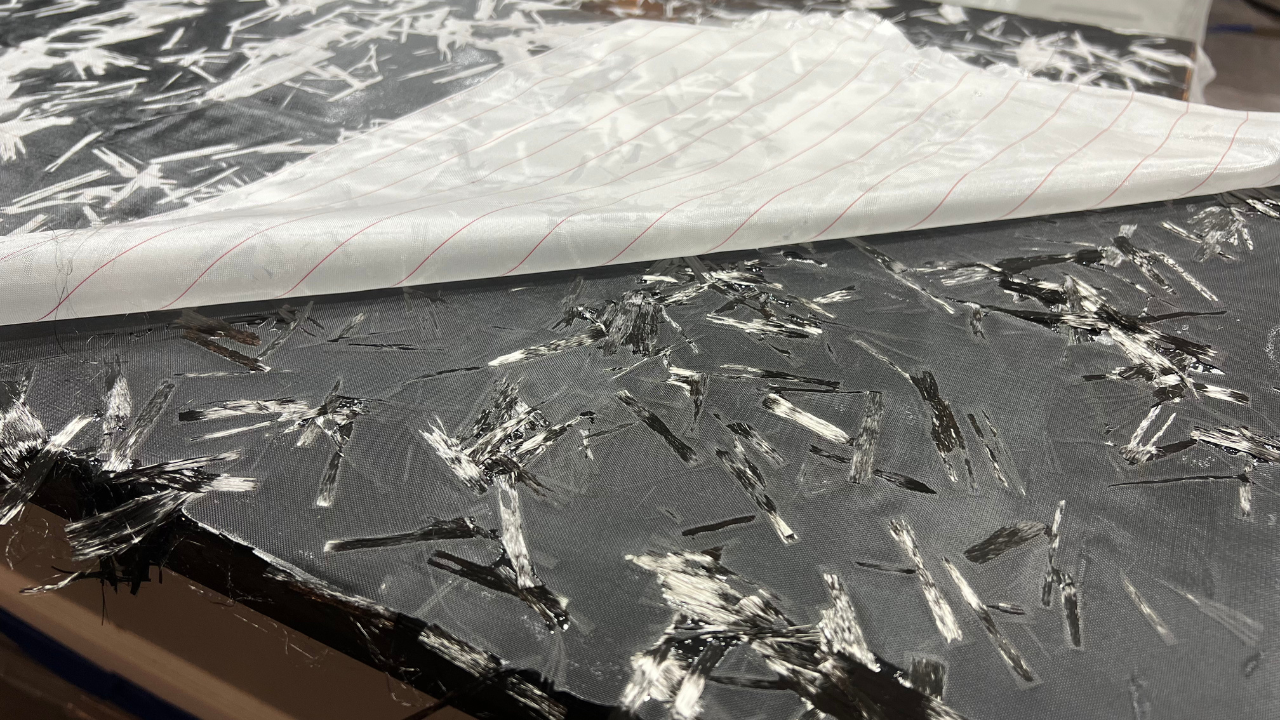
One of the first questions we get is: “Wait, is that even safe to use in a kitchen?” The short answer is yes—because the carbon fiber itself is fully sealed under multiple layers of food-grade epoxy. We used a product specifically designed for countertop use, which cures into a hard, non-toxic, heat-resistant surface. Once it’s cured, it’s as safe to prep food on as any traditional countertop material.
Epoxy is also what made this project possible from a cost and customization perspective. It gives you the freedom to design almost any look—metallics, stones, or, in our case, carbon fiber—at a fraction of the cost of natural stone. And if you’re not the DIY type, there are plenty of professional installers out there who can create a similar custom look with just about any material you can imagine, though many will shy away from the carbon fiber aspect for several reasons.
It is also worth noting we have previous experience in working with both this type of epoxy as well as others and also working with composites like fiberglass and carbon fiber, so this wasn’t our first rodeo, just our first time applying the idea to counters.
Hazards of the Job: Carbon Fiber Is Not Your Average Material
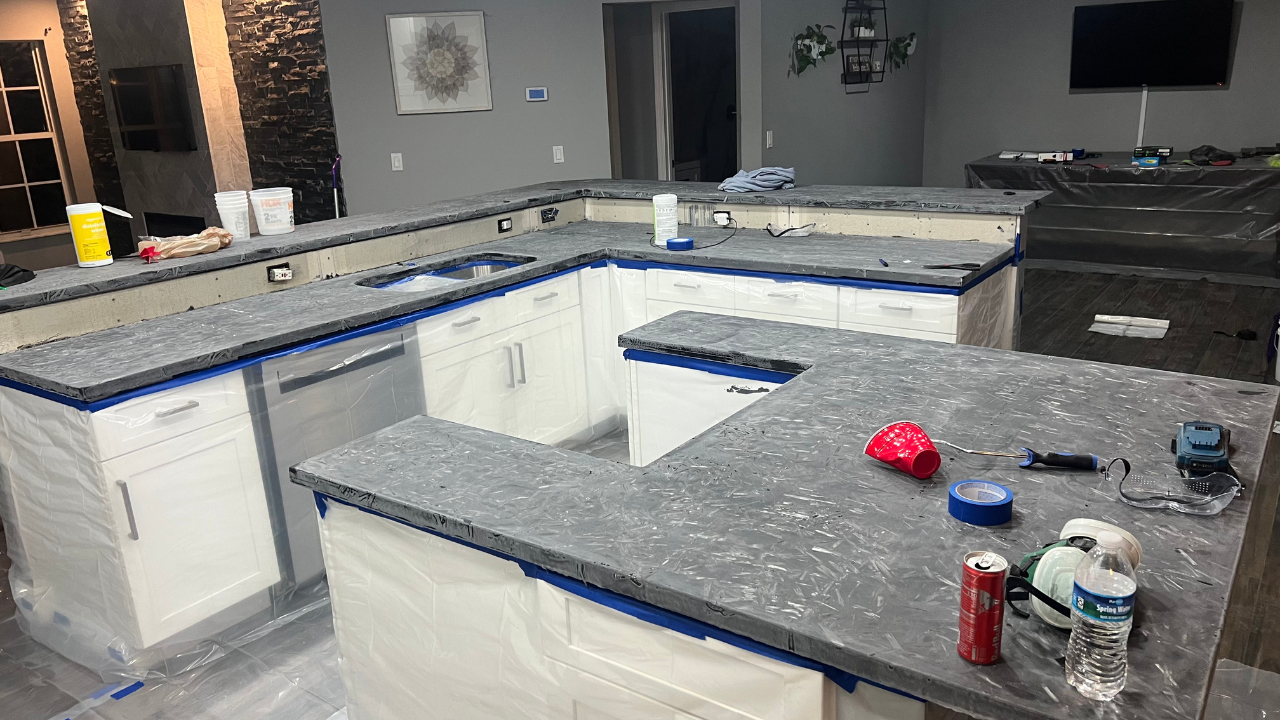
Working with carbon fiber might sound cool—and it is—but it’s also something you need to take seriously. When cut, sanded, or handled improperly, carbon fiber can release fine particles that are dangerous to breathe in or get on your skin. That meant wearing full PPE: a proper respirator, gloves, eye protection, long sleeves, and a full-body protective suit to keep fibers from clinging to clothes or getting tracked into the house. This wasn’t your average weekend DIY.
The most hazardous part of the entire process was sanding the carbon fiber to make sure it sat flat under the epoxy so that each layer could properly adhere. That sanding step created fine carbon dust that can irritate the lungs and settle on every surface imaginable. Even with protection in place, it took multiple days and several rounds of deep cleaning to fully eliminate the debris. It’s a high-risk material to work with and not something to take lightly.
What We’d Do Differently
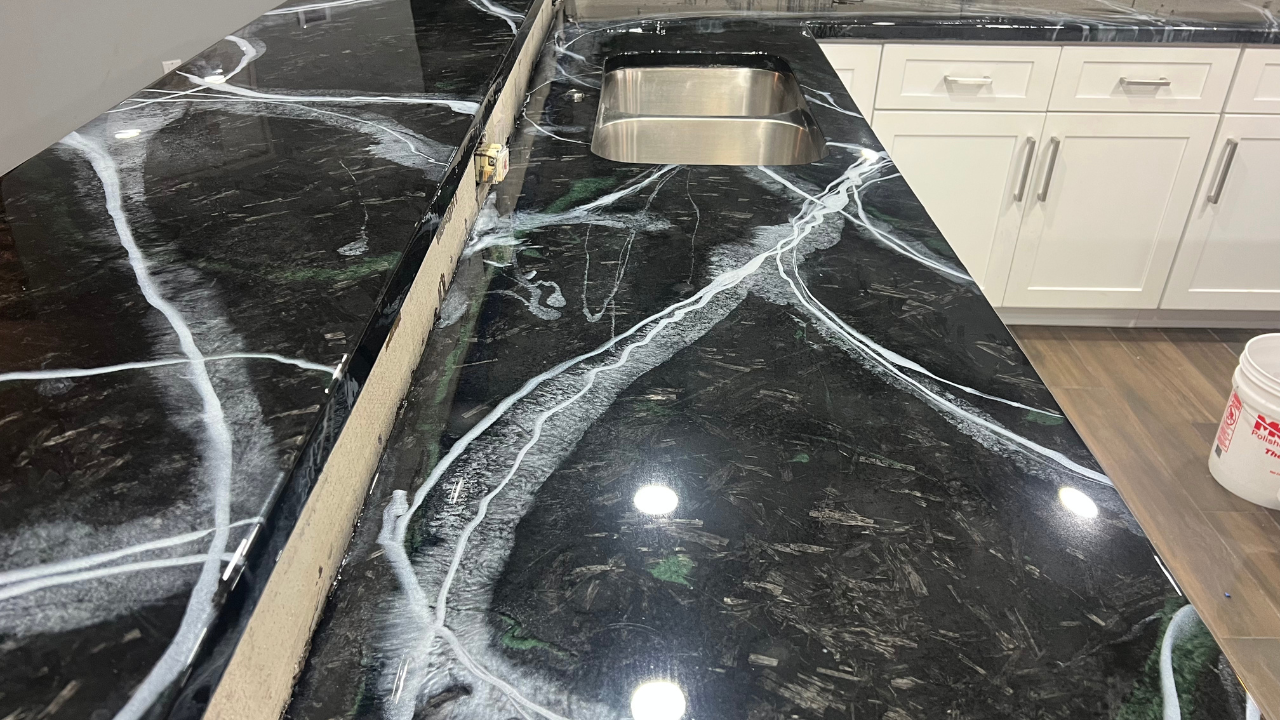
If we could do it again, we’d make sure to work in a fully contained, controlled shop environment with excellent ventilation. We avoided working outdoors because bugs, dust, and weather would have created even bigger problems. Since the base cabinets had been installed quite some time ago, removing them for this project wasn’t an option, so we had to work carefully around them.
We did use plastic sheeting to protect the cabinets, countertops, and floor, which definitely helped keep the mess contained and made cleanup easier. Still, renting an air scrubber or industrial air filtration system during sanding would have made a big difference in reducing airborne dust and protecting our lungs.
Trusting the Process

I won’t lie—through much of the project, I wasn’t in love with how the counters looked. At times, I even started to hate them. The way the carbon fiber under epoxy appeared was not quite what I expected, and it felt far from the sleek, perfect surface I had imagined. It was frustrating watching something you’re so invested in look off or unfinished.
That said, trusting the process was key. The counters definitely didn’t turn out exactly as planned, and to be honest, I’m not sure they’re something we’ll keep forever. But they do reflect our personality and style in a way nothing else could.Sometimes, the value is in the story and the uniqueness—not just perfection.
A Subtle Nod to Our Passion
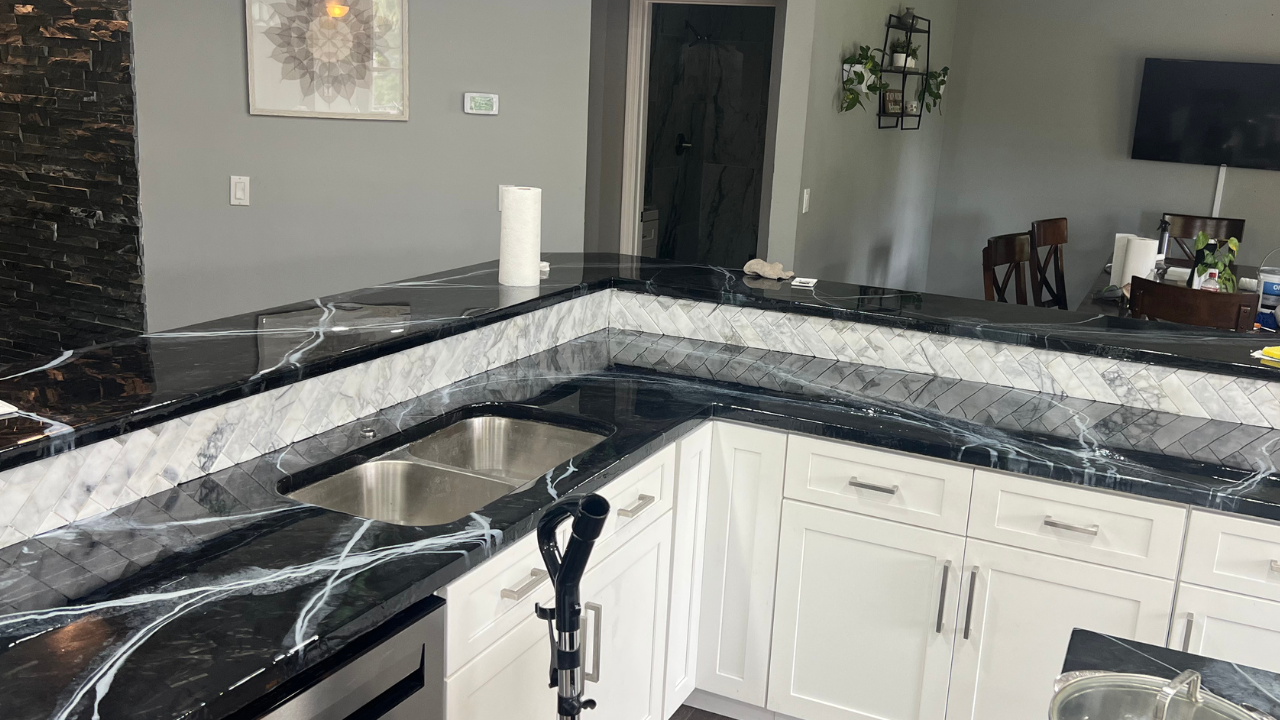
One of the coolest parts of the finished kitchen is how the countertops subtly reveal their story. Instead of the classic woven carbon fiber look—which can sometimes feel flashy or tacky—we used chopped carbon fiber beneath the epoxy. This created an organic, almost natural pattern that shines through the clear layers, giving a hint of texture and depth without overwhelming the space.
The herringbone marble backsplash ties everything together beautifully. Its white veining echoes the subtle patterns in the epoxy surface, creating a cohesive and unique look that feels both modern and timeless. The result is a kitchen that reflects our love for cars in a refined way—something interesting and unexpected, without shouting it from the rooftops.