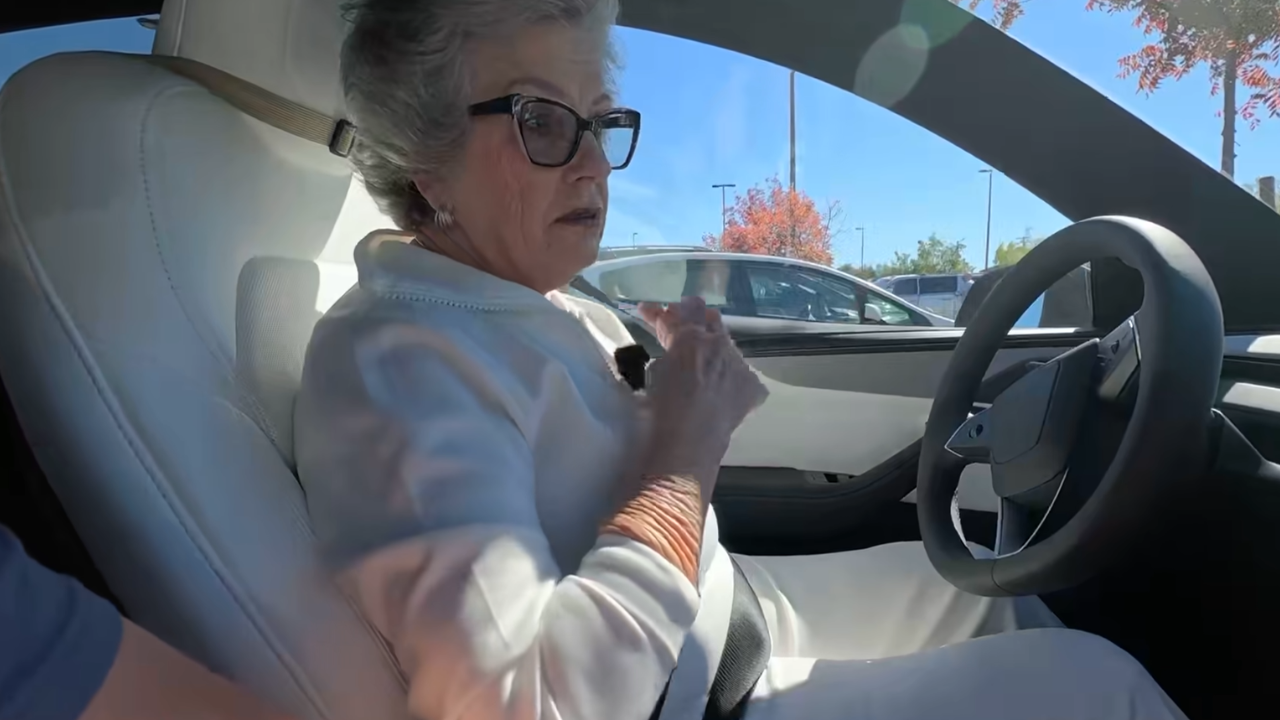
Night driving makes a 76-year-old woman in California uneasy, but she says her Tesla has changed how late she is willing to stay out. She describes seeing shadows on darker roads that are not really there, yet believes Full Self-Driving can help her get home safely.
In an October 27 episode from Retired Young Now What, the great-grandmother answers questions while running errands around Vacaville. She bought the Tesla she calls Tessie at the end of July and says she now uses FSD almost 100% of the time.
Curiosity persuaded her to try the feature, though she initially sat ready to grab the wheel. After starting in Chill mode, she became comfortable enough to use Standard during a trip through Northern California.
Her experience comes with an essential limit: Tesla describes FSD as driver assistance requiring full attention, not an autonomous chauffeur. Poor visibility can also affect its cameras, and federal regulators have investigated whether the system gives drivers enough warning when its ability to see deteriorates.
Out and About
Embedded media follows; please allow a moment for it to load.
Asked whether she still considers the experience driving, she compares it to “having a chauffeur and getting spoiled just a little bit.” For this outing, she uses Grok to request directions while visiting local businesses.
Her trip to Fortuna covered roughly 250 miles each way. She says she could have made that journey in the Cadillac she sold for the Tesla, but preferred the experience in Tessie. Although the car predicted she could reach her destination with about 15% charge remaining, she stopped to recharge because that margin felt uncomfortable.
Parking has also required human help. During the conversation, she and her companion recall taking over in an earlier episode because the car would not finish parking.
After Dark
Tesla’s Model 3 manual warns that its self-driving features may not work as intended on poorly lit roads at night. Bright light from oncoming headlights or direct sunlight can also interfere with the cameras’ view.
The National Highway Traffic Safety Administration opened its initial reduced-visibility investigation in October 2024 after four reported FSD crashes involving conditions such as sun glare, fog, or airborne dust. One crash killed a pedestrian.
On March 18, 2026, NHTSA escalated that inquiry to an engineering analysis. Its opening summary listed nine crashes and focused on whether FSD detects worsening visibility and alerts drivers with enough time to respond.
Earlier this month, Elon Musk admitted FSD doesn’t work as intended at night, announcing that Tesla Cybercabs can’t operate past a certain time.
“The main thing we are trying to solve is making sure that we do not run over pets when they are hard to see at night. Literally trying to avoid grey kittens on grey tarmac in the dark,” he said. It’s worded cutely, but it means the cameras can’t properly detect certain things due to a lack of LIDAR, like the system found on Waymo.
NHTSA describes FSD as relying exclusively on cameras and software to interpret the road. Its concerns include crashes in glare and airborne obscurants where the system did not recognize impaired camera visibility or provide a timely warning. In additional similar crashes identified through Tesla’s responses, FSD also lost track of, or never detected, a vehicle ahead.