

The battlefield may be shifting toward high tech stealth jets and unmanned systems, but the unmistakable growl of the Fairchild Republic A-10 Thunderbolt II is once again echoing across a new and unexpected arena.
According to The Aviatonist’s David Cenciotti, the rugged “Warthog” has been deployed in an increasingly critical maritime role, hunting Iranian fast attack craft in the volatile Strait of Hormuz.
This development marks a notable evolution in how the A-10 is being used in modern conflict. Traditionally designed as a close air support platform, the aircraft earned its reputation by protecting ground troops and destroying armored vehicles.

Nicknamed the “Warthog,” the A-10 was developed in the early 1970s specifically for close air support (CAS) missions to counter Soviet armored forces, and it remains one of the most iconic and effective ground-attack aircraft in U.S. Air Force history. Its mission history spans from Cold War deterrence to extensive combat use in conflicts like the Gulf War, Afghanistan, and Iraq.
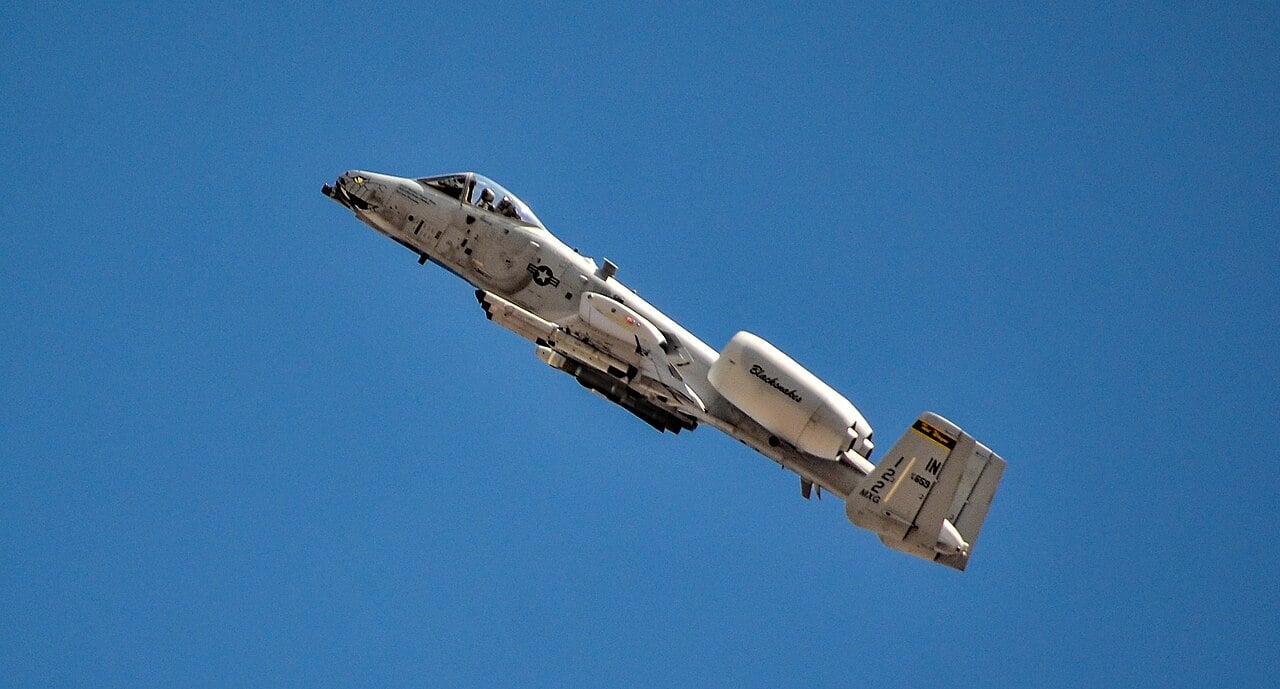
It was built around the GAU-8/A Avenger 30mm Gatling gun, capable of shredding tanks and armored vehicles. It features straight wings for maneuverability at low speeds and altitudes and receives motivation from twin turbofan engines mounted high to reduce vulnerability to ground fire. It has titanium “bathtub” armor around the cockpit to protect the pilot.
Now, under the umbrella of Operation Epic Fury, it is adapting to a maritime threat environment defined by speed, unpredictability, and asymmetric tactics.
A Surprising Fit for Maritime Patrol
The Aviationist notes that the A-10’s mission shift was confirmed during a Pentagon briefing by Dan Caine, who revealed that the jets are actively operating along the southern flank of the conflict zone.
U.S. Air Force A-10 Thunderbolt II’s receive fuel in-flight while supporting Operation Epic Fury. The A-10 Thunderbolt II can loiter for hours, standing by and ready to execute a mission whenever needed. pic.twitter.com/VjESHLR32Y
— U.S. Central Command (@CENTCOM) March 15, 2026
Their focus is on small, fast-moving boats that could threaten commercial shipping lanes or naval assets in one of the world’s most strategically important chokepoints.
The A-10 doesn’t immediately strike as the appropriate choice for maritime patrol. It lacks onboard radar and was never intended to hunt targets at sea. Yet a closer look reveals why it is uniquely suited to this mission.
The aircraft’s ability to fly low and slow gives the pilot exceptional visibility, allowing them to visually identify and track small, agile targets that might evade larger, faster jets. Its weapons configuration tells an even deeper story.
Recent imagery released by United States Central Command shows A-10C variants equipped with a versatile mix of armaments.

These include AGM-65 Maverick missiles for precision strikes against surface targets, APKWS guided rockets for engaging smaller craft with reduced collateral damage, and AIM-9M Sidewinder missiles. While Sidewinders have long served as defensive tools against enemy aircraft, their role is evolving as they are increasingly used against drones, which have become a growing threat in the region.
Endurance and Precision Over Contested Waters
The aircraft also carries a LITENING targeting pod, which enhances its ability to detect and engage targets using infrared imaging and laser designation.
Combined with a 600-gallon external fuel tank, the A-10 gains extended loiter time, allowing it to remain over contested waters for prolonged periods. This endurance is critical in a region like the Strait of Hormuz, where threats can emerge quickly and without warning.
There is also a historical precedent for this kind of mission. Although rare, the A-10 has previously been used in maritime engagements. During operations off Libya in 2011, it worked alongside a Lockheed P-3C Orion to neutralize hostile boats.
More recently, it has participated in training exercises involving submarine escorts and simulated attacks on surface targets, including drills alongside U.S. Navy destroyers.
The renewed focus on maritime threats is driven by changing warfare dynamics. Swarms of small boats or unmanned surface vehicles can overwhelm even advanced naval defenses.
In this context, the A-10’s precision, maneuverability, and heavy firepower make it an effective countermeasure. Its iconic GAU-8 Avenger cannon, capable of delivering devastating firepower with remarkable accuracy, remains one of the most feared weapons in its class.
A New Chapter for a Legendary Aircraft
Operation Epic Fury: The first 48 hours pic.twitter.com/uCQqHq5Ajx
— U.S. Central Command (@CENTCOM) March 2, 2026
Ironically, the A-10’s operational resurgence comes at a time of uncertain future for the aircraft. The U.S. Air Force has long sought to retire the A-10 fleet, arguing that newer platforms can better meet evolving threats. However, Congress has repeatedly intervened, slowing the retirement timeline and ensuring that a portion of the fleet remains active beyond initial plans.
That decision appears increasingly justified. As tensions simmer in key global hotspots, the A-10 continues to prove that adaptability can be just as valuable as cutting-edge technology.
From desert battlefields to contested sea lanes, the Warthog is demonstrating that even in a rapidly changing world, there is still a place for an aircraft built around simplicity, durability, and raw effectiveness.
In the narrow waters of the Strait of Hormuz, the A-10 is not just surviving. It is evolving, rewriting its legacy one mission at a time.
Sources: The Aviationist