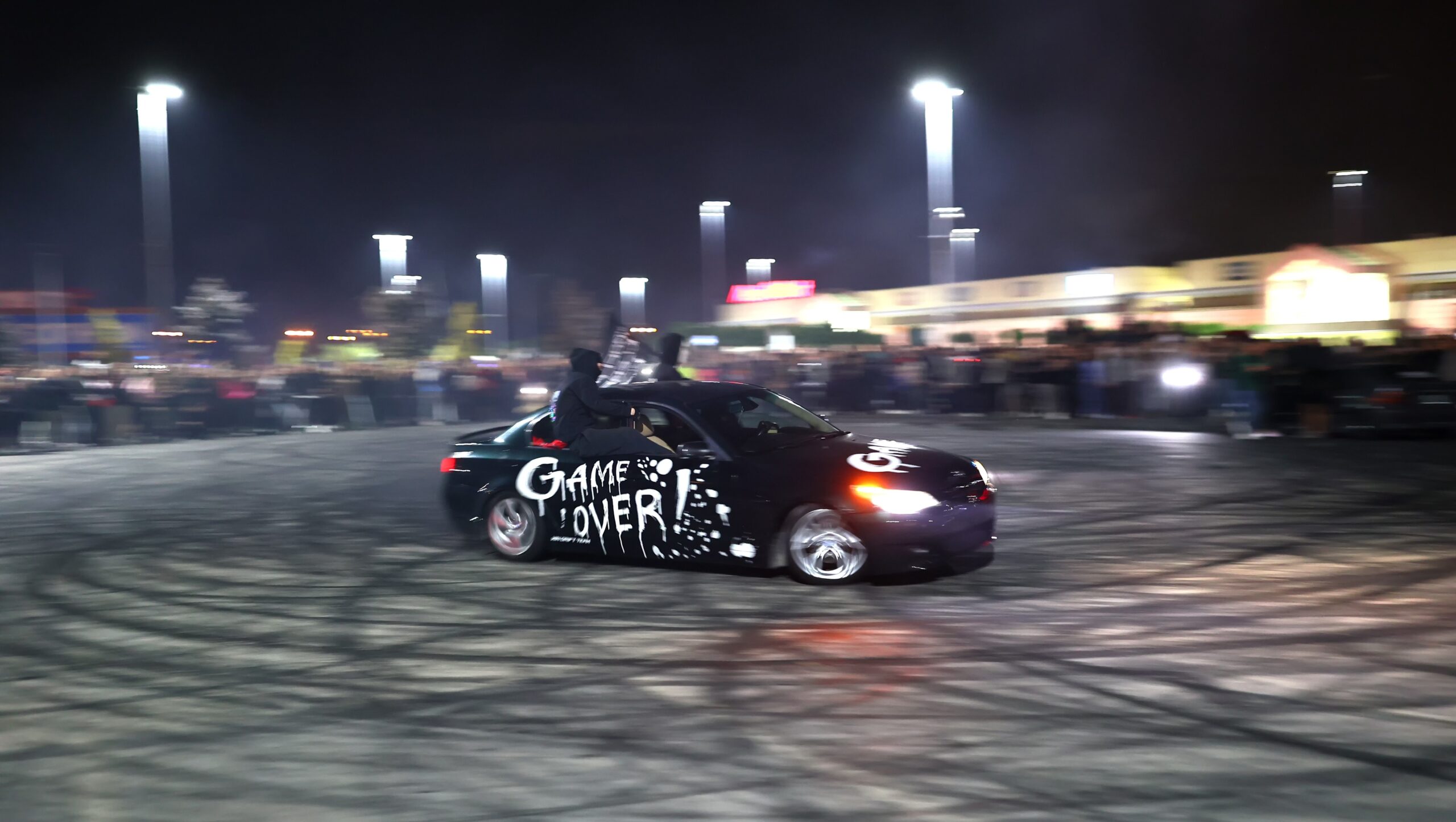
What started as a few cars doing donuts in the middle of the night has turned into something much bigger and a lot harder to ignore. Over the past four weekends, a private parking lot in Rockville, Maryland, has quietly become the scene of repeated late-night car rallies that are growing in both size and damage.
According to MyMCMedia, the activity has been happening in an industrial area along Southlawn Lane, where participants show up around 2:30 a.m., do donuts, gather crowds, and leave behind trash and tire marks before disappearing within about an hour.
What stands out is not just that it’s happening, but how quickly it’s escalating. In just a month, it went from a handful of people to a crowd that one business owner estimates reached around 200.
Joseph Colandreo, president of Seneca Glass Company, told the outlet the first weekend was relatively minor, with just a few people and leftover trash. The second weekend looked much the same. By the third weekend, he estimated 50 to 60 people had shown up.
The weekend of April 4 and 5 marked a clear shift. That is when things jumped to what he described as “probably 200 people,” a number that makes this a much more difficult problem to control.
When Small Meets Turn Into Something Bigger
This pattern has been playing out across the country. A few drivers showing off in an empty lot can quickly turn into a full-scale meetup once word spreads through social media or group chats.
At a certain point, it stops being about cars. Larger crowds bring real safety concerns, unpredictable behavior, and the potential for situations to escalate quickly.
Colandreo said he has not personally witnessed the rallies as they happen, but has reviewed surveillance footage from his business. The behavior described goes beyond just cars spinning tires.
Participants have left trash behind, damaged property, and in at least one case, someone urinated on his company’s door. He also said someone reported being inside their car when others began spitting on it and tapping on the vehicle.
“I don’t want to see these kids get in trouble,” Colandreo told the outlet, “but they are crossing the line.”
Beyond Rockville
What is happening in this parking lot reflects a broader trend.
A recent investigation highlighted by LAist found that street takeovers have surged across Los Angeles County since 2020, often drawing hundreds of people and fueled by social media coordination.
Researchers also found these events are frequently organized, with participants taking on roles ranging from promoting locations to monitoring for police. The gatherings have been linked to property damage, injuries, and in some cases, deaths.
That kind of structure helps explain how something like a small late-night meetup in Rockville can turn into a 200-person crowd in a matter of weeks.
Even Car Enthusiasts Are Pushing Back
Reaction within car culture has started to shift.
In a recent piece, The Autopian described street takeovers as “the absolute worst part of car culture,” pointing to how often they lead to crashes, property damage, and dangerous crowd behavior.
That sentiment is showing up in enthusiast communities as well. In a discussion on Reddit’s r/cars, one user summed it up bluntly: “These things only exist for social media content… people need to stop consuming it.”
Another added, “It is a bad look… I don’t want to be lumped in with these morons,” reflecting a growing frustration that this kind of behavior is reshaping how car culture is perceived.
There is also a recognition that attention is part of the problem. As one commenter put it, “Take away the attention… and you’ll see a reduction.”
That idea lines up with what researchers have already found. The more these events are filmed, shared, and amplified online, the more they spread.
Why These Events Are So Hard to Stop
Local officials say these gatherings are difficult to manage in real time.
County Assistant Chief Administrative Officer Earl Stoddard explained that early-morning staffing is typically lighter, making rapid response more challenging. Without advance notice, police are often reacting after a crowd has already formed or is beginning to disperse.
He added that now that the pattern is known, officials can begin planning for it, while noting there is no guarantee that any given weekend will bring another gathering.
That unpredictability is part of what allows these events to continue. They are loosely organized, move quickly, and often take place in private lots that are empty at night but easy to access.
The trajectory, however, is clear.
A shift from a handful of cars to roughly 200 people in four weekends is exactly how small, informal meets turn into something much larger. Once they reach that scale, they rarely stay contained for long.
As Colandreo put it, “Nothing good can come out of it.”