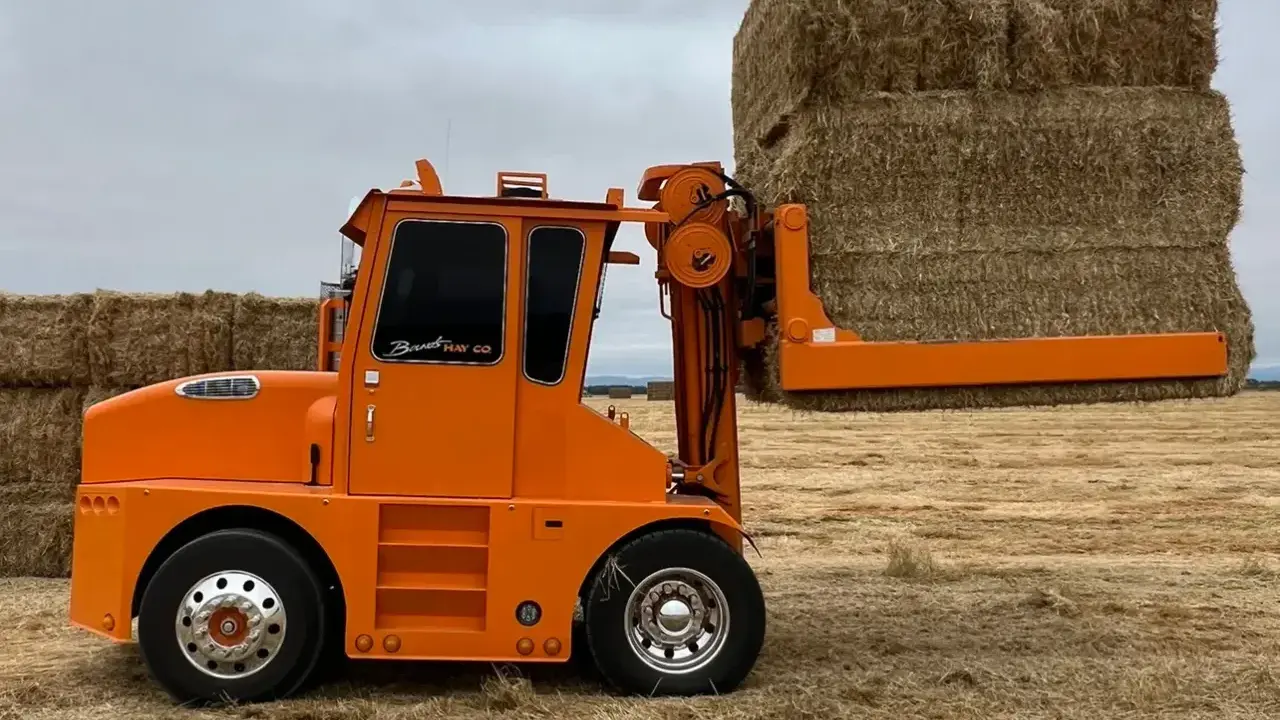
Most forklifts are built to shuffle heavy loads around warehouses, yards, or job sites. The Oregon Roadrunner Hay Squeeze does something far stranger: it can load massive stacks of hay, then head onto the highway and drive to the next field under its own power.
Built by Sunny “D” Manufacturing in Klamath Falls, Oregon, the Roadrunner has been around for decades and was designed specifically for large-scale hay operations. Its core job is simple: move enormous quantities of baled hay quickly without forcing operators to trailer a separate piece of machinery from site to site.
That versatility is what makes the machine so unusual. The Roadrunner combines the lifting capability of a specialized agricultural forklift with the drivetrain and road manners of a medium-duty truck, allowing operators to travel between farms at speeds reportedly reaching 50+ mph.
For hay producers and exporters working across multiple fields, this can eliminate huge amounts of downtime. Instead of loading a slow forklift onto a trailer every time the crew moves, the operator can simply finish one job, drive to the next field, and get straight back to work.
A Forklift With a Cummins L9
View this post on Instagram
Modern Roadrunner Hay Squeezes come standard with an 8.9-liter Cummins L9 diesel producing 330 horsepower. Buyers can also opt for a 370-hp version if they want additional performance.
The engine is paired with an Allison 3000 RDS six-speed automatic transmission, a heavy-duty gearbox also used in vehicles such as fire trucks and agricultural equipment. That combination gives the machine the durability needed for industrial work while also allowing it to travel at real highway speeds.
Older Roadrunners were available with other Cummins and Detroit Diesel engines, but the current setup reflects the machine’s evolution into a modern, emissions-compliant work vehicle. The result looks like a cross between a forklift, a tractor, and a compact semi-truck.
It Can Load Hay and Then Drive Home
View this post on Instagram
The Roadrunner’s main purpose is moving large stacks of hay as efficiently as possible. The machine can reportedly handle 8-by-8 bale stacks and lift loads as high as 20 feet, making it possible to load or unload semi-trailers quickly.
That ability becomes even more valuable when an operation is spread across multiple locations. Hay exporter Jesse Bounds told The Drive that his Roadrunners can move from one field to another throughout the day without needing to be hauled on a trailer.
In one example, Bounds described an operator driving roughly an hour and a half to one field, loading four semi-trucks, then traveling to another location to load 10 more. After another short move and additional loading, the operator could simply drive the Roadrunner back home.
For a commercial operation handling large volumes of hay, that kind of flexibility can have a major impact on productivity.
It Has More Comfort Than You Might Expect
Despite its industrial appearance, the Roadrunner is not completely bare-bones inside. Standard equipment reportedly includes air conditioning, power steering, and an AM/FM radio.
Buyers can add features including dual air-conditioning systems, tinted glass, and an onboard electronic scale. Bounds even compared the ride quality of one of his newer machines to that of a modern Ford pickup.
That may sound excessive for a glorified hay-moving forklift, but operators can spend long hours in these machines and cover significant distances between jobs. Comfort becomes far more important when the equipment doubles as transportation.
Truck Parts Help Keep It Working
View this post on Instagram
Another advantage is that the Roadrunner uses many components familiar to the medium-duty truck world. That can make repairs easier compared with highly specialized agricultural machines that depend on proprietary parts.
If an axle, drivetrain component, or other mechanical part fails, operators may be able to source a replacement from more conventional commercial-vehicle suppliers. For businesses where downtime can delay entire fleets of trucks, that serviceability is a major benefit.
The Price Reflects What It Can Do
A new Roadrunner Hay Squeeze reportedly costs around $250,000, putting it firmly in the realm of serious commercial equipment. Used examples are also valuable, with older machines from the 1990s reportedly selling for around $100,000 in some cases.
That kind of money would be difficult to justify for anyone outside the agricultural industry. For large hay operations, though, the Roadrunner’s ability to replace both a specialized loader and the transport equipment needed to move it can make the investment worthwhile.
It is unlikely to become anyone’s weekend toy, yet that only makes the Roadrunner more interesting. It is an unapologetically specialized machine built around one very specific problem—and the solution happens to be a Cummins-powered forklift that can run with traffic on the interstate.