Some films and shows fade from memory over time. The cars in them do not. Long after people forget the plot, the villain, or even the main actor, certain vehicles stay sharp in the mind.
They show up at car shows, in toy aisles, on bedroom walls, and in conversations that have nothing to do with what first put them on screen. That is a rare thing for a piece of machinery to pull off.
A car is supposed to serve the story. But in some cases, the story ends up serving the car. The vehicle becomes the reason people still talk about the production at all, decades after it first appeared.
This list covers the cars that crossed that line. Some boosted sales of the real models they were based on. Some sparked replica markets, collectible lines, or auction drama. A few became so recognizable that people who have never seen the original film or show can still describe the car in detail. That is not something a prop is supposed to do. That is something a legend does.
DeLorean DMC-12 — Back to the Future

The DeLorean DMC-12 was not a commercial success when it first arrived. Only about 9,000 were built before the company collapsed, which would normally have made it a short-lived curiosity.
Then Back to the Future turned it into a time machine in 1985, and everything changed. Its stainless-steel body and gull-wing doors already looked unusual in real life. On screen, they made the car feel like it had arrived from some better, stranger future.
Several modified DeLoreans were used during production for stunts, special effects, and hero shots. One of the most important surviving screen-used cars now lives at the Petersen Automotive Museum, which says plenty about how far the DMC-12 traveled from failed sports car to permanent pop-culture icon.
1968 Ford Mustang GT390 Fastback — Bullitt

The Highland Green 1968 Ford Mustang GT390 fastback became central to one of the most discussed chase scenes in film history the moment Bullitt reached theaters. The Mustang had a big-block V8, almost no visual fuss, and an attitude that made it look dangerous before the engine even started.
That is a big reason the car outlived the film in popular memory. Ford later built multiple Bullitt tribute Mustangs to celebrate its legacy, and the original hero car eventually resurfaced publicly after decades out of sight.
When that original Mustang sold at auction in 2020, it confirmed something people already knew. The car had become bigger than a famous movie chase. It had become one of the most important Mustangs ever built.
Aston Martin DB5 — Goldfinger

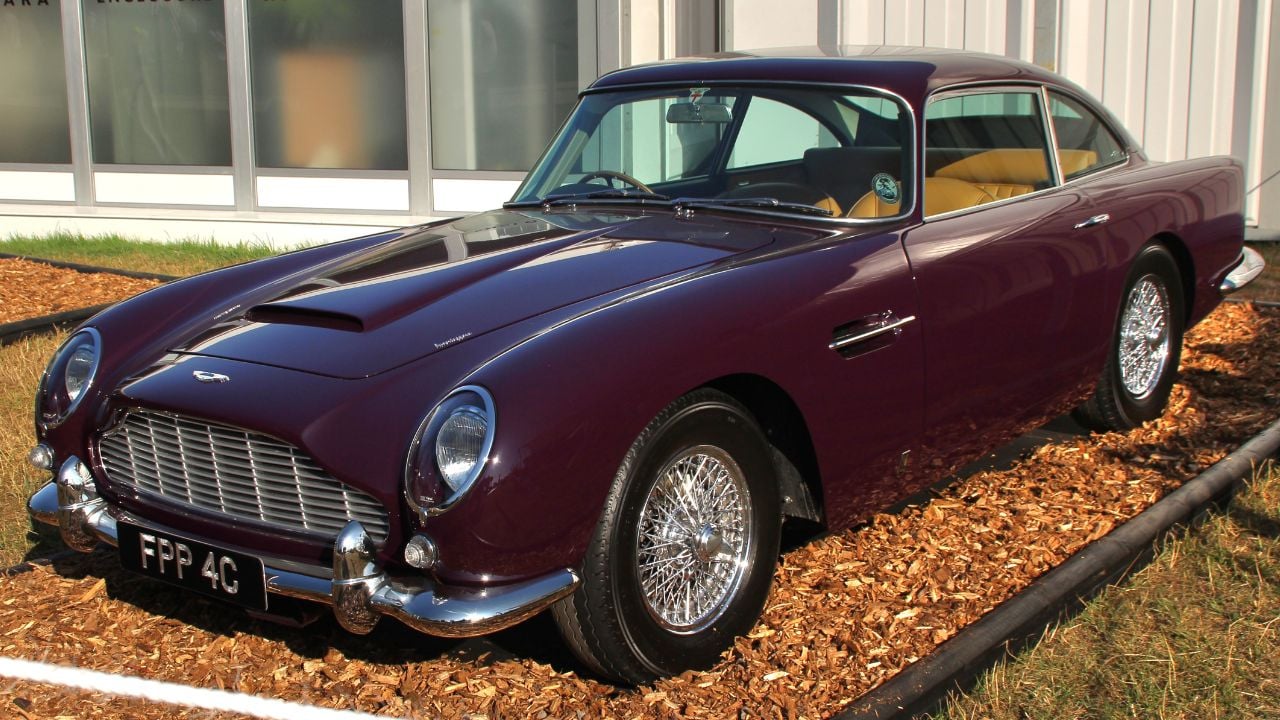
The Aston Martin DB5 first appeared in Goldfinger in 1964 and almost instantly became inseparable from James Bond. The gadgets helped, of course, but the deeper reason was simpler. The DB5 already looked exactly like the kind of car a stylish secret agent should drive.
Its afterlife became enormous. The Goldfinger continuation program proved Aston Martin still understood the Bond connection decades later, and the famous Corgi DB5 toy sold 750,000 units in seven weeks before going on to sell just under four million.
That is the kind of cultural reach ordinary movie props never achieve. The DB5 did not just help define Bond. It became one of the most famous cars in the world on its own.
1977 Pontiac Firebird Trans Am — Smokey and the Bandit

The black-and-gold Trans Am in Smokey and the Bandit was an all-new model when the film arrived in 1977. Pontiac supplied cars for filming, and the movie gave the Trans Am the kind of swagger that advertising alone never could.
The effect on the real car was immediate. Hagerty says the film helped Pontiac gain about 25,000 extra Trans Am sales in 1978, and by 1979 Trans Am sales had climbed to 117,108.
The screaming eagle hood decal, T-tops, and loud V8 made the car feel larger than life, but the movie gave that image a permanent home. Today the Trans Am is remembered not just as a late-1970s performance car, but as the car that stole the film right out from under everybody else.
1959 Cadillac Miller-Meteor — Ghostbusters

The Ecto-1 from Ghostbusters was built from a used 1959 Cadillac Miller-Meteor ambulance and hearse combination. It was white, loaded with emergency lights, and covered in rooftop equipment that made it look equal parts rescue vehicle and fever dream.
Within the story, it was bought cheaply and in rough condition, which only made it feel more believable and more lovable. That slightly absurd, blue-collar quality helped the car stick in memory.
The Ecto-1 has since returned in sequels and follow-up productions, and it has lived on through LEGO, die-cast models, and endless replicas. Plenty of people who cannot quote a single line from the film can still describe the car in detail. That says everything.
1969 Dodge Charger — The Dukes of Hazzard

The orange 1969 Dodge Charger known as the General Lee became one of the most replicated on-screen cars in American pop culture. It had unmistakable roof graphics, a horn everyone recognized, and the kind of stunt-heavy life that ensured it would never just be another television car.
More than 300 different General Lees are commonly cited as having appeared across the run of the series, with many of them destroyed in jumps and other stunts. That helped turn surviving 1969 Chargers into something even more desirable than they already were.
The General Lee outlived the show by decades. At car shows and auctions, General Lee-style Chargers still pull crowds whether the visitors remember the plots or not. That is what happens when the car becomes the main event.
1967 Ford Mustang Fastback “Eleanor” — Gone in Sixty Seconds

The Eleanor Mustang from the 2000 remake of Gone in Sixty Seconds was not a genuine Shelby GT500. It was a heavily modified 1967 Mustang fastback reimagined into something more theatrical, more aggressive, and more memorable than the real car it referenced.
That turned out to be enough. Surviving hero cars have sold for serious money, and the design became so culturally powerful that it sparked years of legal disputes over replicas and copyright claims.
Very few on-screen cars inspire that kind of afterlife. Eleanor did, because the film gave people a modern myth dressed as a Mustang.
Mini Cooper S — The Italian Job

The original 1969 The Italian Job used six Mini Cooper S hero cars and a larger batch of additional Minis for its central heist sequence through Turin. The cars ran through tunnels, flew down steps, and threaded through spaces where almost nothing else could have looked so agile or so cheeky.
That sequence became the defining image of the film. What had been a practical and affordable British city car suddenly became one of the most charismatic small vehicles ever put on screen.
The 2003 remake brought the Mini back for a new generation, but the real magic was already done in 1969. The original film remains a classic, yet it is the cars dancing through the city that most people picture first.
1970 Dodge Charger R/T — The Fast and the Furious

Dominic Toretto’s black 1970 Dodge Charger R/T from the original The Fast and the Furious was portrayed as a terrifying supercharged family heirloom. It appeared in the opening and closing stretches of the film and quickly became the emotional anchor of the franchise.
That mattered because the series was not really built around one specific race or one specific villain. It was built around identity, family mythology, and cars that felt larger than life. Dom’s Charger did that work better than almost anything else in the series.
Well into later sequels, the same car kept returning as a symbol. It helped turn the second-generation Charger into a classic muscle-car obsession for viewers who were far too young to have known the car the first time around.
Batmobile — Batman

The Batmobile is one of the most enduring and recognizable on-screen vehicles ever created. Each version reflected the tone of its era, from the gadget-heavy 1960s interpretation to the armored Tumbler that redefined the car for Christopher Nolan’s films.
Its reach goes far beyond the screen. The Batmobile has lived across films, television, animation, toys, games, and replica culture for generations, which is why it now feels less like a single movie car and more like an institution.
That sort of recognition is almost impossible to build. The Batmobile managed it by constantly changing shape while somehow remaining instantly identifiable anyway.
Ferrari 250 GT California Spyder — Ferris Bueller’s Day Off

The red car everyone remembers from Ferris Bueller’s Day Off was not a real Ferrari 250 GT California Spyder in the driving scenes. It was a Modena replica built to sell the illusion, and it worked beautifully.
The film made the car feel untouchably glamorous, then smashed that glamour into one of the most memorable automotive moments in 1980s comedy. In the process, it dragged the California Spyder name into mainstream pop culture far beyond the world of serious Ferrari collectors.
That is why the car’s image still lands even for people who have never looked up the real market value of a 250 GT California. One movie made the shape unforgettable.
When the Car Is the Story

Most productions are remembered for their characters, their writing, or their moments of surprise. These are different. Mention Ghostbusters and the Ecto-1 appears in the mind almost immediately. Mention Bullitt and it is the green Mustang that comes back first.
These cars did not just support the story. In many cases, they became the story. They outlasted their original productions in the public imagination, and they still show no sign of fading.