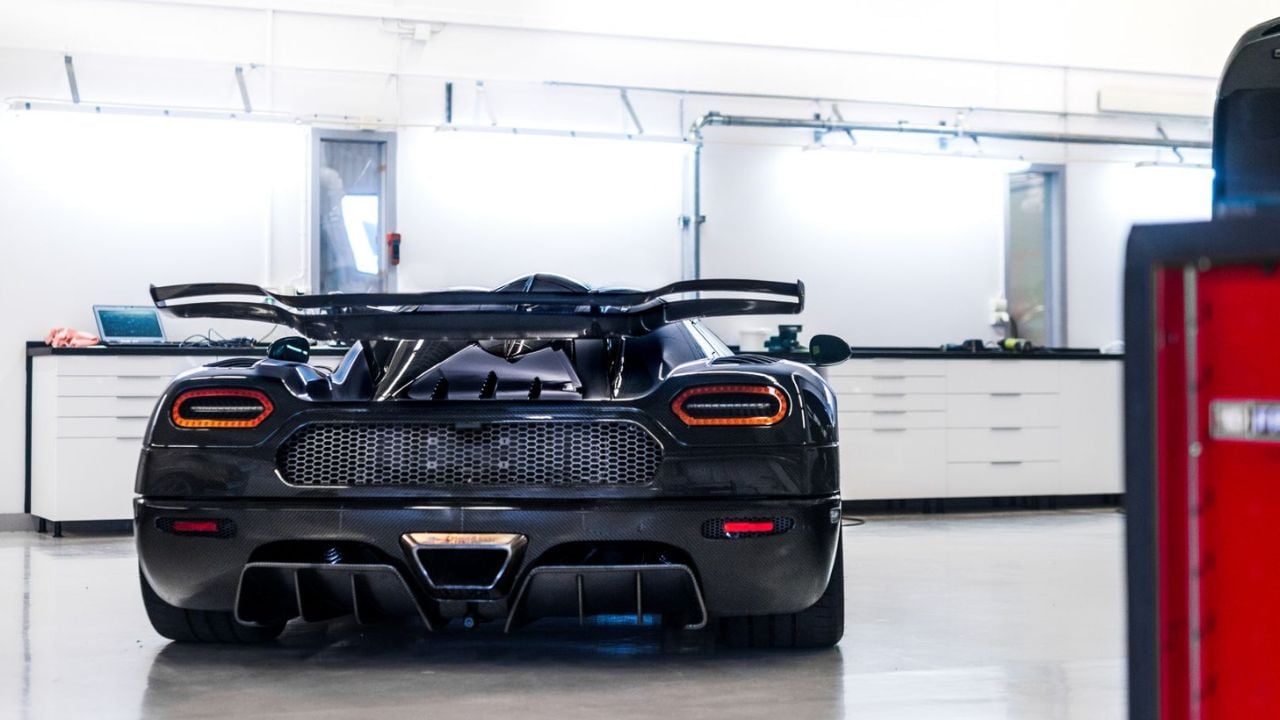
When Koenigsegg unveiled the One:1 at the 2014 Geneva Motor Show, it did more than introduce another hypercar. It presented a new benchmark for what a road-legal machine could achieve. The Swedish manufacturer described it as the world’s first “megacar,” a title rooted in its ability to produce one megawatt of power. That output is rated at 1,360 horsepower. This also matched by an equally radical engineering target of a perfect 1:1 power-to-weight ratio.
At a time when rivals were chasing top speed headlines, the One:1 focused on balance. It combined extreme output with lightweight construction, advanced aerodynamics, and track-ready systems. The result was not just a fast car, but a highly controlled work of art. Built in extremely limited numbers and sold out before production ended, the One:1 quickly established itself as one of the most technically significant performance cars of its era.
A One Megawatt Breakthrough

At the core of the One:1 is a 5.0-liter twin-turbocharged V-8 engine, developed from the Agera platform. It produces 1,360 horsepower, which is equivalent to 1 megawatt, and 1,371 Nm of torque, placing it among the most powerful engines ever fitted to a road-legal car.
This output is not just about peak numbers. The engine delivers more than 1,000 Nm of torque across a broad rev range, ensuring sustained acceleration rather than a narrow power band. The car is paired with a bespoke seven-speed dual-clutch transmission and an electronic differential designed to manage that output effectively.
Performance figures underline the scale of the achievement. The One:1 can accelerate from 0 to 400 km/h in around 20 seconds, with braking from that speed taking roughly half the time. Its capabilities extend beyond straight-line speed, with the chassis engineered to handle up to 2g of cornering force.
The 1:1 Philosophy in Practice

The defining idea behind the One:1 is its 1:1 power-to-weight ratio. That is one horsepower for every kilogram of mass. Long considered a theoretical limit, achieving this balance required extensive use of carbon fiber and advanced materials.
Koenigsegg reduced weight through a lighter chassis and components, such as carbon-fiber wheels, while maintaining structural rigidity and safety. The car’s dry weight of roughly 1,360 kilograms aligns precisely with its power output. This offers one of the most efficient performance ratios ever recorded in a production vehicle.
Aerodynamics also play an equally important role. The One:1 features active aerodynamic systems, including a large rear wing, venturi tunnels, and underbody airflow management. These elements generate significant downforce, allowing the car to remain stable at extreme speeds while improving cornering capability.
Unlike many high-performance cars, the One:1 was also designed with fuel flexibility. It can run on E85 biofuel, race fuel, or standard petrol, reflecting Koenigsegg’s broader push toward alternative fuel compatibility in high-performance engines.
Limited Production, Lasting Influence

Production of the One:1 was strictly limited to seven cars, including one prototype, making it one of the rarest modern hypercars. Each unit was pre-sold, highlighting the demand for ultra-exclusive, high-performance engineering.
Despite its rarity, the One:1 achieved measurable results. It recorded a 0–300 km/h time of under 18 seconds and demonstrated braking performance that rivaled race cars. The car was also capable of speeds approaching 440 km/h, based on its aerodynamic setup and tire specifications.
More importantly, its influence extended beyond its own production run. The One:1 introduced a new way of thinking about performance. It prioritised balance, efficiency, and control alongside raw power. Later hypercars increasingly adopted similar principles, focusing on weight reduction and aerodynamic precision rather than simply increasing horsepower.