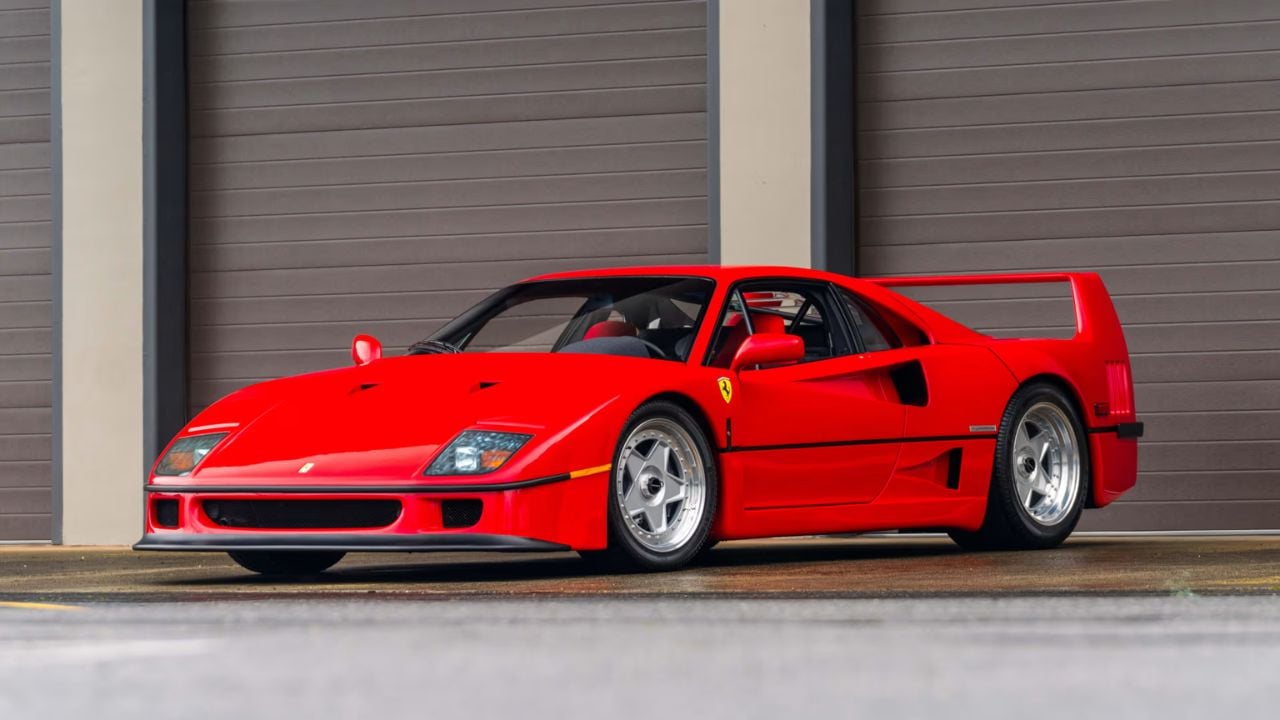
A Ferrari F40 never needs much help commanding attention, but some examples arrive with details that immediately change the temperature around them. Low mileage, U.S.-market specification, prior public-sale history, and no-reserve status are all the kinds of factors that can turn an already blue-chip supercar into one of the more closely watched lots of the day.
That is the territory this 1991 F40 enters at Mecum Indy. The model is already one of the defining analog supercars of the late twentieth century, but this particular car adds the kind of scarcity and prior-market visibility that collectors tend to notice quickly.
The F40’s place in Ferrari history also gives every serious example a built-in edge. This was the company’s raw, twin-turbo anniversary car, the machine that stripped away luxury in favor of speed, lightness, and visual aggression, and it has spent decades building the kind of reputation that rarely weakens once a model reaches this level.
That is why a low-mile, U.S.-delivery F40 offered without reserve at one of Mecum’s flagship events is more than just another exotic crossing the block. It is the sort of lot that makes people stop, watch, and recalibrate the day around it.
Low-Mileage U.S. Example Draws Collector Attention
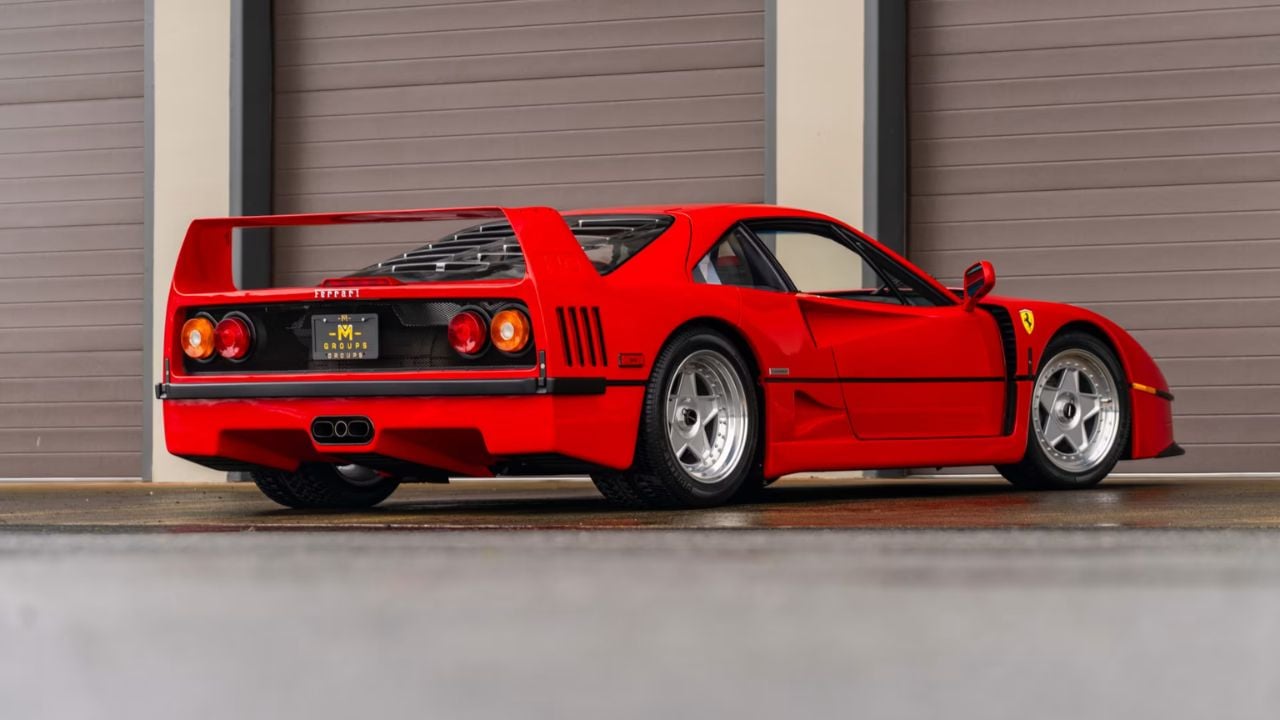
The 1991 Ferrari F40 headed to Mecum Indy is listed as Lot R713 for May 16, 2026, showing 1,771 miles and carrying VIN ZFFMN34A5M0087568. Mecum also identifies it as one of only 213 examples originally delivered to the U.S. market, which immediately gives the car a narrower and more desirable collector profile.
Low-mileage F40s tend to command attention almost automatically, but this one also comes with a visible public-sale trail. The same chassis sold for $1,682,500 at RM Sotheby’s Monterey in 2019 and then for $3,085,000 at Gooding’s Pebble Beach sale in 2023, which makes it an especially easy car for the market to contextualize.
That history does not guarantee a specific result at Mecum, but it does show how strongly the best F40s have been valued when mileage, documentation, and specification align. It also gives this car a very tangible place within the broader F40 market rather than leaving it to auction-day guesswork alone.
The no-reserve status adds one more layer of interest. On a car at this level, that kind of setup tends to focus attention immediately, because bidders know the opportunity is real the moment the lot crosses the stage.
Ferrari’s Raw Twin-Turbo Supercar
Introduced in 1987 to mark Ferrari’s 40th anniversary, the F40 rejected the luxury-supercar formula in favor of something much more severe. It was lighter, more elemental, and more openly aggressive than most of the era’s other exotics, and that purity remains central to its appeal now.
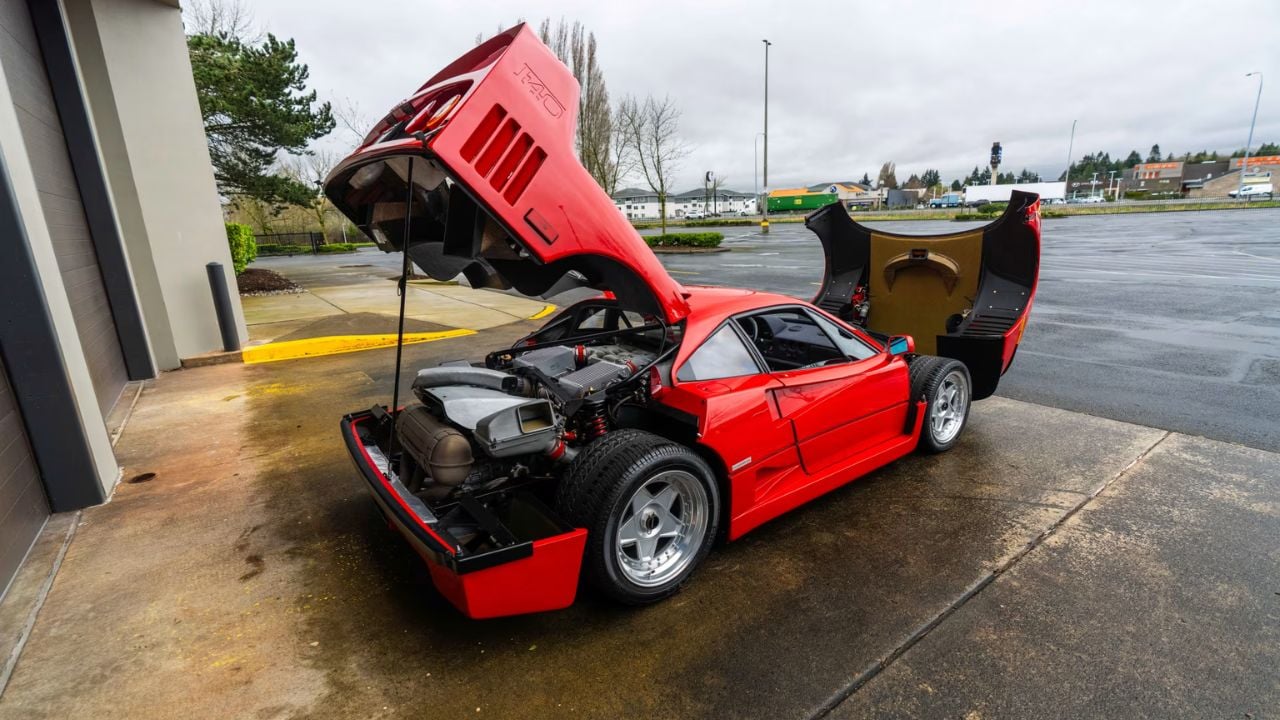
Power came from a twin-turbocharged 2.9-liter V8 rated at roughly 471 horsepower, sent through a 5-speed manual to the rear wheels. Ferrari’s own performance figures put the car among the fastest road machines of its time, with top speed right around the 200-mph barrier and the kind of acceleration that made the F40 feel violent rather than merely quick.
The construction mattered just as much as the engine. Kevlar, carbon fiber, and composite materials helped keep weight in check, while the stripped cabin and minimal comfort concessions made it obvious that this was a car built around intensity rather than pampering.
That is why the F40 still feels so distinctive even in a world full of much faster machinery. It belongs to the last era when a Ferrari halo car could feel this direct, this physical, and this unconcerned with smoothing over the experience for the driver.
Market Momentum and Auction Expectations
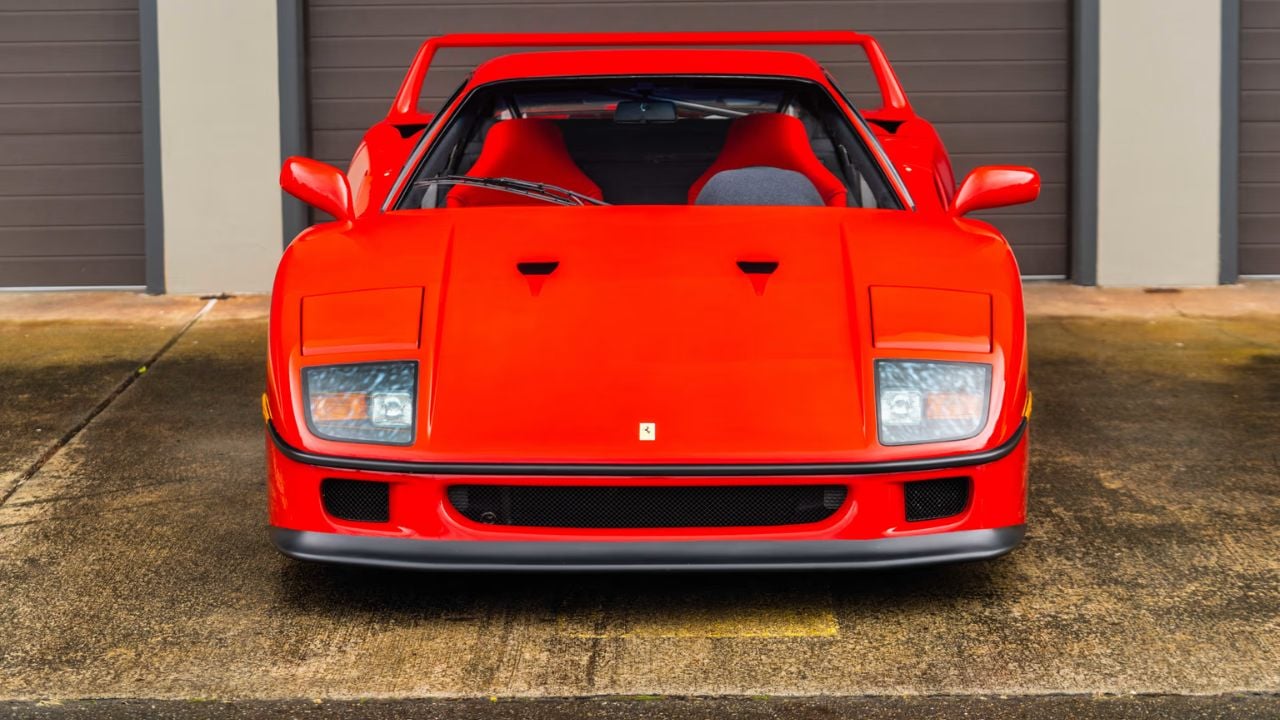
The F40 has held a special position in the collector market for years because it offers something newer Ferraris cannot replicate exactly. It is historically important, mechanically raw, visually iconic, and rare enough that every especially good example feels like a serious event car.
Ferrari originally planned a much smaller production run, but demand pushed total output to roughly 1,311 cars, which is enough to make the F40 attainable only in the broadest sense of the word while still keeping supply meaningfully constrained. Within that number, U.S.-spec cars remain a smaller and closely watched subset.
That is what gives this Mecum example its real gravity. It combines the right market, the right mileage story, and the right model at a time when collectors continue to treat analog supercars as one of the most emotionally durable parts of the high-end auction world.
If bidding comes in strongly, it will not be because this is merely a famous Ferrari. It will be because the F40 still represents something very specific and very difficult to replace: a supercar whose myth remains fully intact once the real car is right in front of you.