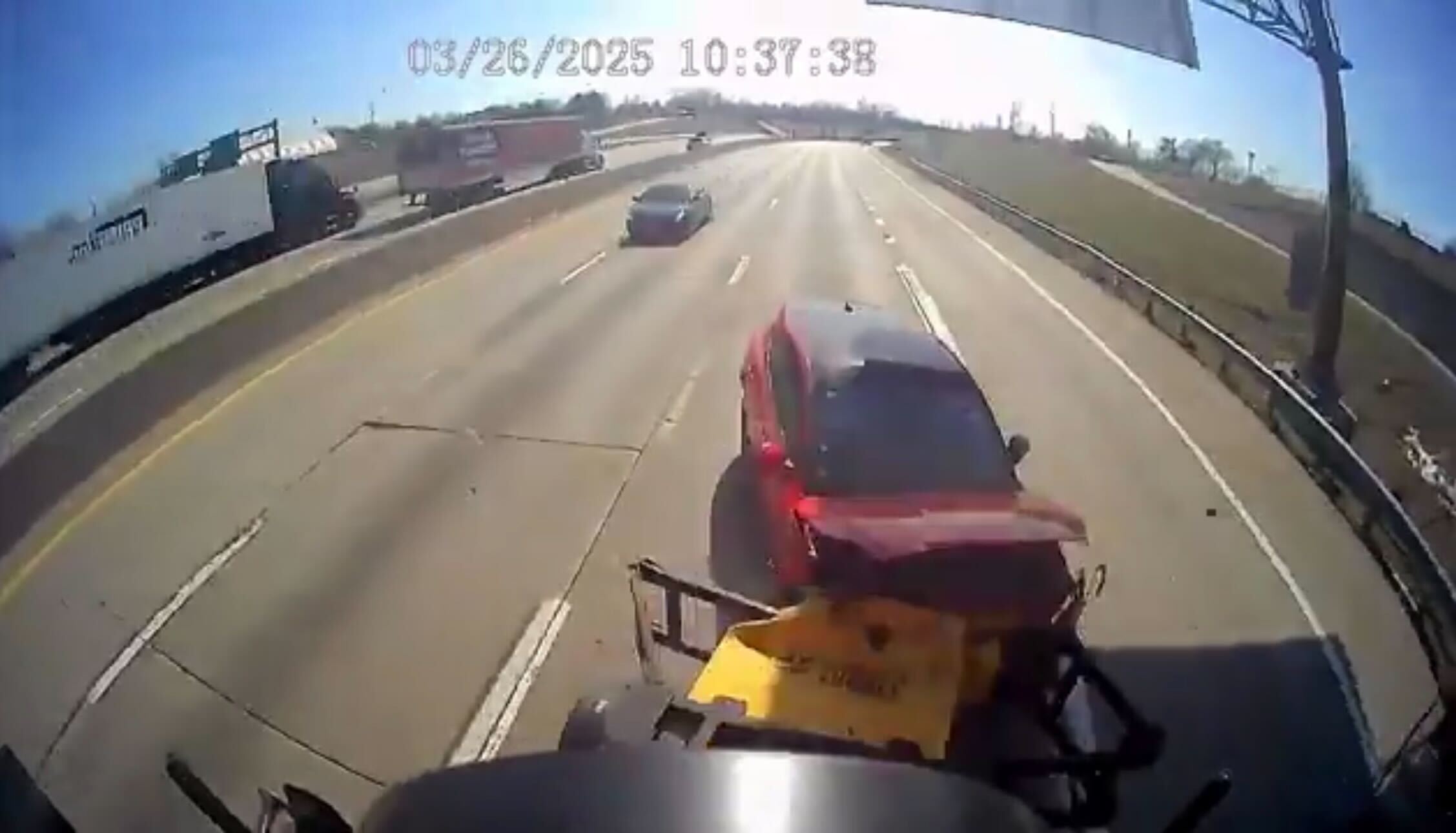
A highway work zone is not supposed to feel like a highlight reel. Cones go up, crews get to work, traffic moves over, and everyone gets home. That is the idea.
This video flips that on its head. Instead of near misses or close calls, it shows something far more unsettling.
Drivers are going straight into clearly marked safety trucks like they are not even there.
The Missouri Department of Transportation (MoDot) says it happened 50 times last year alone. Not once or twice. Fifty separate crashes where a Truck Mounted Attenuator took the hit, so a person did not have to.
Watch closely, and the pattern becomes hard to ignore. No sudden swerves. No last-second corrections. In several clips, there is not even an attempt to brake.
Drivers Are Missing What Is Right in Front of Them
Embedded media follows. Please allow a moment for it to load.
Our TMAs were hit 50 times last year. Fifty.
Distracted driving puts every life on the road at risk. Make the right choice behind the wheel—stay focused. Never drive distracted. 📵🚗 pic.twitter.com/d5gEg67qt1
— MoDOT (@MoDOT) April 23, 2026
The setups are not subtle. These trucks are bright, covered in reflective markings, and often equipped with flashing arrow boards directing traffic to move over. They are placed behind active work zones specifically to create a buffer between traffic and workers.
And yet, in clip after clip, vehicles approach at speed and go straight into them. Not drifting. Not losing control. Just continuing forward as if nothing is there.
That is what makes the footage stick. It is not chaos. It is the absence of awareness.
What a TMA Actually Does
.jpg)
A Truck-Mounted Attenuator (TMA) is a specialized safety vehicle used in highway work zones. It is typically a dump truck or heavy-duty vehicle fitted with a large crash cushion mounted to the rear.
That cushion is designed to absorb and spread out the force of an impact. Instead of a vehicle slamming directly into a crew or equipment, the TMA takes the hit, reducing the severity of the crash.
These trucks act as a last line of defense. They sit behind lane closures or moving work operations, positioned specifically for the moment when something goes wrong. They are also known as crash trucks, scorpion trucks, or blocker trucks. Different names, same purpose. Get hit so someone else does not have to.
Online Reactions: “How Do You Not See That?”
The video sparked a wave of reactions online, and most people zeroed in on the same thing. How obvious these trucks are, and how little reaction some drivers show before impact.
“Some of them didn’t even attempt to brake or turn the wheel,” one commenter wrote, while another pointed out, “That red car never even veered. Just straight into it.”
A large portion of the discussion focused on distraction, especially phones. Many viewers argued that the only way to miss something this visible is to not be looking at the road at all.
“It’s always the phone,” one person said, while another added, “Hard to see the road when you’re looking down.”
Others pushed for harsher consequences, suggesting license suspensions or stronger penalties for drivers who hit clearly marked safety vehicles. At the same time, a smaller group questioned whether work zone setups could be improved by providing more advanced warning or implementing lane closures.
Even with that debate, the core takeaway stayed the same. These crashes are happening because drivers are not paying attention.
The Part That Matters
Every one of those impacts could have been a person instead of a truck. That is not hypothetical. That is exactly why these vehicles exist.
The uncomfortable reality is that the system worked here. The TMA did its job. It absorbed the hit, and in doing so, it likely prevented something much worse.
What the video shows just as clearly is the other side of it. The growing gap between what is on the road and what drivers are actually seeing.
Stay alert. Put the phone down.
Because the difference between hitting a crash cushion and hitting a human being is often just a few seconds of attention.