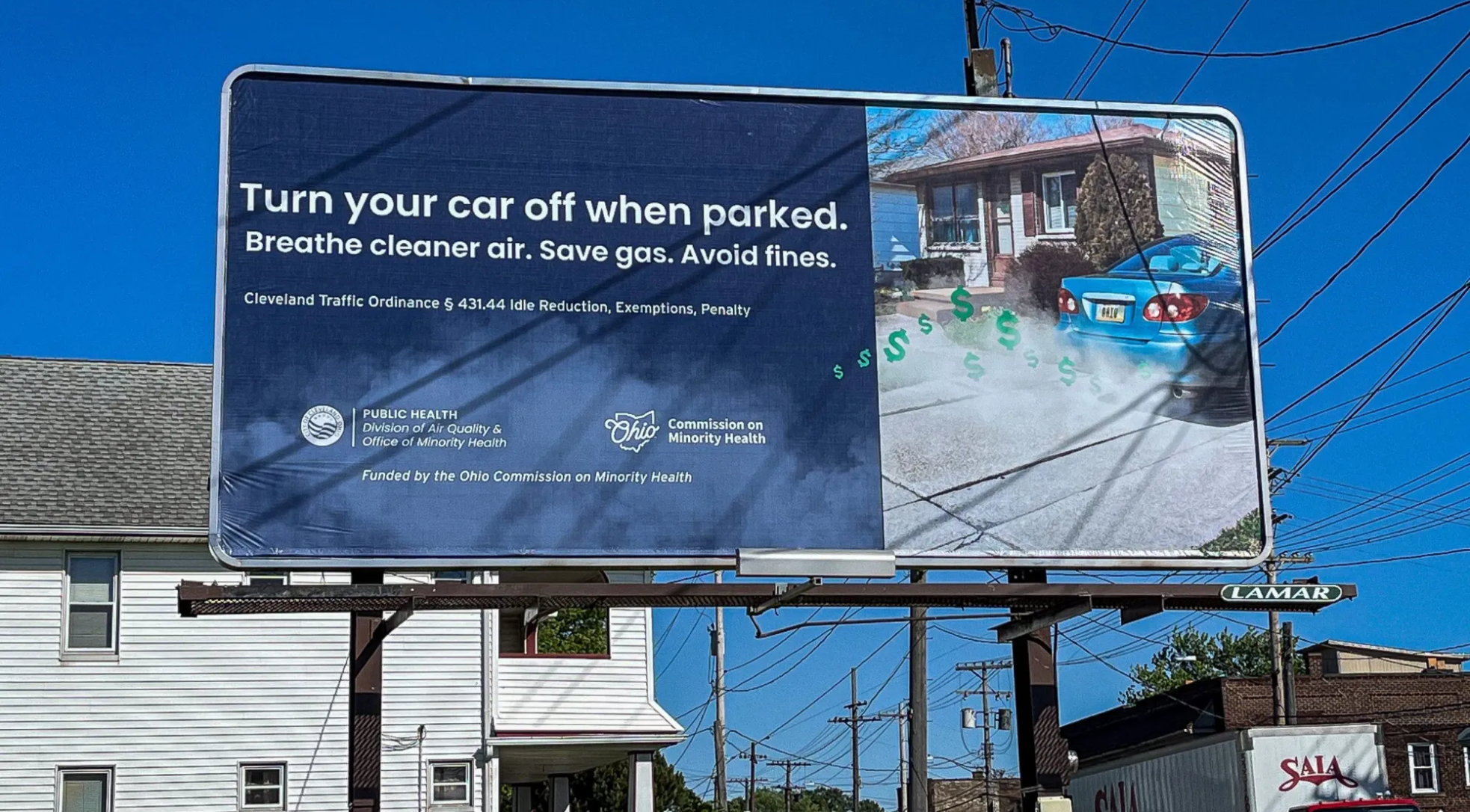
Cleveland’s Department of Public Health has put up a dozen new billboards across the city asking residents to spend less time idling their vehicles. The ad campaign seems to be aimed at DoorDash drivers, construction workers, parents waiting in school pickup lines, and anyone else stuck behind a steering wheel. The point, the agency has said, is to nudge a culture that doesn’t treat idling in a car as a personal choice.
The billboards offer three reasons to switch off the engine, according to Cleveland Scene: breathe cleaner air, save gas, and avoid fines. Public Health chief Dave Margolius is most concerned with the first. His department has spent the past several years backing legislative updates to both the city’s air quality code and its idling rules.
Cleveland emissions inventories put about 40% of the city’s air pollution on vehicle tailpipes. The national average, according to the Environmental Protection Agency, is closer to about 30%. The number runs higher around the kinds of places where engines tend to sit running for a while, like highways, hospitals, and schools.
The billboard push fits into a broader transportation effort from the Bibb administration. The city has been laying down new bike lanes, building greenways and adopting elements of the 15-minute city urban planning model. Reducing how much Clevelanders drive, and how long they idle when they do, are pieces of the same picture.
The Health Department’s Case
Margolius told Cleveland Scene that one of the persistent challenges around idling is a piece of conventional wisdom he keeps having to dispel. Restarting a car, in popular belief, burns more gas than letting it idle. That is wrong, he said, both in terms of fuel economy and in terms of what the engine puts back into the air.
The department, in Margolius’s telling, sees the regulatory push on industrial polluters as necessary but insufficient. Steel companies and their fleets are just one piece of the local emissions story. The rest, he says, comes from everyday people who keep their engines running during pauses in their day.
The Idling Law That’s Already on the Books
Cleveland already has an Idle Reduction law that bans drivers from leaving a vehicle running for more than five minutes. Enforcement, Margolius has acknowledged, is light. Plenty of vehicles are exempt anyway, including police cars, ambulances, armored trucks and city vehicles.
A third violation of the idling rule technically counts as a minor misdemeanor. Margolius has said the goal of the campaign is not to start writing more tickets. The point, as he put it, is for people to step up on their own.
Census data cited by Cleveland Scene shows that seven out of ten Clevelanders drive to work daily. Eliminating all driving in the city isn’t a realistic goal, according to Margolius. What is realistic, he believes, is asking drivers to stop running their engines during the parts of the day when nothing about their engine is doing useful work.
Rising gas prices, in his view, ought to be doing some of this work already. People still leave their cars running. The billboards are an attempt to nudge the cultural baseline rather than wait for prosecution or fuel costs to catch up. It remains to be seen if they’ll actually work or not.