Restomods are having a moment. Once dismissed by purists who wanted to preserve classics exactly as they left the factory, today’s buyers are chasing something different. They want the charm and swagger of vintage steel, but with the performance, comfort, and reliability of a modern machine.
That shift is not subtle. Builders and buyers alike are leaning into upgrades that make these cars easier to live with, not just admire. As one industry perspective has noted, what used to be unusual has become far more common, with fewer straight restorations and more builds tailored to how people actually want to drive.
Old-school cool paired with modern tech has become the formula—and increasingly, it is one that is bringing serious money at auction.
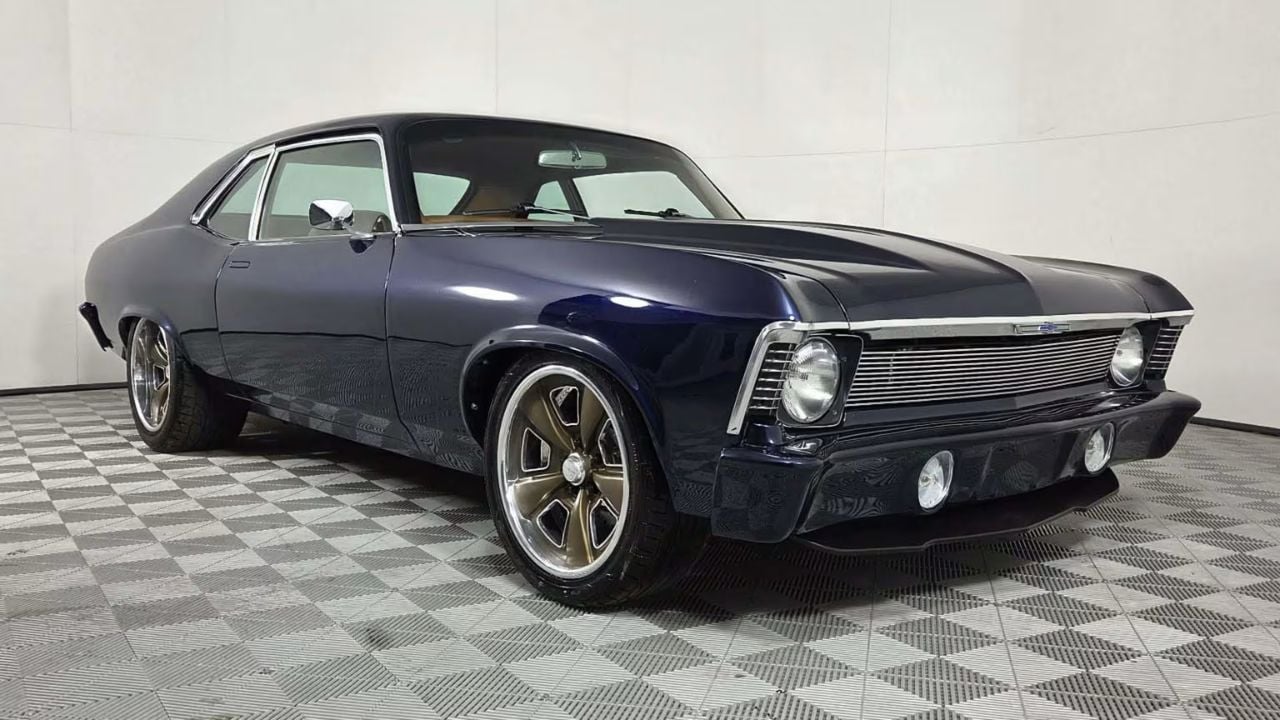
A 1972 Chevrolet Nova heading to Mecum Houston on April 11 fits squarely into that trend. Scheduled to cross the block as Lot S148, this build trades its original powerplant for a modern LS3 V-8, turning a familiar piece of classic muscle into something far more usable in the modern world.
Modern LS3 Power Transforms a Classic Nova

At the heart of this Nova is a Chevrolet LS3 V-8, a modern 6.2-liter small-block introduced by General Motors in 2007 and used in performance models like the Corvette and Camaro SS.
In factory form, the naturally aspirated LS3 produces around 430 horsepower and 425 lb-ft of torque, though builds like this often vary depending on setup. What matters more is what it represents. Compared to the original engine options, this is a completely different driving experience.
The LS3 has become one of the go-to swaps in the restomod world thanks to its balance of power, reliability, and aftermarket support. On a relatively lightweight platform like the 1972 Nova, that translates into performance far exceeding what the car offered when new.
Paired with an automatic transmission, the setup also makes the car more approachable. This is not a temperamental classic you only take out on perfect weekends. It is something you can actually drive.
Why the 1972 Nova Still Works So Well

The 1970–1972 Nova sits in a sweet spot for builders. It is simple, widely available, and relatively affordable compared to many of its muscle car peers.
That accessibility has made it a favorite platform for restomods. The straightforward engine bay and unibody construction make swaps easier, while the car’s compact size and lighter weight help maximize the impact of modern power.
Then there is the styling. The Nova does not shout for attention the way some muscle cars do. Its clean, understated look gives it a natural sleeper vibe, which only adds to the appeal when something like an LS3 is hiding under the hood.
For many buyers, that balance is exactly the point. You get the presence of a classic without the predictability.
Restomods Continue To Gain Ground

Restomod builds like this are showing up more frequently at major auctions and drawing serious attention. Buyers are increasingly prioritizing drivability and usability over strict originality.
Modern components bring better braking, improved cooling, more reliable electrical systems, and a level of comfort that older cars simply were not designed to offer. For many collectors, that makes these cars far more appealing for actual use rather than occasional display.
That shift is helping reshape the market. Where originality once dominated, there is now growing acceptance—and in some cases preference—for thoughtfully modified builds.
This Nova is a clear example of that evolution. Classic shape, modern performance, and everyday usability all rolled into one package.
And if current trends continue, it is exactly the kind of build that will keep showing up—and selling—at auctions like Mecum.