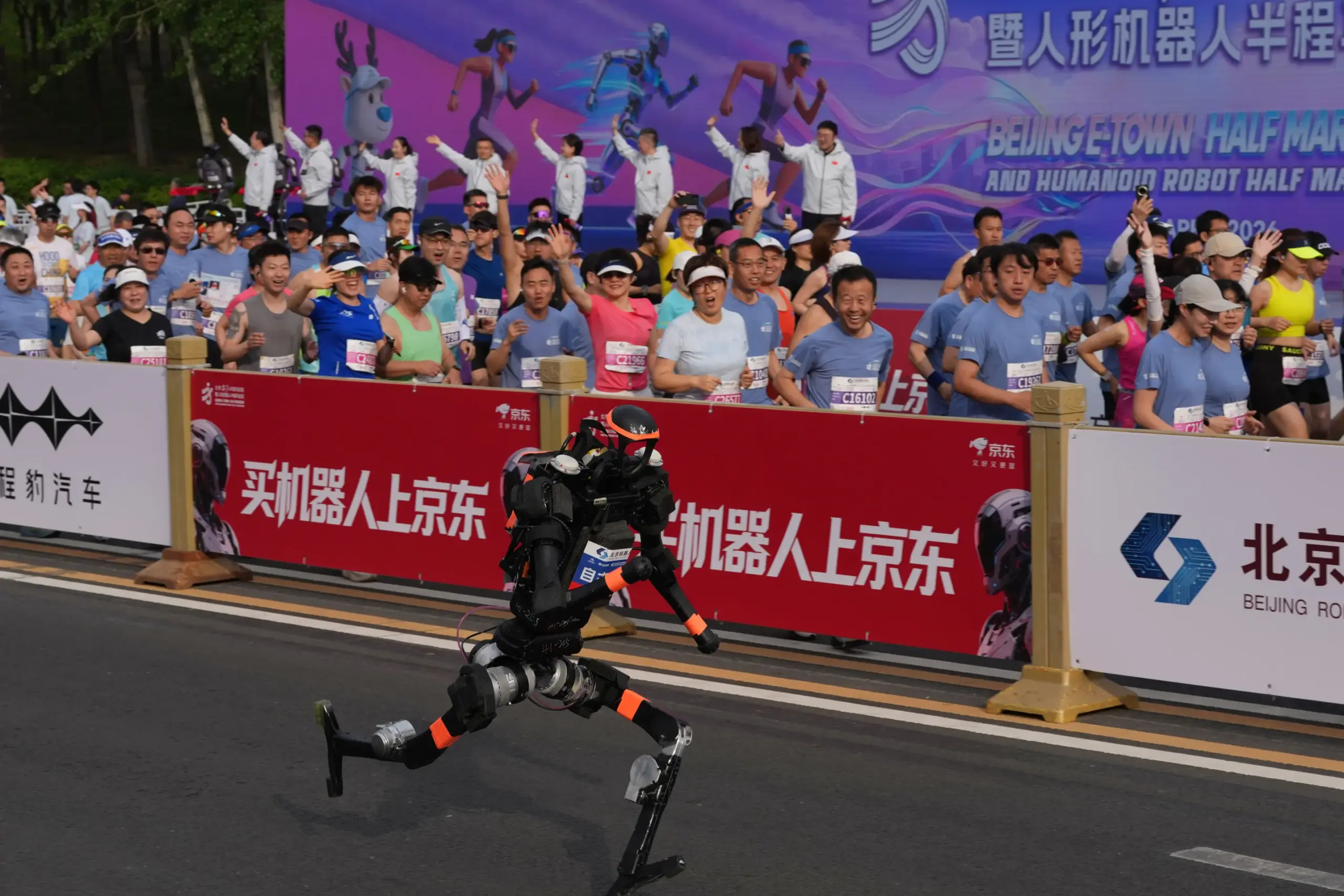
A humanoid robot just outran the fastest human half-marathon time ever recorded, and it did it in Beijing on a Sunday morning like it was out for a casual jog.
The robot, built by Honor, a Chinese smartphone manufacturer that has clearly branched out in a big way, crossed the 21-kilometer finish line in 50 minutes and 26 seconds during a dedicated humanoid robot half-marathon hosted by Beijing E-Town. For comparison, Uganda’s Jacob Kiplimo set the human world record at roughly 57 minutes during a race in Lisbon just last year. That gap is not a photo finish situation. That is nearly seven full minutes. In a half-marathon, that is a different planet.
What makes this even more jaw-dropping is the trajectory. Just one year earlier, the winning robot at the inaugural version of this same race completed the course in 2 hours, 40 minutes, and 42 seconds. In the span of 12 months, the top robot time improved by nearly two hours. If that rate of progress continues, we are all going to need a minute to process what that means.
The race was held alongside a parallel human race, meaning actual flesh-and-blood runners were competing at the same time and in the same space as machines built to mimic them. One spectator, Sun Zhigang, attended both the 2024 and 2025 events and said the difference was staggering. “It’s the first time robots have surpassed humans,” he said, “and that’s something I never imagined.” Another attendee, Wang Wen, put it more bluntly: “This may signal the arrival of sort of a new era.” Hard to disagree.
Not Every Robot Stuck the Landing
Before anyone crowns the robots as flawless overlords, it is worth noting that the race was far from perfect on the machine side. At least one robot took a tumble at the very start line, and another collided with a barrier mid-course. These are not minor bugs in a software patch. These are robots, in a race, in front of cameras, faceplanting.
The event’s rules also added a layer of nuance. According to state media outlet Global Times, a separately operated, remotely controlled Honor robot was technically the first to cross the finish line at 48 minutes and 19 seconds. However, because the competition uses a weighted scoring system that rewards autonomous navigation, the championship went to the robot that ran itself through the entire course without a human controlling it in real time. About 40 percent of the competing robots navigated fully on their own, while the rest were remotely piloted.
China Is Treating Robotics Like a National Sport
This race did not happen in a vacuum. China has made humanoid robotics a core pillar of its national technology strategy, naming it explicitly in its 2026 to 2030 five-year economic plan, which vows to target the frontiers of science and technology and accelerate the real-world deployment of products like humanoid robots.
The country is not just talking about it either. London-based research firm Omdia recently ranked three Chinese companies, AGIBOT, Unitree Robotics, and UBTech Robotics Corp., as the only first-tier vendors in its global assessment of general-purpose embodied intelligent robots based on shipment volume. All three shipped more than 1,000 units last year, with AGIBOT and Unitree each exceeding 5,000 units. That is not a research lab number. That is a manufacturing number.
Technology competition between China and the United States has escalated well beyond consumer gadgets and into territory with national security implications. Robotics, artificial intelligence, and advanced manufacturing are now part of that equation in a very serious way.
What We Can Learn From a Robot Race
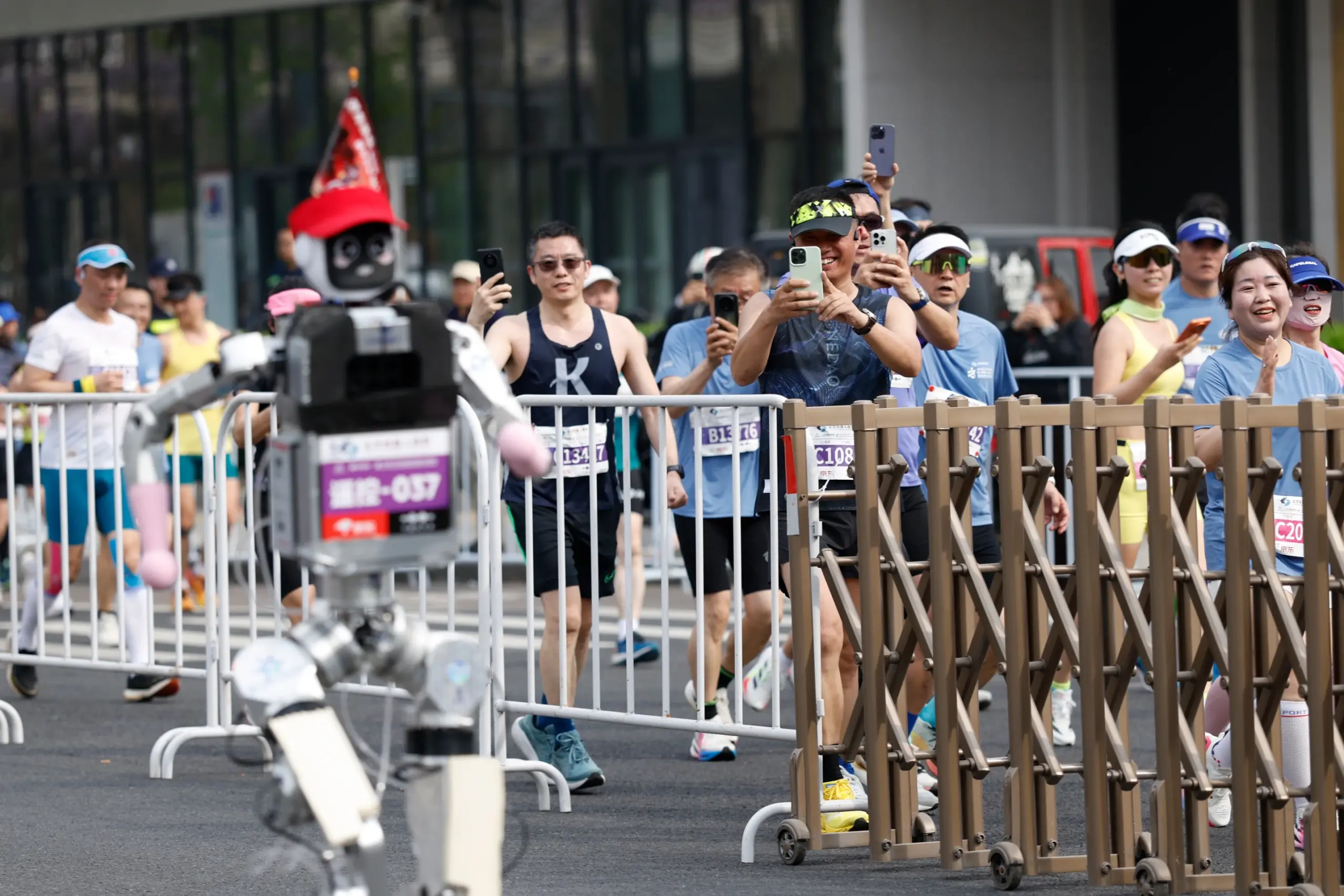
On the surface, a half-marathon for humanoid robots is a quirky spectacle. But look a little closer and the event is actually a high-stakes performance benchmark with real-world implications. Racing forces robots to deal with sustained physical exertion, real terrain, navigational decisions, and the chaos of other moving objects around them. A robot that can complete 21 kilometers on its own without being steered by a human is a robot that is getting close to being useful in logistics, emergency response, manufacturing, and more.
The improvement from 2 hours and 40 minutes to just over 50 minutes in one year also tells us something important about the pace of development. Progress in robotics is not moving in a straight line. It is accelerating.
What Comes Next for Humanoid Robots
The Beijing half-marathon is likely to become an annual benchmark that the entire industry watches closely, similar to how the DARPA Robotics Challenge helped set the pace for robot capability development in the United States a decade ago. With major Chinese companies already shipping humanoid robots at scale and government policy directly backing the sector, expect these times to keep dropping.
Whether a fully autonomous robot will one day qualify for the Boston Marathon is probably still a few years off. But given what just happened in Beijing, maybe do not bet against it.