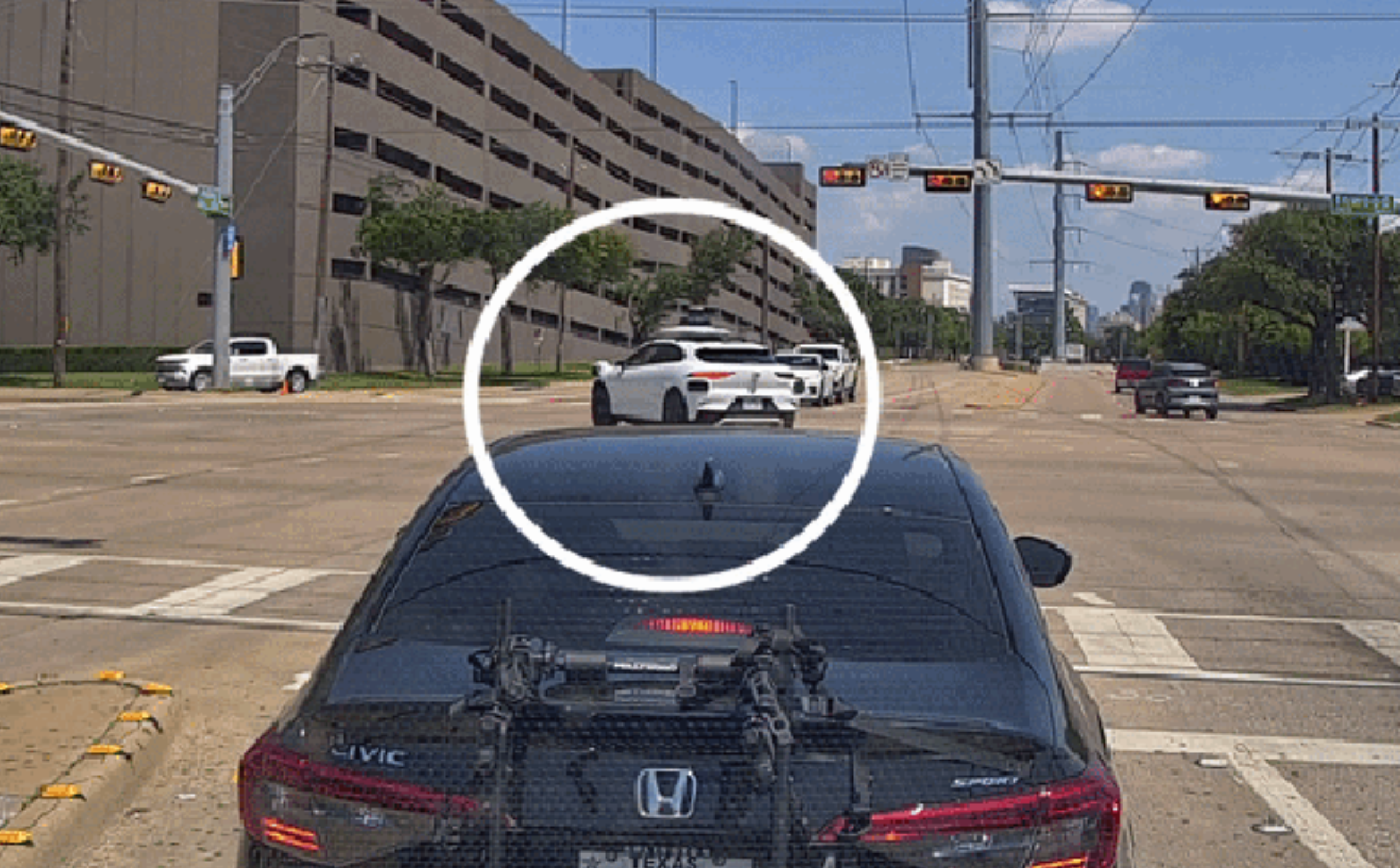
A FOX 4 viewer’s dashcam caught a Waymo self-driving car blowing through a red light in busy Dallas traffic, and the video is making waves online. The incident happened on Irving Boulevard over the weekend, when a Waymo robotaxi rolled straight into a live intersection against a red signal, weaving through moving cars without so much as a pause. Somehow, nobody got hit.
The witness who filmed it described watching the vehicle inch forward slowly, seemingly confused, before it made the call to just go for it. “It kept going forward, going forward, almost like it was going to make a turn,” he said. “And then it just drives right out into the intersection in the traffic.” He chose not to share his name given his career in tech, but he felt the public deserved to see what he saw.
Waymo responded with a statement explaining that the traffic light appeared “heavily dimmed” from the vehicle’s position in the right-turn lane, and said the company is actively working to fix the issue. The company also made sure to drop its standard safety-first line: “Safety is our highest priority at Waymo, for our riders and everyone with whom we share the road.” Whether that reassurance lands after watching a robotic car sail through a red light is another question entirely.
What makes this moment especially significant is the timing. Waymo only launched in Dallas back in February, and the rollout has been anything but smooth. This latest video is now part of a much bigger conversation about whether autonomous vehicles are truly ready to share the road with the rest of us.
What Waymo Said, and What Researchers Are Actually Thinking
Waymo’s explanation centered on the idea that the traffic light looked dimmer than usual from the vehicle’s camera angle in the right-turn lane. In theory, it’s a plausible technical explanation. In practice, it is not exactly comforting to know that a self-driving car can apparently be fooled by a slightly dim traffic light in the middle of a busy city.
Neel Bhatt, a research scientist with the Center for Economy at the University of Texas at Austin, put it plainly: the technology still has a lot of ground to cover. He pointed out that autonomous vehicles are trained on datasets, meaning they learn from past scenarios. When they encounter something outside that dataset, things can go sideways fast. “They’re faced with different scenarios that maybe are not in the data that they’re trained on,” he said. “They will not work well.”
Bhatt does believe autonomous vehicles will get there eventually. But his takeaway for right now? A slower rollout would probably be the smarter play. That sentiment is becoming harder to argue against the more incidents pile up.
Texas Has Seen This Before, and Federal Regulators Are Paying Attention
Dallas is far from the only city where Waymo’s rollout has hit some turbulence. In Austin, the situation has been particularly messy. Police there have reported robotaxis ignoring hand signals from officers directing traffic and driving around barricades set up around active construction zones. Austin ISD even released multiple videos showing Waymo vehicles illegally passing school buses while their stop arms were out and red lights were flashing.
Austin Police Lt. Will White did not mince words about the school bus incidents: “One incident is too many. One of those vehicles not recognizing a school bus arm and passing it is surprising for a system that’s supposed to be significantly safer than humans.”
The National Highway Traffic Safety Administration has confirmed it is currently analyzing 16 crashes involving autonomous vehicles in Dallas and Austin. Meanwhile, a separate investigation is underway after a Waymo vehicle in Santa Monica, California allegedly failed to slow down in a school zone and struck a child, who fortunately suffered only minor injuries.
On top of that, Waymo recently filed a voluntary software recall with the NHTSA tied to how its vehicles handle extreme weather, after a robotaxi entered a flooded lane in San Antonio during a storm. The car was unoccupied, so no one was hurt, but the recall is still a notable development for a company trying to build public trust.
What We Can Actually Learn From the Dallas Incident
The red light incident is not just a Waymo problem. It is a useful window into the broader challenges facing the entire autonomous vehicle industry. Self-driving systems are incredibly sophisticated, but they are not infallible, and edge cases like a dimly lit traffic signal or an unexpected hand gesture from a police officer can expose real gaps.
What this incident underscores is that the path from “impressive technology” to “ready for widespread urban deployment” is longer than many companies would like to admit. Training AI on massive datasets helps, but real-world driving is unpredictable in ways that datasets cannot always anticipate. A dimmer-than-usual traffic light, a school bus with an unexpected stop arm, or an officer waving cars through are all things a human driver navigates instinctively. For an autonomous system, each one is a potential blind spot.
There is also a transparency question worth raising. Waymo’s explanation for the red light violation was technically detailed but came only after the video circulated publicly. Greater proactive communication from these companies, especially when incidents occur, could go a long way toward rebuilding the trust these rollouts keep chipping away at.
Waymo Says Dallas Service Will Continue, Despite the Investigations
Despite the NHTSA investigations, the software recall, and the growing catalog of incidents, Waymo has confirmed that it does not plan to pause or suspend its Dallas operations. The company is pressing forward, working through issues as they surface.
That may end up being the right call if the fixes come quickly and the safety record improves. But for everyday Dallas drivers sharing the road with these vehicles, “we’re working on it” is only so reassuring when the proof keeps showing up on dashcam footage. For now, the robotaxi experiment continues, bumps, red lights, and all.