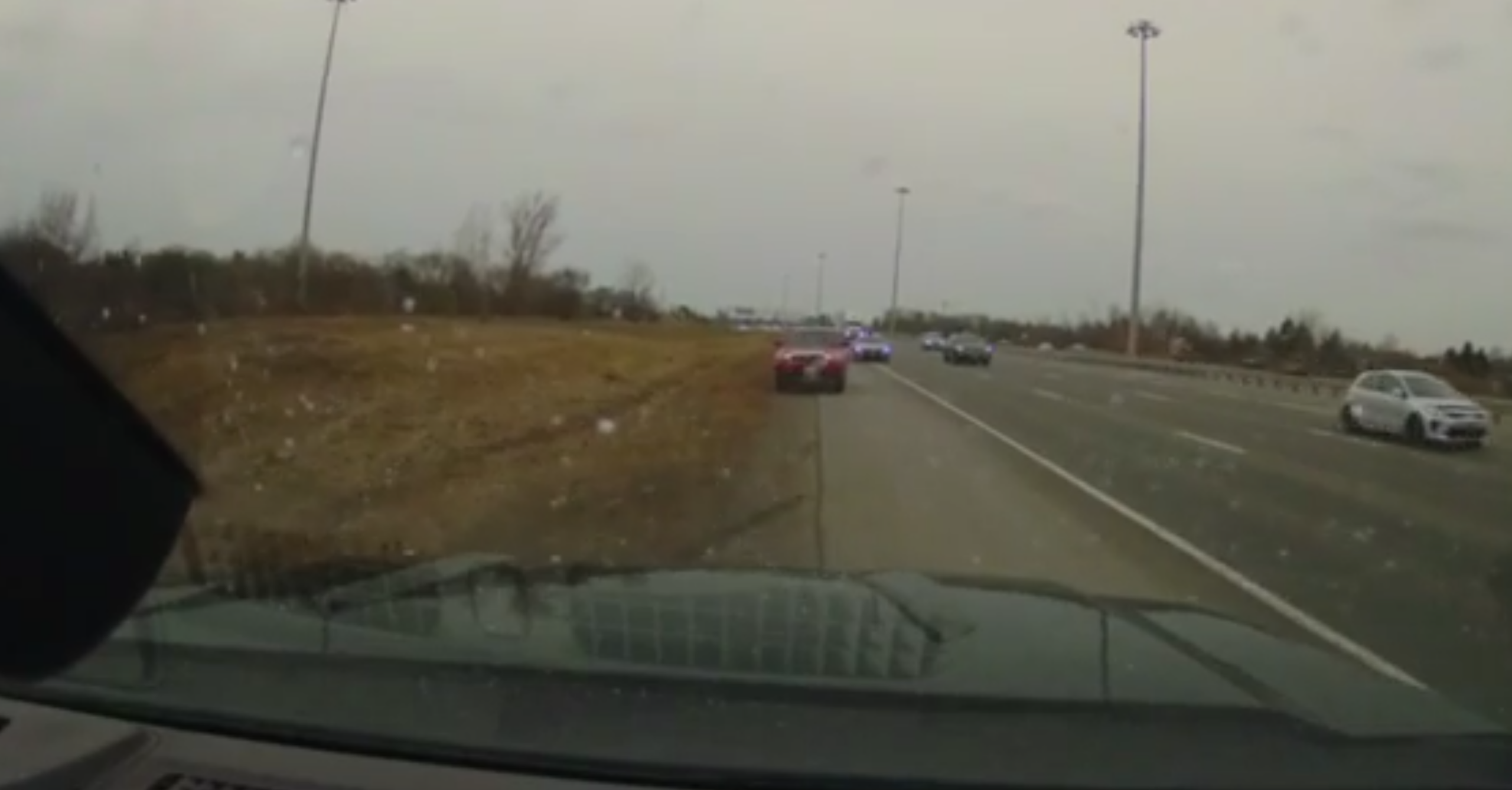
Highways are one of those places where overconfidence gets expensive fast. You can do everything right, signal properly, maintain your speed, leave appropriate following distance, and still end up sideways on the asphalt because someone else decided mirrors were optional. That is not a hypothetical scenario. That is exactly what happened to one driver whose dashcam footage recently surfaced on Reddit and quickly reminded the internet why recording your drives is no longer a luxury.
The clip, timestamped from early April 2026, starts out completely unremarkable. Traffic is flowing, the sky is clear, and nothing about the opening seconds suggests that things are about to get very dramatic, very fast. Then a silver sedan decides it wants to be in the fast lane without actually checking whether the fast lane is available. Spoiler: it was not. The sedan clips the rear right corner of the recording vehicle, and physics immediately takes over.
What follows is the kind of spinout that makes your stomach drop just watching it from the safety of your couch. The car rotates across the live lanes of the highway before the driver, through either remarkable composure or pure adrenaline-fueled instinct, manages to guide the vehicle off the road without hitting anyone else. No injuries were reported, which at highway speeds is genuinely remarkable and something worth pausing to appreciate.
Here is the part that really set the comments section on fire, though. The original poster captioned the video with a line that just about every driver has feared hearing: the person who caused the crash turned around and blamed the victim for getting hit. Let that sink in for a second. The dashcam footage exists. The whole thing is on video. And somehow, the other driver still tried it.
What Actually Happened During the Crash
[OC] Spun out on the highway. Guy blamed me for hitting me. No one was hurt.
by
u/ulysseswest in
IdiotsInCars
The mechanics of this particular incident are worth breaking down because they illustrate just how little time a driver has to react when someone else makes a careless decision at speed. The sedan was traveling in a slower lane when its driver began merging into the fast lane without checking the passenger-side mirror or blind spot. The merge connected with the rear corner of the faster vehicle, which is one of the worst contact points during a lane change because it initiates a rotational force that the struck driver has almost no ability to counteract.
Automotive safety experts refer to this type of contact as a PIT-style impact, a term most commonly associated with law enforcement pursuit tactics. When the rear quarter panel of a moving vehicle takes a lateral hit, the front wheels lose their directional authority and the car begins to rotate around its own center of gravity. At highway speeds, that rotation happens in a fraction of a second and leaves almost no window for correction. The fact that this driver recovered without secondary contact is genuinely impressive.
Why the Other Driver Tried to Assign Blame
The blame-shifting after a crash is unfortunately not a rare phenomenon. Insurance dynamics, financial stakes, and plain old pride all contribute to a surprisingly common post-accident instinct: get your story out first. Without evidence to the contrary, the narrative often defaults to whoever is most confident and loudest in the immediate aftermath. Police reports rely heavily on driver statements when there are no independent witnesses, and in a highway incident where other cars kept moving, the physical evidence alone can sometimes be ambiguous enough to create doubt.
That calculation changes completely when one of the vehicles involved has a dashcam running. Footage from a mounted camera is admissible in both insurance claims and legal proceedings in most jurisdictions across the United States, and insurers increasingly treat it as highly credible evidence. A 30-second clip can collapse an entirely fabricated version of events before it ever makes it to an adjuster’s desk.
Dashcams Are the Cheapest Insurance You Are Not Buying
If you have been putting off buying a dashcam because it feels like an unnecessary expense, consider what the alternative actually looks like. Your word against theirs. Conflicting statements. A potentially drawn-out dispute with an insurance company that has every financial incentive to split liability down the middle or find some way to assign partial fault to you, even when you did nothing wrong.
A quality dashcam costs somewhere between $50 and $200 depending on the features you want, and hardwiring one into your vehicle is a straightforward job that most auto shops will handle in under an hour. Front-and-rear setups are worth the extra investment because rear-end collisions are among the most commonly disputed accident types. The Garmin dashcam visible in this particular Reddit video is a popular choice among daily drivers for its reliability and image clarity, though several other brands offer comparable performance.
Think of a dashcam less like an accessory and more like a witness that never blinks, never gets a detail wrong under pressure, and never forgets what it saw.
The Takeaway From This Video
The broader lesson here is not really about this one crash or this one careless driver. It is about the reality that no matter how defensively and responsibly you operate a vehicle, you share every road with people who are distracted, overconfident, or simply not paying attention. That is a variable you cannot eliminate through skill alone.
What you can do is make sure that when something goes wrong and someone inevitably tries to rewrite history in their own favor, you have 60 frames per second of irrefutable proof ready to go. The driver in this video walked away unhurt and, thanks to their dashcam, with their version of events completely intact. That is the best possible outcome from a terrifying situation, and it started with a decision they made long before they ever got on that highway.