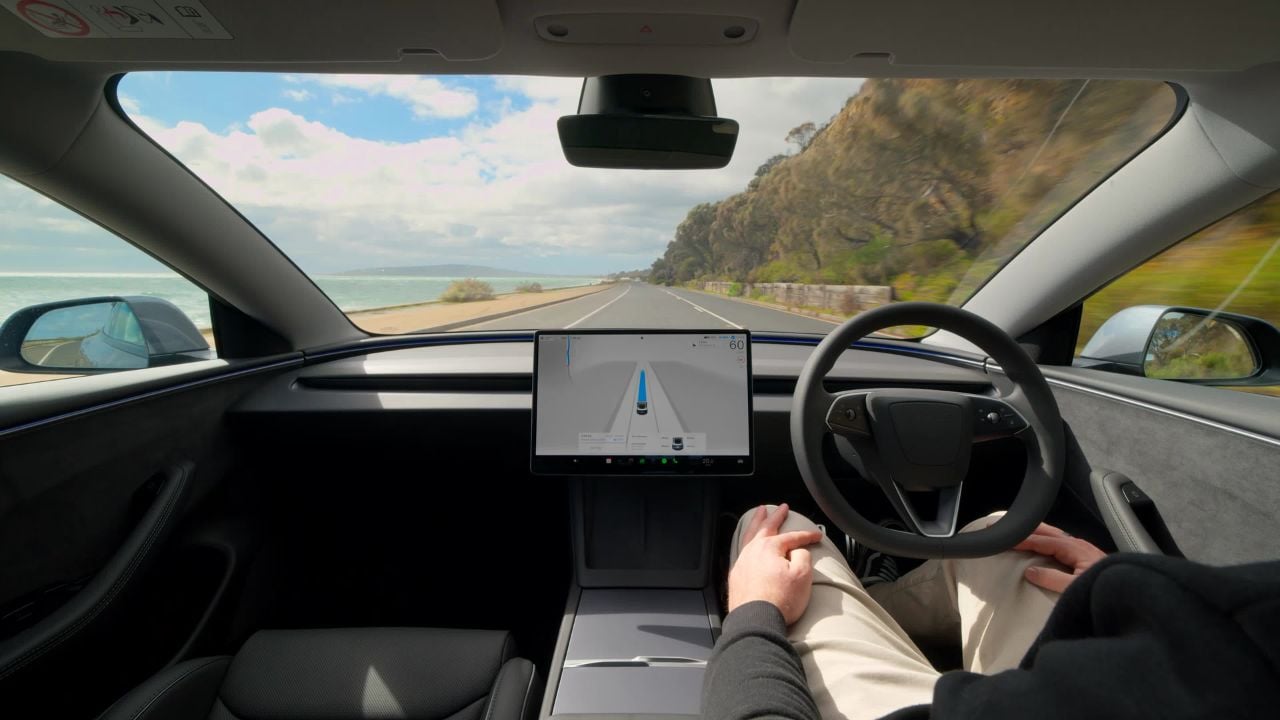
Tesla has begun rolling out version 14.3.3 of its Full Self-Driving (Supervised) software, and early users are already reporting noticeable improvements in how the system behaves on public roads. Drivers say the latest update delivers smoother acceleration, more natural lane changes, and more confident low-speed maneuvering, helping the software feel closer to the way a human driver operates.
One of the most discussed changes, however, has little to do with steering or braking performance. Users have discovered that Tesla’s driver monitoring system appears to issue fewer attention warnings than before, allowing drivers to look away from the road for longer periods before receiving a prompt to re-engage. That shift has quickly sparked concern among safety advocates who argue the technology still requires constant supervision.
Tesla continues to market the system as “Full Self-Driving (Supervised),” emphasizing that drivers must remain attentive and ready to take control at all times. Critics say reducing driver alerts risks encouraging complacency, especially as the software becomes increasingly smooth and predictable in everyday traffic situations.
The update also arrives as Tesla expands FSD availability into additional international markets. Broader deployment gives the company access to more real-world driving data, which Tesla believes will help improve the system’s long-term safety and capability.
Smoother Driving and Improved Smart Summon
14.3.3 nags less too https://t.co/IuiWzuYO6O
— Elon Musk (@elonmusk) May 18, 2026
Drivers testing FSD v14.3.3 report that the software handles routine traffic situations with greater refinement than previous versions. Steering inputs appear less abrupt, braking feels more progressive, and lane changes are said to happen less aggressively in the standard driving profile.
Tesla’s Actually Smart Summon feature has also received attention in the update. The system, which allows owners to remotely move their vehicle using the Tesla smartphone app, reportedly operates at higher speeds than before, increasing from roughly 6 mph to around 8 mph in some scenarios. Users say the change helps the vehicle move through parking lots in a way that feels more natural and less hesitant.
The Smart Summon system has previously faced scrutiny following reports of low-speed crashes and awkward maneuvering. Tesla has steadily refined the feature through over-the-air updates, and federal regulators recently closed an investigation tied to the technology after software improvements were introduced.
Reduced Driver Warnings Raise Concerns
While many Tesla owners welcome a less intrusive monitoring system, safety experts remain cautious about the change. FSD is still classified as a Level 2 driver assistance system, meaning the human driver is legally responsible for monitoring the environment and intervening when necessary.
Several users report that the updated system allows longer periods of distraction before issuing alerts. Supporters argue the change makes the driving experience less frustrating during normal use, particularly when compared to earlier software versions that frequently demanded steering wheel input or visual attention confirmation.
Critics counter that reducing reminders may increase the likelihood of misuse. Concerns surrounding driver overconfidence have followed Tesla’s FSD and Autopilot systems for years, especially because the branding can create unrealistic expectations about the software’s true capabilities.
Early Feedback Highlights Better Hazard Detection
Some testers say the newest version appears more capable of anticipating potential hazards. One early user shared an example of the software reacting to a vehicle running a stop sign before the driver fully recognized the danger, potentially preventing a collision.
Additional feedback suggests the system handles parking maneuvers with greater accuracy and behaves more confidently in dense traffic. Tesla’s aggressive “Mad Max” driving profile is also said to feel smoother and more controlled despite its assertive lane-change behavior.
There are still complaints, however. Some users note that speed management in certain 55 mph zones remains inconsistent, while pothole detection and avoidance continue to need refinement. Those issues highlight the reality that, despite rapid progress, Tesla’s system is still evolving rather than fully autonomous.
Tesla Continues Expanding FSD Globally
Tesla’s expansion of FSD into additional European markets marks another important step for the company’s broader autonomous driving ambitions. Each new region introduces different road layouts, traffic behavior, and signage, giving Tesla access to a wider range of driving data.
That growing data pool is central to Tesla’s development strategy. The company relies heavily on real-world driving footage collected from customer vehicles to train and improve its neural network systems over time.
For many Tesla owners, version 14.3.3 represents another meaningful step toward a more polished driving assistant. For regulators and safety advocates, however, the reduced driver monitoring raises fresh questions about how much freedom supervised systems should allow before true autonomy is achieved.