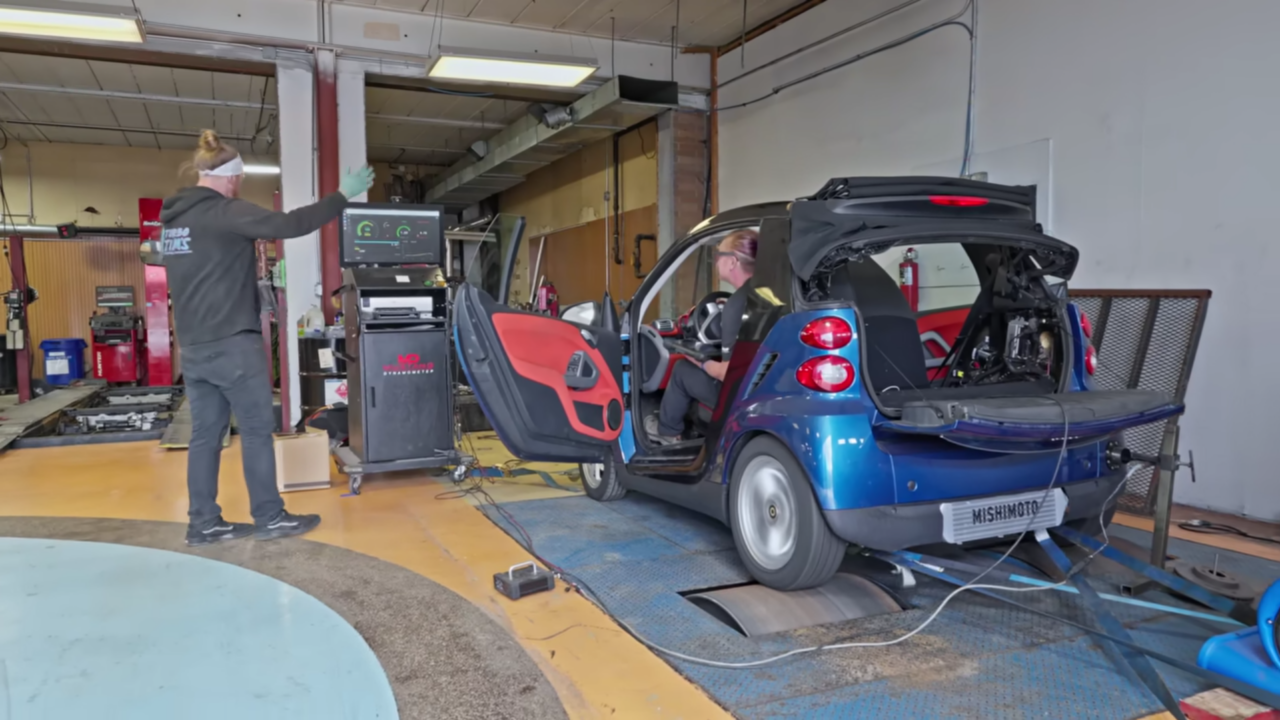
The Smart Fortwo has never been known for speed. The tiny city car was designed for efficiency, compact parking, and urban commuting, not drag racing or dyno glory. In stock form, the little rear-engine hatchback makes roughly 52 horsepower, which means even modest highway acceleration can feel painfully slow.
That underwhelming performance inspired the Turbo Tims Does It Big! YouTube channel to attempt something completely unnecessary and undeniably entertaining: bolting a turbocharger onto the tiny three-cylinder engine and seeing just how much power the platform could handle.
What started with a cheap eBay turbo eventually escalated into a much more serious build involving upgraded fueling, revised tuning, transmission software tweaks, and a tiny dual ball-bearing Pulsar turbocharger. The result was a Smart car producing more than 200 horsepower, nearly quadruple its factory output!
Surprisingly, the engine itself wasn’t the biggest problem. The Smart’s automated manual transmission quickly became the weak link, turning what should have been a quick little rocket into one of the strangest “high-horsepower” builds on the internet.
Starting With Just 52 Horsepower
According to Turbo Tim’s original dyno testing, the Smart Fortwo produced about 52 horsepower in factory form. After the first turbo setup was installed, output jumped dramatically to around 158 horsepower, though the larger turbo created lag and poor drivability at lower RPM.
Seeking better response, the team swapped to a much smaller Pulsar dual ball-bearing turbo measuring 39 mm on the compressor side and 42 mm on the exhaust side. The new setup was designed to improve low-end power delivery and make the car feel quicker in normal driving conditions.
The revised build also added an AEM fuel and ignition controller to work alongside the stock ECU. Earlier tuning attempts had exposed limitations with the factory electronics, and even experimenting with a European-market turbo Smart ECU failed to fully solve the fueling issues.
Once the smaller turbo and revised tuning package were installed, dyno testing immediately showed improvement. Initial pulls produced around 187 horsepower before fueling inconsistencies forced additional troubleshooting.
Chasing the 200-HP Barrier
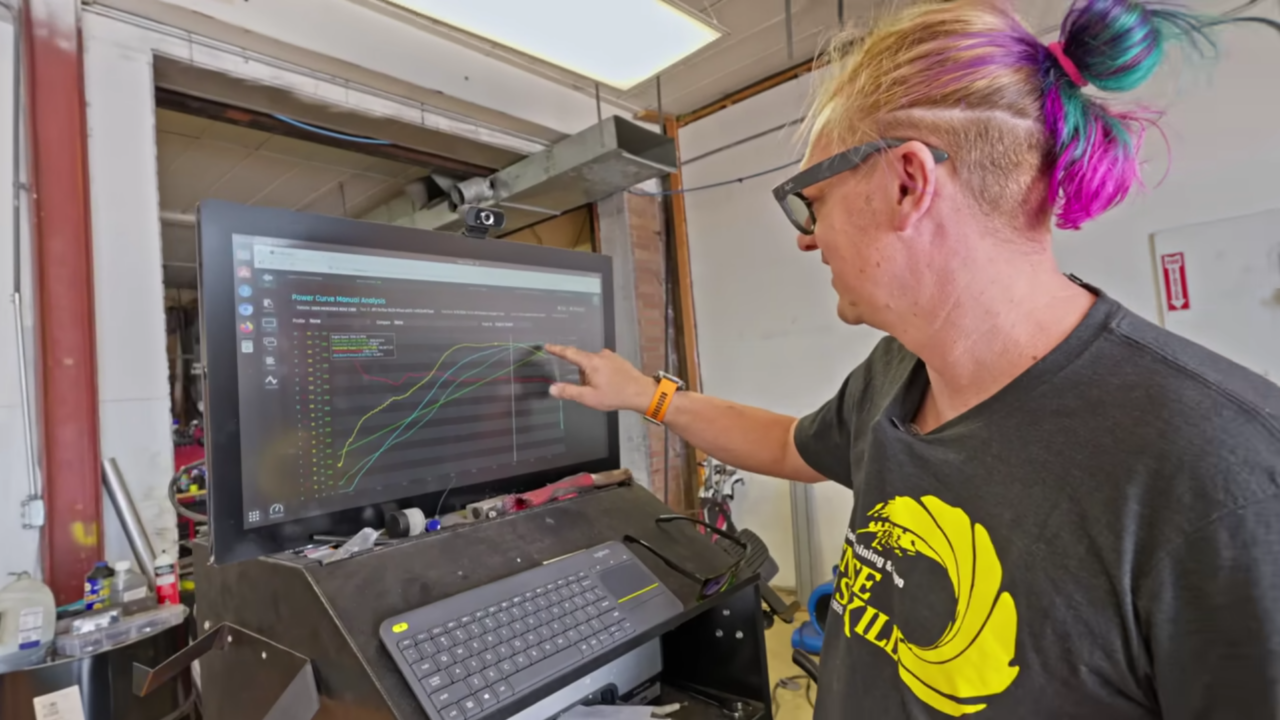
One of the biggest challenges during tuning came from air-fuel ratio readings and sensor calibration issues. At one point, the dyno’s oxygen sensor setup caused inaccurate lean readings after pressure pushed the sensor pipe loose during testing.
After correcting the O2 sensor problem and adding more fuel through the AEM controller, the little Smart car responded dramatically. Power climbed to 192 horsepower while maintaining safer air-fuel ratios throughout the rev range.
Naturally, stopping short of 200 horsepower was never going to happen.
With boost pressure increased incrementally, the Smart eventually produced 201 horsepower at roughly 18.5 psi. For a car weighing around 1,700 pounds, the resulting power-to-weight ratio theoretically placed it in genuinely quick territory.
The team noted that the upgraded setup now made more horsepower at 2,900 RPM than the stock car produced at redline.
The Transmission Became the Real Problem
Despite the massive power increase, real-world acceleration results turned out to be strangely disappointing. Quarter-mile testing revealed the Smart Fortwo still struggled to run impressive times, initially managing only around 17-second passes. The culprit was the transmission.
The Smart Fortwo’s automated manual gearbox shifts notoriously slowly even in stock form, and once the engine began producing serious power, the delays became painfully obvious. Each gear change interrupted acceleration long enough to ruin momentum, wasting much of the turbocharged engine’s newfound output.
Turbo Tim’s team suspects the transmission’s torque management programming is actively forcing the engine ECU to reduce power during shifts. Even after transmission control unit flashing and tuning adjustments, the gearbox still behaved sluggishly under hard acceleration.
That disconnect created a bizarre situation where a 200-horsepower car with a favorable power-to-weight ratio performed far slower than expected at the drag strip.
More Power Isn’t Always the Answer
The project ultimately highlighted one of the biggest truths in performance tuning: horsepower numbers alone do not guarantee speed. While the Smart Fortwo’s tiny engine proved surprisingly capable of handling substantial boost pressure, the rest of the drivetrain struggled to keep up.
It’s now believed that future improvements will require more extensive transmission changes rather than additional engine modifications. Possibilities mentioned include further TCU development, a manual transmission swap, or even experimenting with a snowmobile-style clutch system.
For now, the turbocharged Smart remains one of the internet’s funniest engineering experiments: a tiny city car producing supercar-level horsepower per liter while still fighting to escape the 17-second quarter-mile range.
Even so, transforming a 52-horsepower commuter into a 200-horsepower turbo monster counts as a win in enthusiast circles, regardless of how awkward the launch looks at the drag strip.