If it feels like California has been having a moment with high-speed chases lately, you are not imagining it. Another night, another pursuit stretching across multiple freeways with a news helicopter overhead and traffic waiting ahead.
This one just happened to involve a neon-green Chevrolet Corvette, a car built for speed, not subtlety. It started in Orange County and kept going well into Los Angeles County.
For a while, it looked like the driver still had options. Open freeway, space to move, and a car capable of making distance in a hurry.
That part never lasts. These chases almost always end the same way, when the road runs out, and reality catches up.
Plenty of Speed, Nowhere To Go
Embedded media follows. Please allow a moment for it to load.
According to FOX 11 Los Angeles and CBS Los Angeles, the pursuit began in Santa Ana after the driver was wanted for speeding. From there, the Corvette moved across multiple freeways before dropping onto surface streets through areas including Compton, Downey, Long Beach, Norwalk, and eventually Torrance.
One reason this chase stood out is that, at least early on, it was less about wild lane-cutting and more about speed. In the live coverage, the Corvette was often seen holding its lane before surging ahead, at times with broadcast speed estimates pushing toward 100 mph.
That might look controlled on video for a few seconds at a time. It is not safe, and it only takes one slower driver, one merge, or one bad decision for a chase like this to turn ugly.
The Moment It Should Have Ended
At one point, the driver pulled into a Chevron gas station near Sepulveda Boulevard and Del Amo Circle East. For a moment, it looked like the whole thing might finally be over.
It was not. As officers moved in, the driver took off again, and what could have ended as a bad speeding stop kept growing into something much worse.
That is the part that sticks with these pursuits. There is often a moment when the driver still has an exit ramp from the bad decision, and this looked a lot like that moment.
Traffic Ends It
The chase did not end with some flawless maneuver. It ended because the road finally closed in.
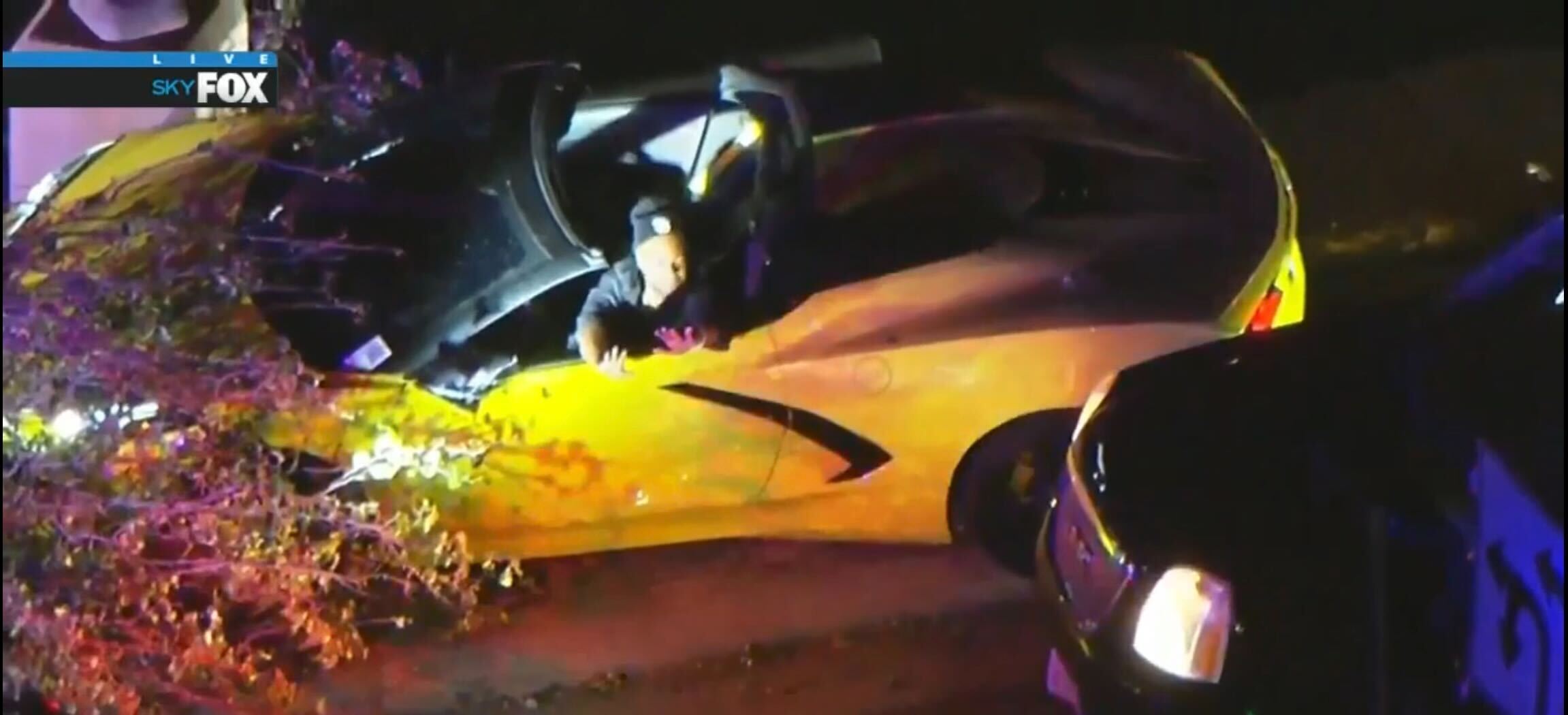
CBS Los Angeles reported that the suspect made a U-turn, got caught in traffic, then tried to force the Corvette up onto a sidewalk before crashing into an SUV and a tree. In the live coverage, the final seconds looked exactly like what happens when a driver runs out of space and starts improvising with nowhere left to go.
You can outrun a cruiser for a while. You cannot outrun traffic.
The Arrest Was Almost as Strange as the Chase
After the crash, the driver put his hands up but did not immediately get out of the car. Live coverage then showed him appearing to remain inside, holding what commentators described as a cell phone, before officers finally moved in and used a swarm-style takedown to end it.
That surreal ending only added to the chaos of the whole thing. A chase that started as a speeding case had now crossed county lines, hit city streets, crashed into another vehicle, and ended with the suspect lingering in a wrecked Corvette as officers closed in.
The YouTube Comments Went Exactly Where You Would Expect
Because the chase was playing out live, the comments under the embedded YouTube video quickly turned into their own running side show. Some viewers focused on the danger to other drivers, others fixated on the Corvette itself, and plenty took aim at the broadcasters calling the action.
Many viewers zeroed in on accountability. One commenter argued that “five years in prison for fleeing the police would help address this problem,” while others predicted the driver would spend little time in custody, reflecting the usual back-and-forth that follows these chases.
Others kept coming back to the car. “Nice car, bad driver,” one person wrote, while another called it “a beautiful Corvette” wasted by a reckless decision, which pretty much sums up the car-guy reaction here.
And since this is still the internet, the humor showed up fast. “Tree: 1, Driver: 0,” one viewer joked, while another called it “practicing for GTA 6.” Another added, “That tree came out of nowhere,” while someone else summed up the ending with, “You can’t park there.”
A few viewers even pointed out the obvious irony. “Bright green Corvette trying to hide from a helicopter,” one comment read, while another added, “That car stands out more than the sirens.”
It is the same mix you see every time. Concern, frustration, car talk, and just enough humor to remind you how many people are watching these things unfold in real time.
Why this works:
The Bigger Debate Was Happening in Real Time Too
The more interesting part of the live stream was not just the chase itself. It was the running argument about when police should stay in a pursuit, when they should back off, and whether California is too reliant on letting these things play out until a driver either gives up or crashes.
That debate was happening on air and in the comments at the same time. The live discussion touched on alternatives such as GPS darts, grappler-style devices, and remote-disabling technology, while also raising the obvious question: if the initial reason was speeding, at what point does public safety outweigh the value of staying in the chase?
That is not an easy question, and pretending it has an easy answer is how you end up writing dumb things about pursuits. Keep chasing, and you risk escalation; back off, and you risk letting someone dangerous disappear into traffic for the moment.
Technology Exists, but It Is Not a Magic Fix
The conversation around pursuit technology sounds simple until you get past the talking points. The live broadcast discussion pointed to GPS darts, grappler systems, drones, and other tools, but also made clear that cost, deployment, and real-world limitations still keep those systems from being a universal answer.
That is probably the most honest takeaway here. People love the idea of a clean, high-tech solution that ends every pursuit safely, but right now, most of these still come down to the same brutal math of speed, space, traffic, and bad judgment.
What Happens Next
Officers ultimately took the driver into custody at the scene. Authorities have said the initial reason for the pursuit was speeding, but what happens next will almost certainly be shaped by everything that followed the driver’s decision to run.
That includes the chase across two counties, the gas station fake-out, the crash into another vehicle, and the public safety risk created along the way. Many of the details that matter most here were not the initial reason for the stop. They became part of the story because the driver made them so.
The Part That Matters
A modern Corvette is a serious piece of machinery. Fast, capable, and more than enough car for just about any public road.
None of that matters when the person behind the wheel decides to treat traffic like a problem to be solved instead of people trying to get home. This started as speeding, turned into a chase, and ended the same way too many of these have lately in California: with a wrecked car and a lot of unnecessary risk.
We do not yet know why the driver chose to run in this case. But based on patterns seen in similar pursuits, a surprising number of these chases start with something minor and escalate because of one bad decision, the belief that you can outrun a stop or avoid a ticket.
That decision almost always makes the situation worse. What could have been a citation turns into a crash, additional charges, and a much more dangerous outcome for everyone else on the road.