
In an age of fleeting trends, these twelve cars remind us that true elegance transcends eras. From the jagged roar of a V-12 Ferrari slicing through hairpin turns to the sculpted wings of a Mercedes roadster opening like a sci-fi hatch, each model showcases timeless design married to unforgettable performance.
Whether you grew up marveling at newsreels of the Bismarck or dreamed of flying in an An-225, these icons stir nostalgia and admiration alike. Expect pop-culture Easter eggs (yes, there’s a Bond nod for the DB5 fans) alongside trivia that will make history buffs and boomer readers grin with recognition.
Jaguar E-Type: The British Siren

- Why does it prove timeless beauty? It’s often attributed to Enzo Ferrari that he called it “the most beautiful car ever made,” though the quote is not firmly documented.
Jaguar’s E-Type burst onto the scene at the 1961 Geneva Motor Show with curves so fluid even Michelangelo might have paused to admire them. Its 3.8-liter straight-six was clocked at around 150 mph, and period 0–60 times were about 7 seconds (varying by test and spec), astonishing in the early sixties.
Designed by aerodynamicist Malcolm Sayer and based on race-winning D-Type technology, it featured disc brakes and independent rear suspension years before rivals caught up. With over 72,000 built, the E-Type proved that beauty and usability can share the same chassis.
Ferrari 250 GT Coupé: The Grand Tour Elegance
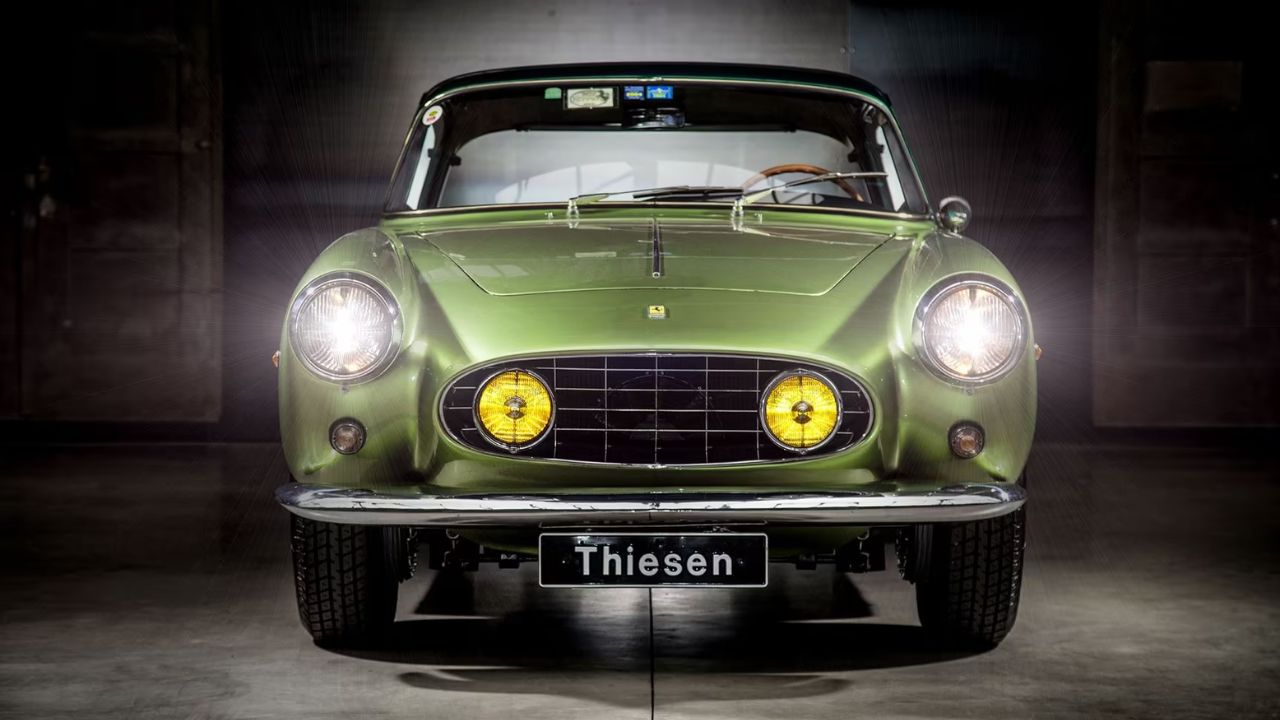
- Why does it prove timeless beauty? Its Pininfarina coachwork and three-liter Colombo V-12 set the template for every Ferrari grand tourer that followed.
Produced from 1958 to 1960, the 250 GT Coupé packed 240 hp from its Colombo V-12, and period figures are typically around 230 km/h (about 143 mph), depending on specification and testing. Its Pininfarina-designed coachwork, designed by Pininfarina, combines race-bred pedigree with civilized comfort, featuring leather-trimmed seats and accommodating two-plus-two passengers.
Only about 350 of the earliest coachbuilt examples exist, making them concours-prize rare. Spot one slicing coastal highways today, and you’re witnessing automotive poetry in motion.
Mercedes-Benz 300 SL Gullwing: The Winged Wonder

- Why does it prove timeless beauty? It was the world’s fastest production car upon its 1954 debut, and its upward-swinging doors remain a design showstopper.
The 300 SL borrowed its tubular space frame and fuel-injected 3.0-liter inline-six, clocking a record speed of 161 mph for a road car. Engineers raised their door sills to stiffen the chassis, then invented gullwing doors so owners wouldn’t need contortionist skills to enter.
Hollywood royalty and oil sheiks alike posed beside those flared fenders, turning magazine covers into instant icons. Nearly seven decades later, it still commands jaw-dropping admiration at every car event.
Aston Martin DB5: The Spy Car Legend

- Why does it prove timeless beauty? It defined British elegance on screen when James Bond drove it in Goldfinger with flawless cinematic flair.
Built from 1963 to 1965, the DB5’s 4.0-liter straight-six produced 282 bhp and sent it to 145 mph, plenty for 007’s errands in style. Carrozzeria Touring Superleggera’s Superleggera body features hand-formed aluminum panels wrapped around a tubular frame, offering both strength and feather-light agility. Inside, leather seats reclined while wood trim gleamed under cabin lights, beckoning secret-agent daydreams.
1,059 originals were built at Newport Pagnell, and their screen debut cemented them as the world’s most famous Bond gadget.
Porsche 911: The Enduring Icon

- Why does it prove timeless beauty? Its rear-engine layout and fastback silhouette have evolved over sixty years, yet remain instantly recognizable in any era.
Unveiled at the 1963 Frankfurt Motor Show as the 901 before Peugeot nudged it to 911, its air-cooled flat-six kicked out 130 PS while topping 210 km/h, impressive for a new sports car. Ferdinand Alexander Porsche’s original design laid the groundwork for over 1.2 million units built across eight generations.
Round headlights, a sloping roofline, and 2+2 seating remain the recipe for purity and performance. Today, a modern 911 still feels like driving automotive history with light-speed response and a grin-inducing exhaust note.
Maserati 3500 GT: The Italian Vision

- Why does it prove timeless beauty? It was Maserati’s first true grand tourer built in series production, marrying race-bred straight-six power with Pininfarina flair.
Launched in 1957, the 3500 GT carried a 3.5-liter Tipo 101 inline-six pushing 220 PS across a 2,846 lb chassis. Touring’s Superleggera aluminum coachwork wrapped slender curves around a steel tube frame for exotic looks and light handling.
Around 2,226 units rolled out by 1964, setting Maserati on a course toward luxury-performance icons. Spot one at a concours, and you’ll swear you’ve stepped into an Italian film set from the sixties.
Chevrolet Corvette Sting Ray: The American Dream

- Why does it prove timeless beauty? Its split-window roof and shark-nose lines captured 1960s optimism and hot-rod culture in one striking package.
The 1963 C2 Sting Ray introduced hidden headlamps and a fastback roof that was so aerodynamic, it looked ready to breach time itself. Its weight-saving fiberglass body and small-block V8 pushed it to mid-six-second 0–60 mph times, respectable for Detroit’s first true sports car.
Convertible or coupe, it became a symbol of freedom and jukebox rock ’n’ roll riding on four wheels. Today, collectors still crowd swap meets, hunting for fiberglass bits and dyno charts from the original small-block era.
BMW 507: Teutonic Elegance

- Why does it prove timeless beauty? With just 252 built from 1956 to 1959, it remains BMW’s rarest production roadster and one of the most valuable cars ever made.
Albrecht von Goertz’s sleek aluminum body over a shortened BMW 503 chassis weighed just 2,932 lb and housed a 3.2-liter V8 blooming 150 PS, good for 122 mph in 11.1 seconds flat. Max Hoffman urged BMW to build an American-style cruiser, but it proved too costly at $10,500, when buyers expected $5,000.
Elvis Presley bought two anyway, and one imagines the King serenading his car stereo in full denim glory. Today, a single BMW 507 can fetch well into seven figures.
Lamborghini Miura: The Supercar Pioneer

- Why does it prove timeless beauty? It was the world’s first mid-engine production supercar, sparking a revolution in exotic car design.
Debuting at Geneva in 1966, the Miura’s transverse 3.9-liter V12 belted out 350 PS through a Bertone body so low it barely cleared speed bumps. Marcello Gandini’s sculpture on wheels hit 170 mph and shattered notions of supercar layout, with the engine behind the seat, not in front.
Production is commonly cited as 763 total: 275 P400, 338 P400 S, and 150 SV, making it rarer than most museum pieces. Its slatted rear deck and eyelash-framed headlights remain the ultimate Lamborghini calling card.
Rolls-Royce Silver Cloud II: The Ultimate Gentleman Cruiser

- Why does it prove timeless beauty? Its 6.2-liter V8 boosted torque and quiet luxury yet retained the Silver Cloud’s noble presence.
Built from 1959 to 1962, the Cloud II carried a 380-cu-in V8 under a John Blatchley-penned body, measuring 5,410 mm in length and weighing 2,108 kg, luxury at a stately pace, with a top speed of 114 mph. Power steering became standard, and coachbuilders like Mulliner crafted bespoke drophead coupes for jet-set aristocrats.
Riding on semi-elliptic leaf springs and a wool carpet, it felt more like a Rolls-Royce lounge than an automobile corridor. Collectors prize its blend of old-world craftsmanship and ample torque for effortless motorway cruises.
Ford GT40: The Le Mans Conqueror

- Why does it prove timeless beauty? Its 7.0-liter V8 mid-engine layout silenced Ferrari’s dynasty with four straight Le Mans wins starting in 1966.
Born from Henry Ford II’s vow to beat Ferrari, the GT40 stuffed a 427 cu in V8 behind the driver and drove to 200 mph on Mulsanne Straight. About 105 GT40s were produced in total (all variants). The road-legal version was the Mk III, with only seven built, making it rarer than a primo Le Mans truffle.
Its 40-inch height gave it the name and jet-fighter proportions; picture Spielberg’s grainy footage of its low silhouette chasing Porsches at dawn. A 1-2-3 finish at that ’66 race proved that brute Ford horsepower and British chassis nimbleness could rewrite racing history.
Ford Thunderbird: The Original Personal Luxury

- Why does it prove timeless beauty? It kicked off the personal luxury segment in 1955, blending sporty flair with upscale appointments.
Introduced as a two-seat convertible with a 4.8-liter V8, the T-Bird was not marketed as a pure sports car but as a personal cruiser, complete with comfort-focused features and a removable hardtop. In 1955, it outsold the Corvette by more than 23 to 1 (16,155 Thunderbirds vs. 700 Corvettes), proving Americans craved comfort with a sporty dash.
In 1958, it added a rear seat and tailfins, expanding its role as the “cool parent” of luxury coupes. Decades later, its porthole window and snorkel hood remain enduring design cues for personal luxury cars.
Wrapping Up the Legacy of Timeless Design

From the nomadic heavyweights of war to the sleek curves of Italian and British roadsters, these twelve icons prove that automotive beauty never fades. Each entry blends form and function into timeless art on wheels, whether roaring past a pit lane or prowling a coastal highway.