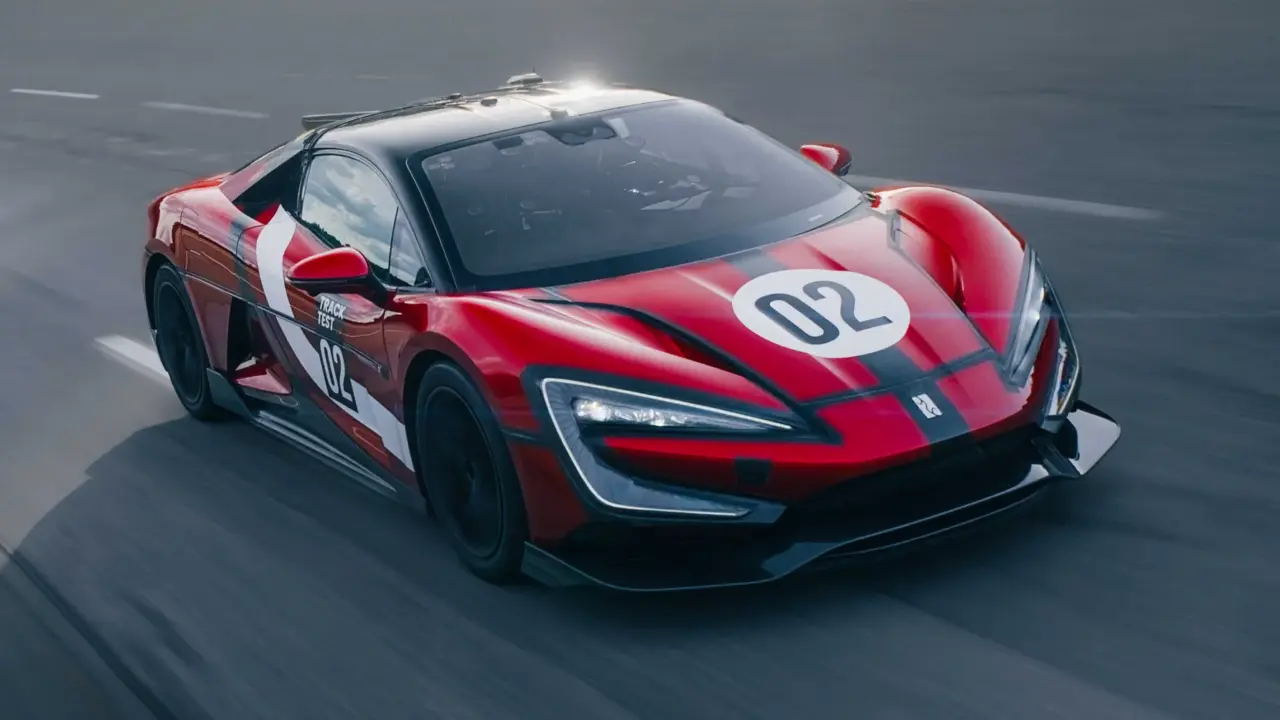
Don’t get me wrong: what BYD’s Yangwang U9 Xtreme just accomplished is absolutely mind-blowing. Three hundred and eight point four miles per hour. That’s faster than most small aircraft take off. That’s nearly five miles per minute. That’s the kind of speed that makes you question whether we’re building cars or guided missiles with license plates.
But here’s the thing: I can’t shake the feeling that we’ve officially jumped the shark.
Yes, I’m impressed. How could I not be? The engineering behind cramming 2,978 horsepower into a road-legal vehicle is nothing short of miraculous. Four electric motors spinning at 30,000 rpm, a 1,200-volt electrical system that could probably power a small town, and battery technology so advanced it makes a Tesla look like a Model T. The German test driver Marc Basseng deserves a medal just for having the stones to point this thing down a track and floor it. One car enthusiast even said on YouTube: “Cannot deny, electric or not, that is seriously impressive.”
But let’s be honest here…
Who Exactly Is This For?
I’ve been driving for a while now, both through the city of Los Angeles and on tracks, and I can count on one hand the number of times I’ve had the opportunity to safely exceed 100 mph, let alone 308. Unless you live next door to the Bonneville Salt Flats or have a private runway in your backyard, this kind of speed is about as useful as a submarine with screen doors.
Even Germany’s famed Autobahn – the holy grail of unrestricted driving – has speed limits on most sections these days. The few remaining unlimited stretches are typically so crowded that hitting 150 mph requires the patience of a saint and the timing of a Swiss watchmaker. Good luck finding a 10-mile stretch where you won’t encounter a semi-truck, construction zone, or soccer mom in a Passat doing exactly the speed limit in the left lane.
And that’s assuming you can actually use this speed. At 308 mph, you’re covering 452 feet per second. That’s the length of one and a half football fields every single second. Your reaction time better be superhuman, because at that speed, spotting trouble and doing something about it becomes a mathematical impossibility rather than a driving skill.
Here’s what really gets me: while we’re busy building rockets masquerading as cars, the actual driving experience – you know, the thing that made us fall in love with automobiles in the first place – seems to be getting lost in the horsepower wars.
I’d rather have a car that can dance through a mountain pass at 45 mph than one that can hit 308 on a closed course I’ll never see. Give me precise steering that talks to me through the wheel. Give me a suspension that can read the road like braille and react accordingly. Give me an engine note that stirs something primal in my chest – whether it’s the growl of a V8 or the sophisticated whir of a well-tuned electric motor. Okay, not yet, not yet.
The best driving experiences I’ve had weren’t about straight-line speed. They were about finding that perfect balance point in a corner, feeling the car compress and release over a hill crest, or threading the needle through a series of S-curves with mechanical precision. You can have those moments in a Miata just as easily as in a hypercar; maybe more easily, since you’re not terrified of wadding up a quarter-million-dollar investment.
Don’t even get me started on the practicality aspect. The U9 Xtreme weighs 5,467 pounds – that’s more than two Honda Civics. It’s limited to just 30 examples worldwide, probably costs more than most people’s houses, and requires tires that likely need replacing after looking at them wrong. Meanwhile, the “regular” U9 with its measly 1,288 horsepower sits around doing absolutely nothing that a well-sorted sports car couldn’t accomplish for a fraction of the price.
But Okay, It’s Still Cool

I’m not trying to rain on anyone’s parade here. The technological achievement is genuinely remarkable, and I respect the engineering prowess required to make this happen safely. The advances in battery technology, power management, and aerodynamics will undoubtedly trickle down to benefit regular cars that regular people actually drive. BYD loves to take things to the extreme.
But somewhere along the way, we’ve lost the plot. We’ve become so obsessed with the numbers game that we’ve forgotten what makes driving special in the first place. It’s not about having bragging rights at the local car meet. It’s about the connection between human and machine, the satisfaction of executing a perfect heel-toe downshift, the joy of finding that empty back road on a Sunday morning.
The most fun I’ve had behind the wheel recently was in my ’93 Miata that can barely hit 80 mph if you shut off the AC. No fancy electronics, no four-figure horsepower numbers, no top speed that requires a physics degree to comprehend. Just a well-balanced chassis, a willing engine, and roads that begged to be explored. I probably never exceeded 70 mph, and I had an absolute blast.
That’s what we should be chasing – not some arbitrary speed record that serves no purpose beyond flexing engineering muscles. Instead of asking “How fast can we go?” maybe we should be asking “How good can we make the experience of actually driving?”
Because at the end of the day, 308 mph is just a number on a press release. But the feeling of a car that responds to your inputs like an extension of your own body? That’s something you can enjoy every time you turn the key.
Even if you never go faster than the speed limit.