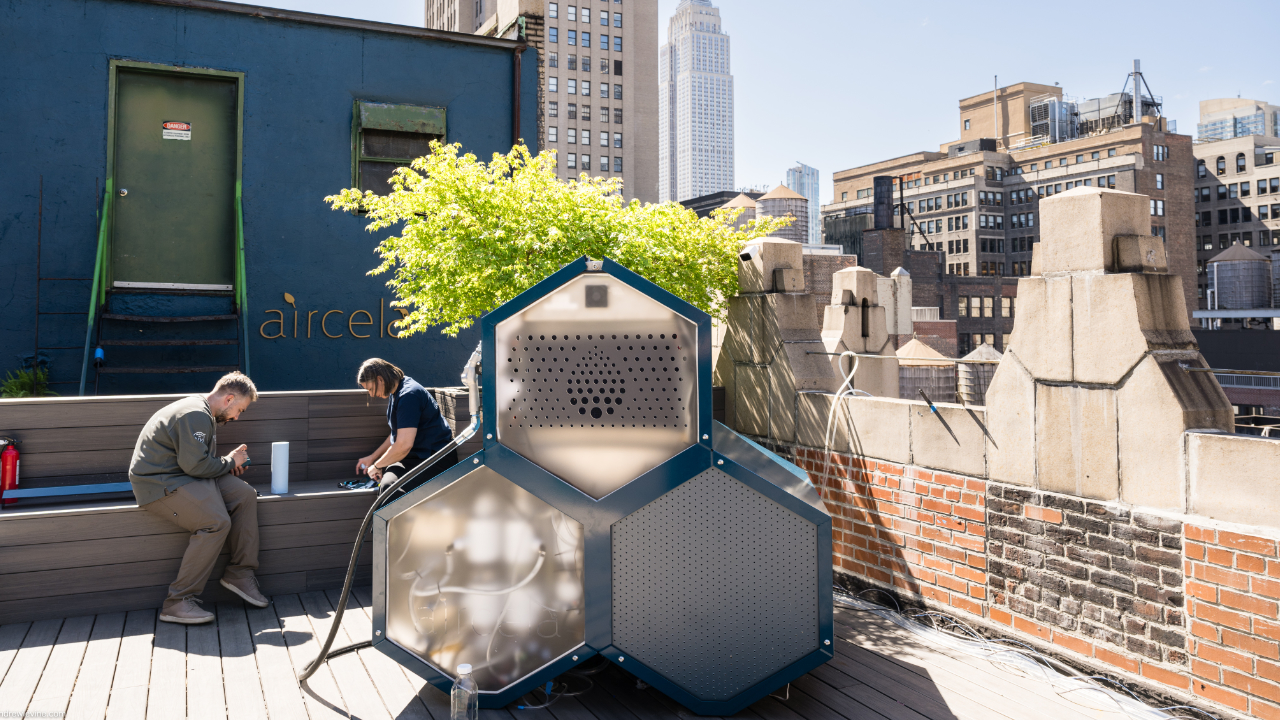
In the middle of Manhattan’s Garment District, a compact machine is quietly pulling carbon dioxide from the atmosphere and turning it into real, engine-ready gasoline. It’s not a science experiment or a distant concept: it’s already working. Unveiled by New York–based fuels company Aircela, the refrigerator-sized unit made its public debut during a rooftop demonstration on May 20, producing gasoline on-site and in real time.
Aircela’s technology combines two complex processes — direct air capture and fuel synthesis — into one modular system. It draws CO₂ directly from ambient air, adds hydrogen extracted from water using renewable electricity, and synthesizes the two into clean fuel. The result is gasoline that’s free from fossil inputs, sulfur, ethanol, or heavy metals, and fully compatible with any standard combustion engine. No vehicle modifications are required.
“We didn’t build a prototype. We built a working machine,” said Eric Dahlgren, Aircela’s co-founder and CEO. “We want people to walk away knowing this isn’t too good to be true—it actually works.”
A New Path to Decarbonization—Without New Infrastructure

What sets Aircela apart from larger-scale synthetic fuel ventures is its radically different approach. Instead of centralized megaprojects, the company has focused on making its tech small, scalable, and deployable anywhere. The machines are designed to support off-grid, residential, commercial, and industrial sites, bringing fuel production directly to the point of use.
Aircela’s drop-in fuel approach offers a practical way to reduce emissions without overhauling global infrastructure. With over 90% of vehicles worldwide still running on fossil fuels, the company sees its system as a bridge technology: something that meets the moment without requiring drivers to change habits or buy new vehicles.
The project builds on decades of research from physicist Dr. Klaus Lackner, a pioneer of direct air capture, who joined Aircela’s demonstration to walk attendees through the science, marking a milestone for a vision that’s been years in the making.
Investor Confidence Grows
The machine’s debut drew a crowd that included New York City Councilmember Erik Bottcher, State Energy Chairman Richard Kauffman, and several early investors. Among them was Karl Dums, former Senior Project Lead of eFuels at Porsche AG, who admitted he was initially skeptical.
“When I first spoke with Eric, I told him, ‘I wish you all the success in the world, but I can’t believe this is going to work.’ Fortunately, I was wrong,” Dums said. “I’m convinced this marks the beginning of a long and important journey—one whose impact is still vastly underestimated today.”
Shipping giant Maersk, through its venture arm Maersk Growth, also sees long-term potential in Aircela’s model. Morten Bo Christiansen, the company’s head of energy transition, said they invested because of the machine’s ability to produce low-emission fuel using direct air capture. “We now look forward to seeing Aircela scale and reduce cost, paving the way for what will hopefully become the transition of Maersk from investor to customer.”
What Comes Next
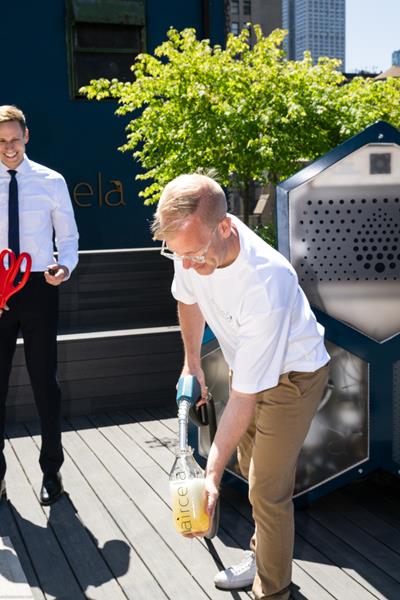
Aircela plans to begin scaling production this summer, with initial deployments expected to roll out later this fall. The company, founded in 2019 by Mia and Eric Dahlgren, is backed by investors including Ripple founder Chris Larsen, ExxonMobil board member Jeff Ubben, and Maersk Growth.
If the machine’s rooftop debut is any indication, it may be the beginning of a very different kind of energy revolution — one that starts small, but aims high.