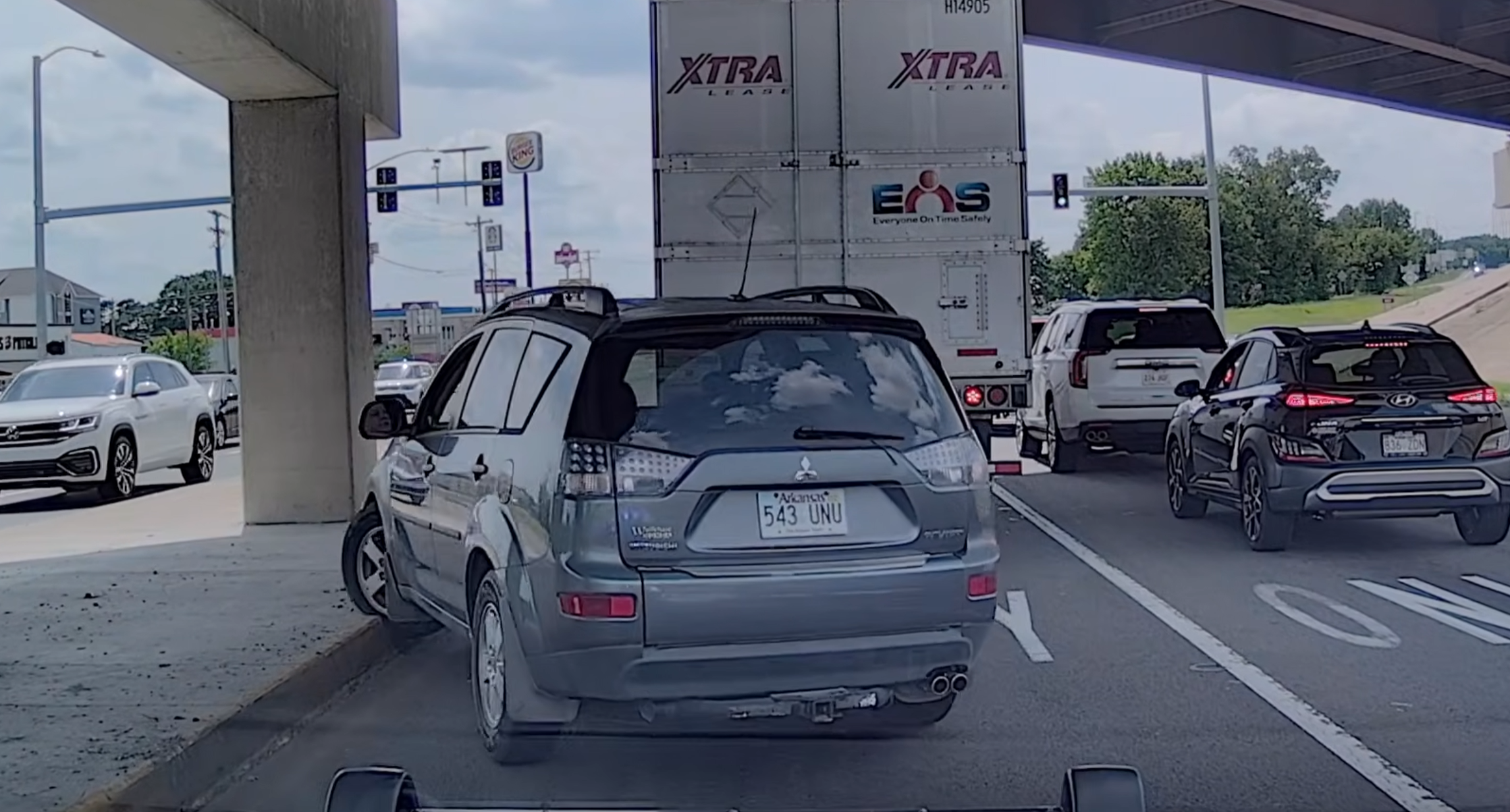
A lot of police pursuits start with something mundane, a broken taillight, an expired tag, maybe a rolling stop. This one started with a trooper clocking a gray SUV doing 86 miles per hour in a 55 zone while the driver appeared to be holding either a baby or a small dog. It was, in fact, a dog. What followed was several miles of reckless driving through residential speed zones, a run through a red light, an SUV driven across a concrete median into oncoming traffic, and ultimately a tactical vehicle intervention that brought the whole circus to a stop.
The incident happened on June 3 in Conway, Arkansas, when Arkansas State Police Trooper Tyler Ryals spotted the SUV southbound on U.S. Highway 65, swerving into the center turn lane and blowing past other vehicles. Radar confirmed 86 in a 55. Ryals turned around and caught up near Pickles Gap, where he got close enough to confirm the driver was indeed steering with a dog in her arms, not a child. He activated his emergency equipment. She did not stop.
The driver, 51-year-old Leah L. Taylor, allegedly responded to the trooper pulling alongside her by making obscene gestures and continuing south. As the pursuit moved deeper into Conway and the speed limit dropped from 55 to 45 and then to 35 mph, Taylor allegedly kept pace well above the posted limits, ran a red light, changed lanes erratically, and eventually crossed a concrete median into oncoming lanes near the Interstate 40 eastbound entrance before merging onto the ramp. At that point, Trooper Ryals performed a tactical vehicle intervention, ending the pursuit.
Taylor was taken into custody without a struggle. Investigators then learned the SUV she had been driving did not belong to her. It belonged to her mother, who arrived on scene, collected the vehicle, and took the dog with her. Taylor was booked at the Faulkner County Sheriff’s Office on charges including felony fleeing while exceeding the speed limit, reckless driving, unauthorized use of a vehicle, failure to wear a seat belt, and disorderly conduct. Bond was set at $40,000. All charges remain allegations at this stage; Taylor is presumed innocent until proven guilty in a court of law.
What the Charges Actually Mean
The felony fleeing charge is the one that carries real weight here. In Arkansas, fleeing from law enforcement while exceeding the speed limit is a Class D felony, which carries up to six years in prison. It is a step up from misdemeanor fleeing and applies specifically when the suspect was driving at unlawful speeds during the pursuit, which, given that radar clocked her at 86 mph before the chase even started, would appear to be well established.
Reckless driving on top of that adds another layer, particularly given the median crossing into oncoming traffic, which is the kind of thing that tends to stand out in a charging document.
How the Tactical Vehicle Intervention Works
The tactical vehicle intervention, commonly called a TVI or PIT maneuver depending on the agency, is a technique in which a pursuing officer uses their vehicle to contact the rear quarter panel of a fleeing vehicle, causing it to lose directional control and spin out. Done at lower speeds on a straight road with enough room, it is a controlled and reasonably predictable way to end a pursuit without a prolonged chase.
Arkansas State Police troopers train extensively on the maneuver and use it fairly regularly, which is part of why ASP dashcam footage of TVIs has become a recognizable genre of its own online. The maneuver is not without risk, but it is generally considered far safer than allowing a pursuit to continue indefinitely through populated areas.
The Unauthorized Use Angle
One detail in this story that deserves a second look is the unauthorized use charge. Taylor allegedly took the SUV from her own mother without permission, which puts it in that legally complicated but all-too-familiar category of family vehicle disputes. Unauthorized use of a motor vehicle in Arkansas is a Class
A misdemeanor when the vehicle is taken without intent to permanently deprive the owner of it, though circumstances can elevate the charge. The fact that the owner, Taylor’s mother, showed up at the scene to retrieve both the vehicle and the dog suggests the relationship between the parties is, at minimum, complicated.
Why Pursuit Policies Are Always Being Debated
Incidents like this one inevitably reopen the conversation about when and whether police should pursue fleeing vehicles. The argument against aggressive pursuit policies centers on the risk to uninvolved people in traffic, pedestrians, and bystanders. The argument for them is that a no-pursuit policy effectively tells anyone willing to hit the gas that they can escape any traffic stop they choose.
Arkansas State Police operates under a policy that permits pursuit when officers believe the fleeing suspect poses a greater danger to the public than the pursuit itself, a judgment call that Trooper Ryals had to make in real time.
Given that Taylor was already driving 86 mph in a 55 zone while holding a dog before she even knew she was being followed, that calculus was probably not difficult.