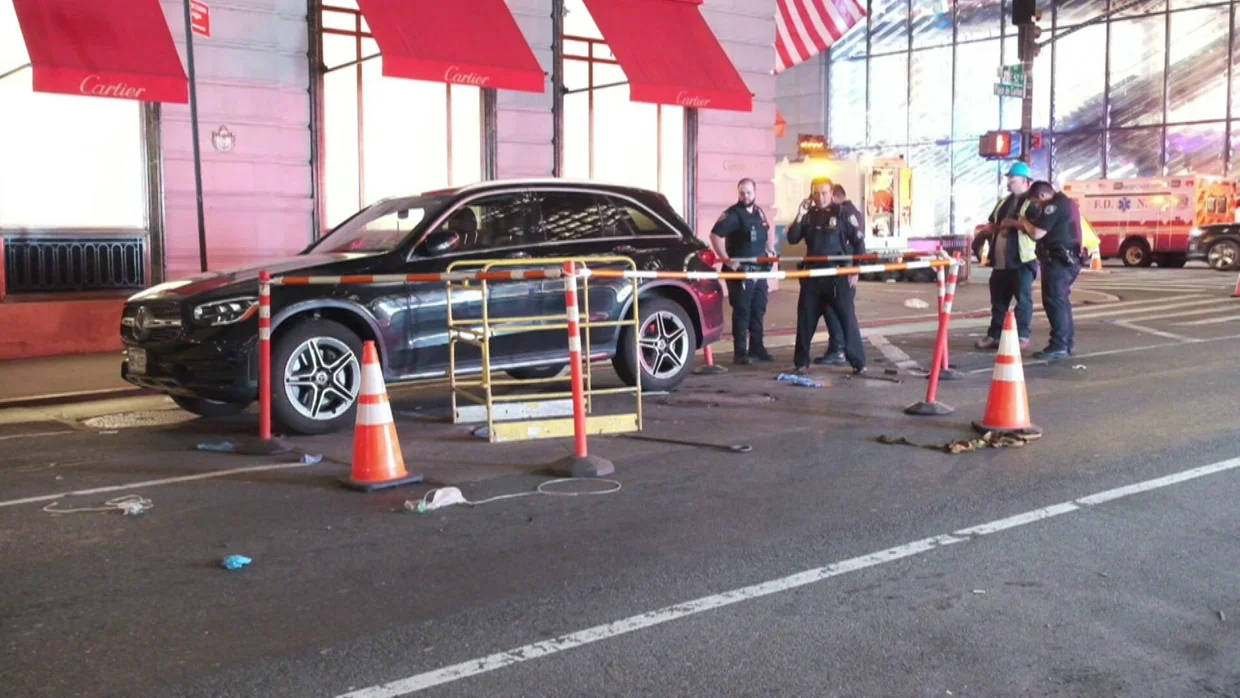
A tragic and shocking accident in the heart of Midtown Manhattan has left a family grieving and a city asking serious questions about who is responsible for keeping pedestrians safe from the dangers literally lurking beneath their feet.
On the night of Monday, May 18, 2026, at approximately 11:19 p.m., 56-year-old Donike Gocaj of Briarcliff Manor, New York, stepped out of her car near 52nd Street and Fifth Avenue. She took one step forward and vanished. Not into a crowd, not around a corner. She dropped straight down into an open Con Edison manhole, plunging 10 feet into a utility vault below street level. Witness Carlton Wood, who was nearby and watched the whole thing unfold, described the moment with chilling simplicity: she closed the car door, took a step, and just disappeared.
Emergency responders arrived to find Gocaj unconscious at the bottom of the shaft. Footage from the scene captures the FDNY executing a full ladder rescue operation to extract her from the hole. She was rushed to New York Presbyterian Hospital, but it was too late. Gocaj was pronounced dead, leaving behind a son, a daughter, and two grandchildren.
What makes this tragedy even harder to process is how preventable it appears to have been. According to Gocaj’s daughter-in-law, there were no cones, no warning tape, no barriers, and no signs of any kind around that open hole in the ground. For a city as densely populated as New York, a completely unmarked, uncovered pit in the middle of a busy street at night is not just an oversight. It is a disaster waiting to happen.
What Caused the Manhole to Be Left Uncovered?
Con Edison, the utility company responsible for the manhole, has offered an explanation. According to a spokesperson, company-reviewed surveillance footage indicates that a truck turning onto 52nd Street drove over the manhole cover and dislodged it. Approximately 12 minutes later, Gocaj parked her car nearby and stepped directly into the now-open shaft.
The utility acknowledged that heavy vehicles can displace manhole covers, though they called it a rare occurrence. The 12-minute window between the cover being knocked loose and Gocaj stepping out of her car is a detail that raises uncomfortable questions. Was anyone monitoring the area? Did any passersby notice? Could anything have been done in that window of time?
Con Edison said it is reviewing the full details of the incident. The NYPD has stated that no criminality is suspected and that the investigation remains ongoing.
NYC Rules Exist for Exactly This Reason
New York City has regulations specifically designed to prevent this kind of accident. The rules are clear: manholes must either be covered or surrounded by clear barriers that prevent accidental access. The reasoning is obvious. A 10-foot-deep open hole on a busy city sidewalk or street is an immediate public hazard.
Attorney Christopher J. Gorayeb, speaking about the incident, noted that the rules require covers to be placed and secured in a way that prevents them from being accidentally removed or dislodged. He also pointed out something that should give everyone pause: this kind of accident is not as rare as people might assume in New York City. The infrastructure beneath the streets of a city this old and this dense is a constant maintenance challenge, and when something goes wrong up top, the consequences can be deadly.
Gocaj’s family visited the scene the following morning, hugging each other and trying to make sense of an unthinkable loss.
What We Can Learn From This Incident
Wood, the witness who called 911 and watched as bystanders tried desperately to help using a short ladder that did not reach far enough, put it plainly: “She wasn’t in her phone. She wasn’t distracted. There weren’t protective things around this hole. This could have happened to me.”
That line should land hard. This was not someone being careless. She got out of a car. She took a step. The sidewalk swallowed her.
There are a few things this incident highlights clearly. First, utility companies need faster systems for detecting and responding to displaced manhole covers. A 12-minute gap before someone fell in is not just unlucky, it is a systemic vulnerability. Second, city inspection and alert systems should be robust enough to catch these situations in real time, especially in high-traffic areas like Midtown Manhattan. Third, accountability matters. Someone owns that manhole, and with it comes a responsibility to keep the public safe.
For everyday New Yorkers and visitors, this is also a reminder that city streets, especially at night, can hide hazards in plain sight. Gocaj’s death is a devastating loss for her family, but it is also a moment that should push the city and its utility companies to take a hard look at how these situations are monitored and how quickly they can be addressed before someone else pays the same price.