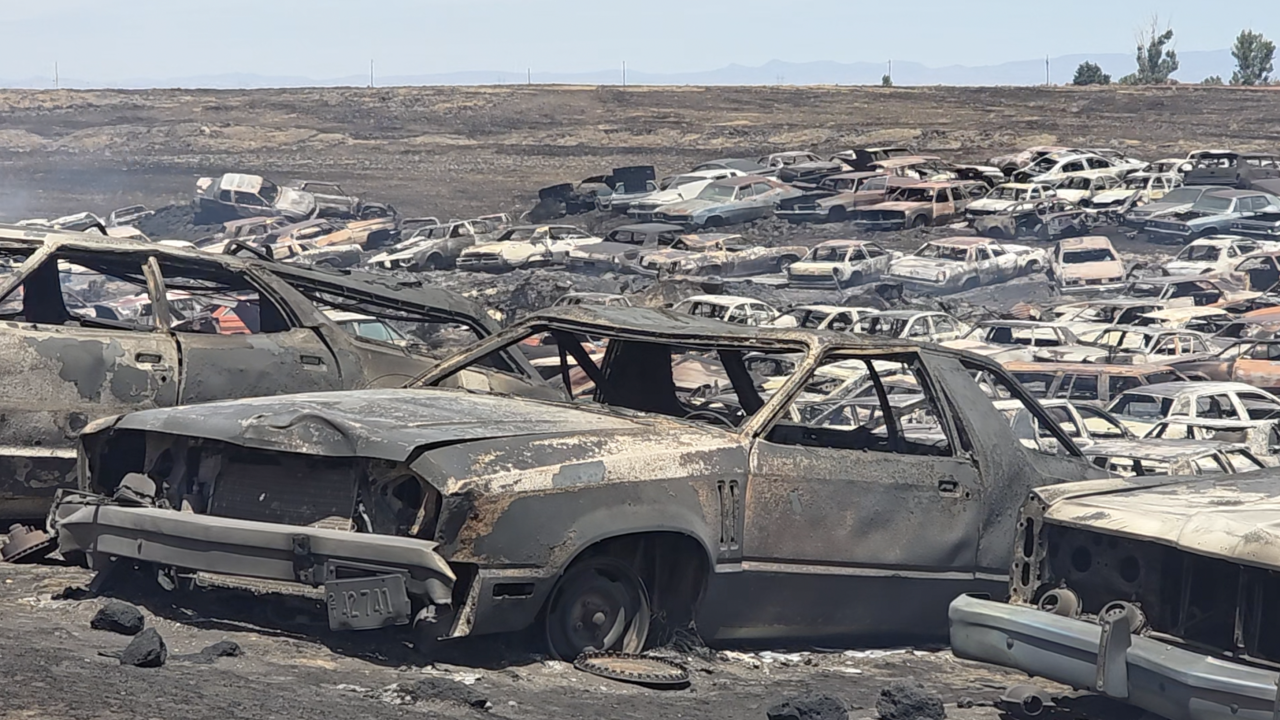
A wind-driven wildfire in southern Idaho didn’t just burn acreage last Wednesday. It walked straight through the inventory of one of the region’s oldest family-run salvage operations and left almost nothing standing.
The Median Fire tore through Gooding County near Wendell, Idaho, with enough speed and fury to overwhelm L&L Classic Auto before crews had any real chance to intervene. The yard, which had been accumulating vehicles since the 1960s, held an estimated 10,000 cars at the time. By Thursday morning, roughly 9,000 of them were gone. So was the business office. So were all of the records. A newly built tow shop didn’t make it either.
Manager Jesse Johnson, who has run the operation for years under owner Larry Harms, described having to make a split-second decision to escape as the fire closed in on Highway 46. Visibility collapsed. He couldn’t breathe. He spotted a turn, took it, pushed through open desert in a rollback truck, and got out. It’s the kind of story that sounds cinematic until you remember what he drove back to the next morning.
What makes this more than a local fire story is the financial structure, or lack of one, sitting underneath it all. Johnson was candid about the insurance situation: covering a field full of junk cars is, in practical terms, not something the industry accommodates well. The policy L&L managed to hold barely covered the building itself, not the inventory. So a yard that spent six decades building a stockpile of parts, panels, and donor vehicles is now looking at losses with essentially no financial backstop.
A Six-Decade Inventory, Gone in an Afternoon
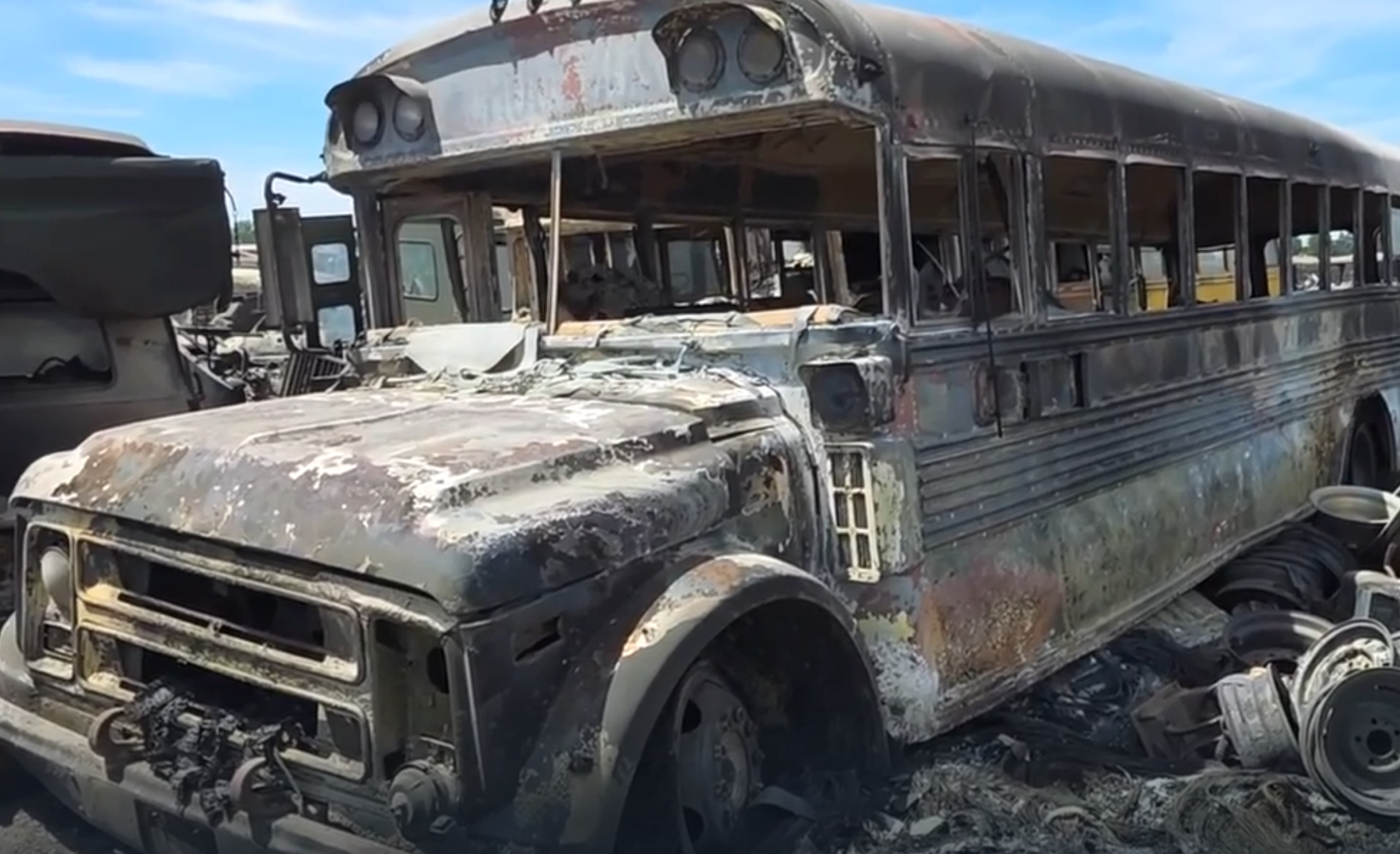
Salvage yards like L&L don’t happen overnight. They accumulate over generations, car by car, with vehicles arriving as donations, insurance write-offs, trade-ins, and purchases. Ten thousand cars represent decades of towing, cataloging, stripping, and storage. The parts supply chain that independent mechanics and restoration hobbyists depend on is built on yards exactly like this one.
Losing 9,000 vehicles in a single afternoon is not just a property loss. It’s the erasure of an inventory that cannot be reconstructed quickly, if at all.
Why Salvage Yards Are Nearly Uninsurable
This is a detail that gets glossed over in most fire coverage, but it matters. Standard commercial property insurance does not extend easily to open-lot vehicle inventory. Carriers view large quantities of stored, non-operational vehicles as a compounded liability: fuel, fluids, batteries, and combustible materials sitting close together across acres of land. Premiums for salvage operations have climbed steadily, and the coverage that survives the underwriting process often protects structures rather than stock.
L&L’s policy, according to Johnson, covered the building to a limited extent. The cars themselves were effectively uninsured.
The Human Side of the Loss
Johnson mentioned that L&L’s owner, Larry Harms, is 90 years old. Getting him to fully absorb what happened is its own challenge. Johnson’s words about Harms were direct and hard to shake. There’s something particularly difficult about watching a business that someone spent their working life building disappear in a single afternoon, especially at an age when rebuilding from zero isn’t a realistic option.
Johnson himself struck a pragmatic tone the morning after, even as he acknowledged he’d gone home hoping it was a bad dream. His position was clear: put your boots on and see what’s salvageable. That kind of attitude is easy to admire and hard to sustain when the scale of the loss is this significant.
The Broader Fire Damage in Gooding County
L&L wasn’t the only operation hit. The Gooding County Transfer Station, located directly across the highway, lost its administrative building in the same fire. That facility remained closed as of Thursday while crews worked to assess the full scope of the damage. The Median Fire itself peaked at more than 8,600 acres before crews got forward progress stopped by Thursday morning, helped in part by winds finally settling down.
For a region where agricultural operations and small family businesses form the backbone of the local economy, a fire of this size and speed is not a minor weather event. It is, in the plainest terms, a multi-generational setback for at least one business that has no obvious path back.