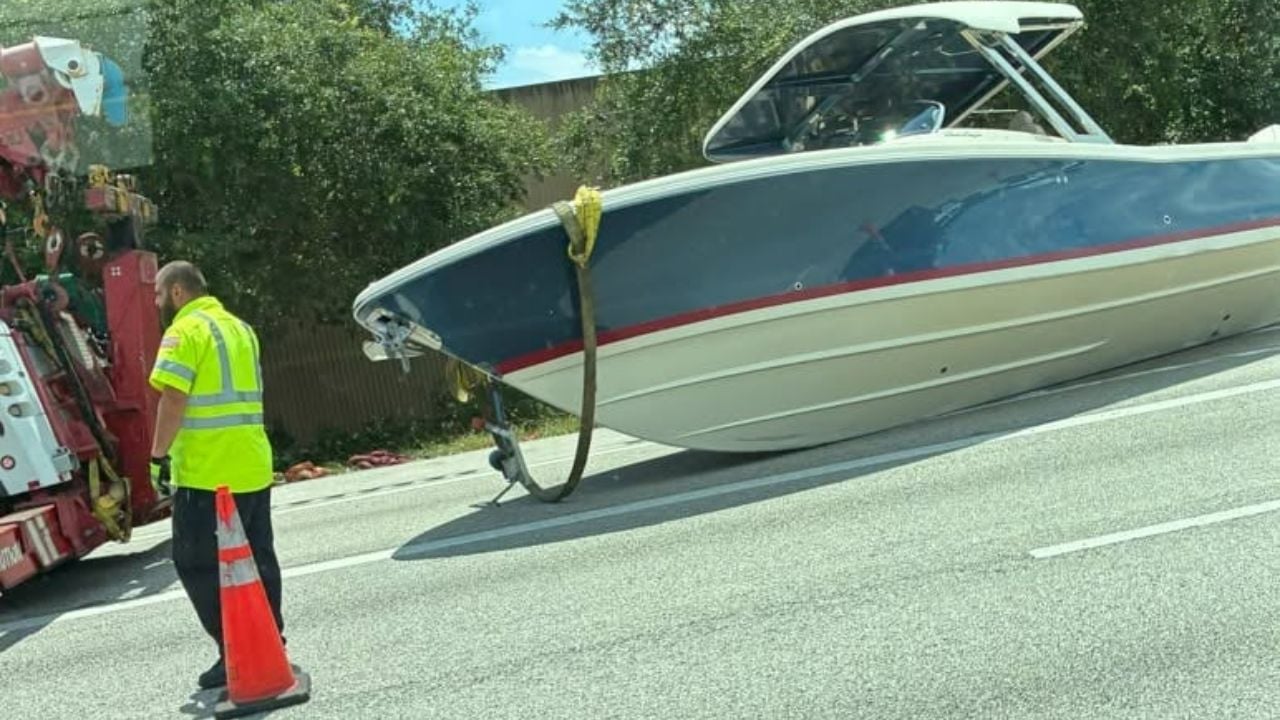
South Florida drivers heading north on I-95 near Palm Beach County got a surprise they weren’t expecting Tuesday morning: a fishing boat sitting on the highway where cars are supposed to be. The vessel wound up on the roadway near the Lantana Road exit, Exit 61, after a 10:20 a.m. crash that shut down two lanes and the off-ramp right lane, creating the kind of backup that reminds everyone just how little it takes to unravel traffic on one of the country’s busiest interstates.
Florida 511 logged the incident and nearby traffic cameras confirmed what first responders were dealing with when Palm Beach County Fire Rescue units arrived on scene. A boat, presumably being towed by a vehicle, separated from its trailer and came to rest in a place boats absolutely do not belong: a major highway off-ramp during mid-morning traffic. Whether it was a hitch failure, a coupling that was never properly secured, or something more dramatic involving the tow vehicle itself, the result was the same. The conditions and identities of the motorists involved had not been released as of the time of this report.
This is not a new phenomenon on I-95 in Florida, but it never gets less jarring to see. The corridor between Palm Beach County and Broward is a well-traveled route for boaters hauling vessels to and from the ocean and the Intracoastal, and the Lantana area specifically sits just minutes from public launch ramps and marinas. On any given morning, you will see pickup trucks hauling bass boats, center consoles, and flats skiffs heading toward the water. Most of them make it. Some don’t.
The incident drew attention not just because of the traffic chaos it caused, but because it highlights an everyday risk that tends to get overlooked until something like this happens. Trailer towing safety is one of those areas where the gap between what drivers know they should do and what they actually do tends to be widest right before a fishing trip, when the focus is on the water and the checklist gets skipped.
What Happened on I-95 Near Lantana Tuesday Morning
The crash occurred at 10:20 a.m. on northbound I-95 near Exit 61 at Lantana Road in Palm Beach County. Two travel lanes and the right lane of the off-ramp were closed as first responders managed both the crash scene and the fishing boat left in the roadway. Nearby traffic cameras showed heavy congestion surrounding the scene, and motorists were urged to seek alternate routes or expect significant delays.
The conditions and identities of those involved had not been publicly released. Florida 511 tracked the incident in real time as crews worked to clear the scene.
Florida Is the Perfect Storm for Boat Towing Incidents
Florida has more registered boats than any other state in the country, with well over a million vessels on the books. That means there are a lot of boat trailers on Florida roads at any given time, and a lot of drivers with varying levels of experience behind the wheel of a truck with a few thousand pounds in tow. The I-95 corridor through Palm Beach County is particularly busy with marine traffic because of the density of boat ramps, marinas, and fishing access points throughout the area.
The Lantana Boat Ramp on the Intracoastal is a short hop from the exit involved in this crash, which makes it a natural waypoint for trailered boats heading out for a morning on the water.
Trailer Safety: Where Most Incidents Begin
Boat trailer incidents on highways almost always come down to a short list of preventable causes. A ball hitch that doesn’t match the coupler size is one of the most common. Safety chains that are attached but never really functional are another. Add in a coupler that wasn’t fully latched and locked, worn trailer tires that were never inspected before the season started, or wheel bearings that haven’t been serviced in years, and you have a recipe for exactly the kind of scene that materialized on I-95 Tuesday morning. The pre-departure checklist that most trailer manufacturers include in their documentation takes about five minutes to complete. It almost never gets completed in full when someone is in a hurry to beat the tide.
This is not an indictment of any particular driver. It is a description of human nature. The problem is that on a highway moving at 65 miles per hour, a boat that separates from a trailer becomes an immediate hazard for every driver in the vicinity. In a previous incident in Pompano Beach, a boat separated from its tow vehicle on I-95, cleared the concrete median, and landed in opposing lanes of traffic. A light pole came down. Two trucks were damaged. When a boat goes, it goes fast and it goes far.
What Drivers and Towers Should Take From This
If you tow a boat in Florida, and millions of people do, this incident is worth taking seriously as a reminder rather than a news curiosity. Safety chains need to be crossed under the tongue and connected to the tow vehicle with enough slack to allow turns, but not so much that they drag the pavement. The coupler needs to be fully seated on the ball and the latch needs to be physically confirmed, not assumed. Trailer lights need to work every single time, because the driver behind you needs to know what you are doing well before they need to react to it. Tires need to be at the correct pressure, and if the trailer has been sitting since last season, the bearings deserve attention before the first highway run.
For everyone else sharing the road with trailered boats, the takeaway is straightforward. If you are behind a vehicle towing a boat or any trailer on the highway, leave more space than feels necessary. A load that separates does not give you reaction time. It gives you a problem.