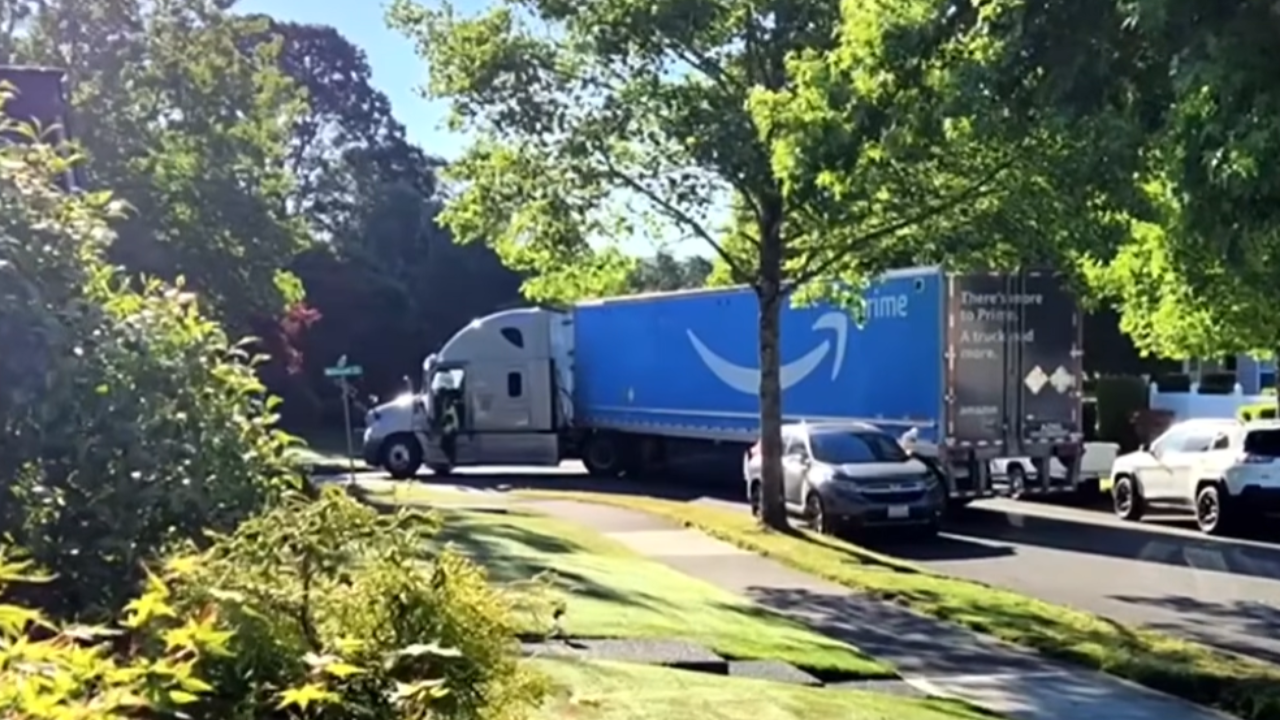
A neighborhood in DuPont, Washington, got more than it bargained for when construction rerouted commercial truck traffic onto narrow residential streets, and the GPS units guiding those rigs apparently did not get the memo that McDonald Avenue is not a freight corridor.
It started with a fairly routine road project. The city of DuPont temporarily closed the main truck route serving the nearby Amazon warehouse complex, and as part of that arrangement, drivers were permitted to use Center Street as an alternative for a few days. Somewhere in the handoff between municipal planning and navigation software, however, a different message went out entirely. Some GPS devices began routing heavy semi trucks through a residential neighborhood that has no business handling that kind of traffic, and what followed was the sort of chaos that tends to generate a lot of doorbell camera footage.
Resident Judy Norris described watching enormous semi trucks barrel down McDonald Avenue and get themselves trapped on corners, exactly the kind of scene that takes hours to untangle and leaves nearby parked cars worse for the wear. Multiple neighbors recorded the trucks on their phones, equal parts disbelief and outrage fueling their documentation efforts. The city has since acknowledged what happened, apologized, and installed no-truck signage throughout the area.
What makes this story stick around after the construction is finished and the signs go up is a detail that should give any fleet operator pause: even after the original route reopened, GPS systems continued sending some drivers back into the neighborhood. The construction excuse no longer applies. Something in the mapping data is still pointing big rigs down streets lined with kids on bikes and American flags, and that is a problem with a longer tail than a few days of roadwork.
When Navigation Software Meets Reality
The broader GPS misrouting problem is not unique to DuPont. Truckers and the municipalities dealing with them have been fighting this battle for years. Consumer navigation apps like Google Maps and Waze were not designed with 80,000-pound vehicles in mind, and even truck-specific routing tools have been known to produce directions that any experienced driver would refuse to follow.
The assumption that software will make sensible routing decisions on behalf of professional drivers has been stress-tested repeatedly, and it keeps failing in the same ways.
The Driver Responsibility Question
Neighbors raised a pointed observation after the incident: even granting that GPS sent these drivers down the wrong road, a seasoned truck driver should recognize trouble before committing to a turn. One resident noted the trucks were not slowing down or hesitating.
They were moving at speed, apparently trusting the device over their own windshield. There is an old rule of thumb in the industry: if you do not see a 13’6″ clearance cutout in the tree line, trucks have no business on that road. Eyes still matter, regardless of what the screen says.
What the City Is Doing About It
DuPont says it is now working with Amazon and other warehouse operators in the area to communicate clearer instructions to their drivers. The no-truck signs are installed and, according to at least one resident, appear to be having some effect.
Whether the mapping data itself gets corrected is a separate and slower process. Municipalities have to petition navigation platform providers directly to update routing restrictions, and those updates do not happen overnight.
Who Pays for the Damage
That question remains open. Residents with damaged vehicles are left navigating the gap between city liability, Amazon’s responsibility for its delivery contractors, and whatever insurance the trucking companies carry. When a GPS-guided 18-wheeler takes out a parked car on a street it had no business being on, accountability tends to diffuse quickly among a lot of parties who would each prefer it land somewhere else.
For the residents of McDonald Avenue, a peaceful summer has returned, but the bills from a few weeks ago have not gone anywhere.
There is a truck specifically GPS, but it is rather expensive!! It guides trucks on legal roads to avoid low weight bridges and low clearance bridges. It also avoids any roads that are weight restricted!! Many drivers don’t want to spend the extra money so they use a cheaper one.