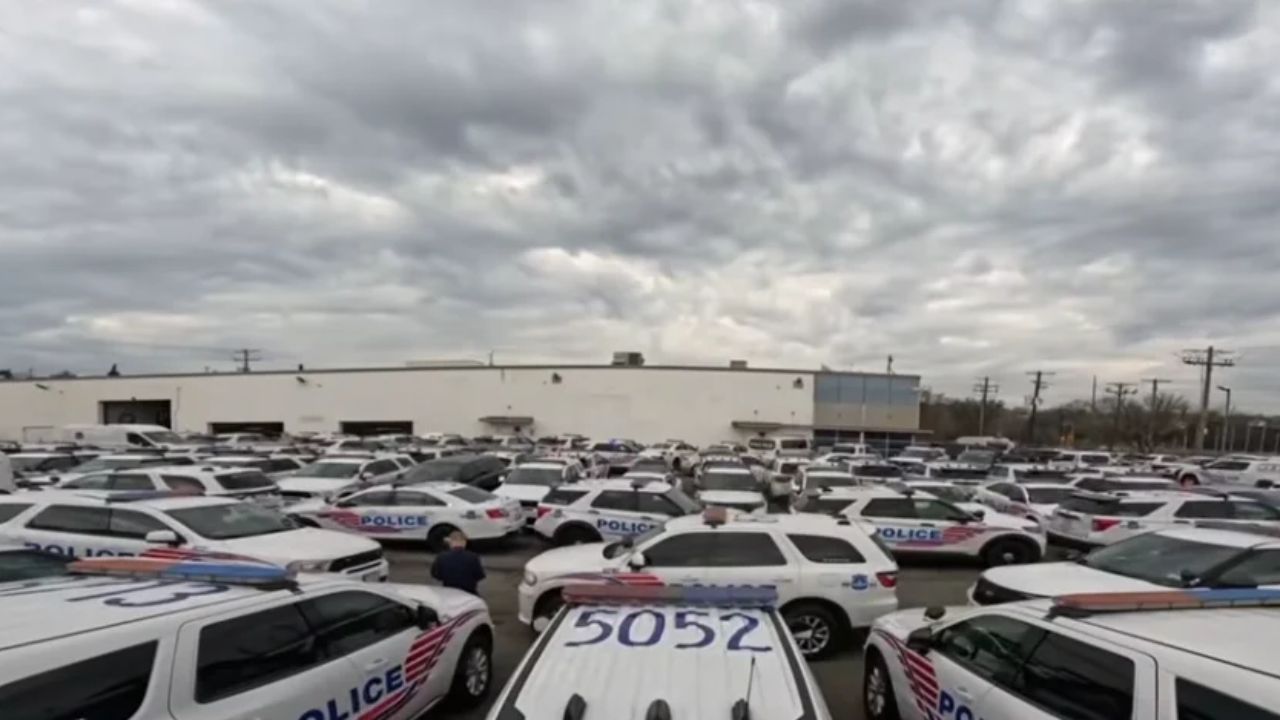
Washington DC’s Metropolitan Police Department is running what amounts to a very expensive parking lot. While residents dial 911, nearly 200 department vehicles have been sidelined for maintenance or repairs rather than patrolling the streets. An investigation by the 7News I-Team found rows of cruisers, vans, and specialty vehicles parked behind fences at the department’s Northeast DC fleet facility, some of which appeared to have gone untouched for months.
It was, as the reporters aptly noted, more reminiscent of a game day parking lot than an active police fleet operation.
The numbers here are not subtle. Of MPD’s 533 marked patrol cruisers, 81 have been pulled from service for repairs so far this year. That works out to roughly one in every seven patrol cars sitting idle instead of covering a beat. At its worst point, nearly one in four marked patrol vehicles in the Third District alone was out of rotation.
The department has quietly been pushing some officers onto bicycles and foot patrols to compensate, though MPD has declined to name which neighborhoods or how many officers have been affected, citing operational security concerns.
Fleet availability at MPD has now declined for three consecutive years, consistently falling short of the department’s own 95% target. As of the time of the investigation, the fleet was running at 88% availability before ticking up slightly to 91% following increased attention to the issue.
Close, perhaps, but not exactly a ringing endorsement of how things are being managed. Meanwhile, maintenance costs have climbed to nearly $17 million over the past two fiscal years, or roughly $5,100 per vehicle per year across a fleet of approximately 1,640 units.
The department’s fleet is managed under a contract with Vector Fleet Management worth up to $8.5 million annually. Through May of this fiscal year, Vector had already billed the District more than $3.5 million. The company had not responded to press questions at the time of the report. Vector was acquired by Amerit Fleet Solutions in February 2025, meaning the organization managing DC’s police vehicles is currently in the middle of a corporate transition.
Whether that has any bearing on the repair backlog is not confirmed, but the timing is at minimum worth noting.
What Is Actually Breaking Down Out There
The repair records reviewed by the I-Team read less like fleet maintenance logs and more like a running list of things that should never be allowed to happen to a law enforcement vehicle.
Among the documented failures: vehicles that would not start, broken air conditioning, malfunctioning sirens, cars stuck in gear, and, perhaps most memorably, patrol cars with rats inside them. These are not rare edge cases. They represent a documented pattern across a fleet that is supposed to be professionally maintained under a multimillion-dollar contract.
For officers trying to respond to calls, the practical fallout has been a daily scramble. Sources familiar with department operations told the I-Team that officers are frequently left competing for whatever vehicles are actually available for patrol, which is a remarkable situation for a department that supposedly has 1,640 vehicles on its books.
The Contract Raises Questions
Vector Fleet Management markets itself as a company that delivers “100% contract compliance” and promises government clients that their vehicles will be “mission-ready.” The company has been in the government fleet maintenance business since 1988 and holds Sourcewell cooperative purchasing approval for state and federal contracts.
Its website is full of language about uptime, accountability, and “never leaving residents waiting.” The gap between that marketing posture and what the I-Team found in Northeast DC is significant enough to warrant some pointed questions, particularly since Vector has so far not answered any of them.
The contract pays Vector up to $8.5 million per year to keep the MPD fleet operational. If the fleet is hitting availability rates well below the department’s own targets, year after year, the natural question is what the contract’s performance benchmarks actually require and whether there are any consequences for missing them.
DC Council member Brooke Pinto, who oversees MPD’s budget, declined an on-camera interview but indicated through her office that she is working with the department to address vehicle shortages and secure funding for repairs and replacements.
The Plan to Fix It, and Why It Will Take a While
The District says it plans to spend $18 million this year to purchase 184 new patrol vehicles. That is not a trivial investment, and it should meaningfully help once those vehicles are actually delivered and deployed. The problem is the gap between now and then.
Until those replacements arrive, the department is still operating a degraded fleet with a maintenance contractor that has not publicly explained the backlog, and officers are still making do with whatever is left in the lot.
For context, MPD is already stretched in other ways. The department currently employs just over 3,100 sworn officers, down from approximately 3,650 in 2020 and well short of the city’s stated goal of 4,000. Fewer officers, fewer functioning vehicles, and a repair contractor that appears to be struggling to keep pace is not a combination that inspires confidence.
The city is spending real money on this problem. Whether it is being spent effectively is a separate question entirely, and one that neither MPD leadership nor their fleet contractor has been eager to answer on camera.
What People Are Saying
The public reaction to this story has been blunt. Online comments ranged from “Poor fleet management, that director needs fired” to more pointed speculation about where the maintenance money is actually going. Those reactions may be unverified, but they reflect a legitimate frustration: when a department is spending $17 million on vehicle upkeep over two years and still cannot keep its patrol cars on the road, something is structurally wrong.
Whether the problem lies in contract oversight, procurement timelines, the contractor’s own performance, or some combination of all three is what accountability reporting is supposed to find out. The cameras were turned away. The questions remain open.