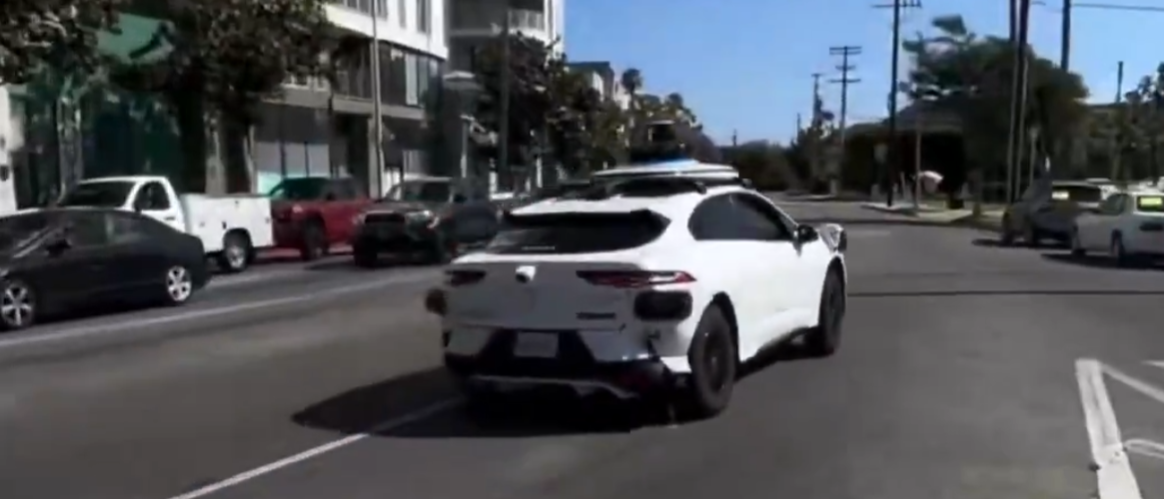
A TikTok video posted by user LASHY BILLS has gone viral after capturing footage of a Waymo robotaxi near what appears to be a four-car pileup at an intersection. The vehicle pauses briefly before accelerating away, even using its blinker before turning right, which is either impressively law-abiding for a car that allegedly just wrecked four vehicles, or the most ironic use of a turn signal in recent memory. The video racked up attention and outrage fast, with commenters calling for Waymo to be banned from city streets entirely. But not everyone is convinced the robotaxi is actually the villain of this story.
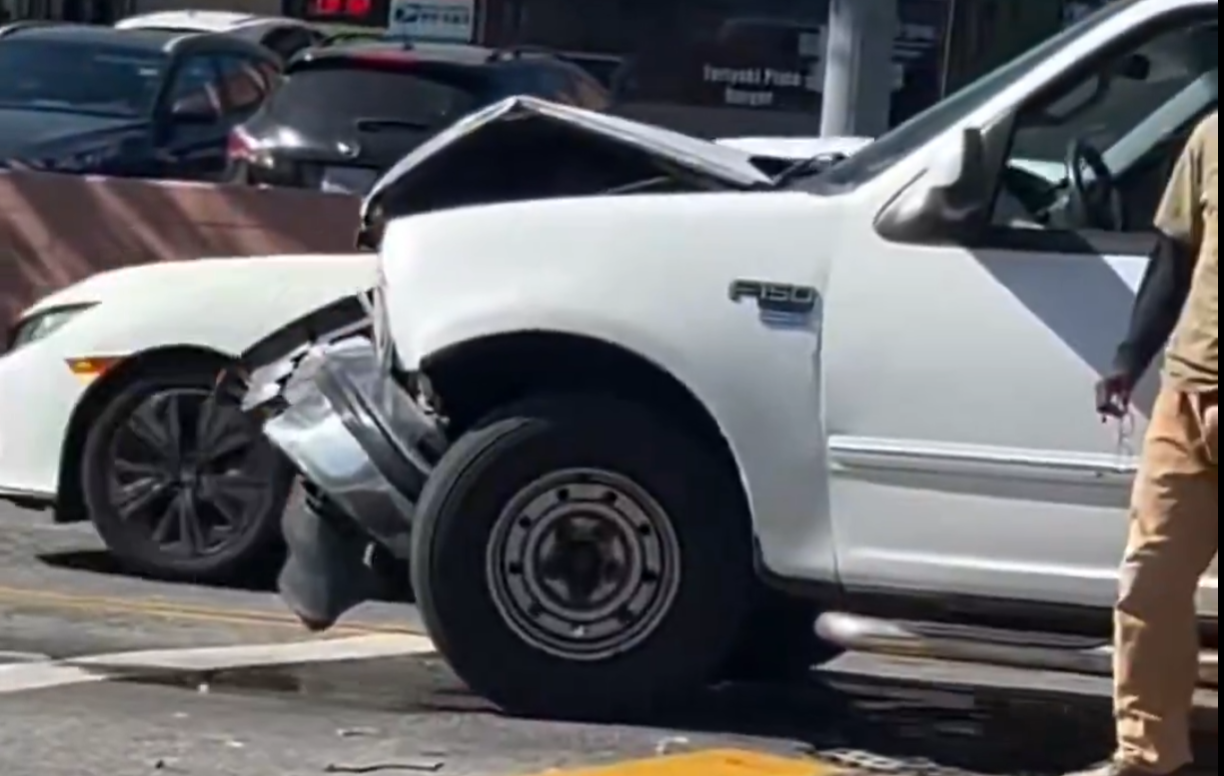
The damage shown in the clip is genuinely striking. A white Ford F-150 sits with a hood so badly crumpled it looks like it tried to argue with a cement wall. A woman nearby paces around her dented car, already on the phone with what is presumably her insurance company. Both damaged vehicles are stopped at a crosswalk, facing opposite directions, which suggests the pileup involved cars moving in two different lanes. Here is where it starts to get interesting: the Waymo, by comparison, appears to have walked away from all of this with relatively minor damage. A few dents on the back end. That is it.
That detail has not gone unnoticed. While a large portion of the comments section is calling for Waymo’s head, another group is pumping the brakes and asking a genuinely fair question: if this Waymo caused a four-car pileup, why does it look like it barely got touched? The answer to that question changes this story significantly, and right now, nobody seems to know it for certain.
Wait, Did the Waymo Actually Cause This?
Waymo Self-Driving Car Hits 4 Vehicles Then Drives Off pic.twitter.com/H8ZcjuhkjU
— LASHY BILLS (@LASHYBILLS) April 26, 2026
Here is the uncomfortable truth about this video: it is not clear. The footage shows a Waymo near a crash. It shows damage on other vehicles. It shows the Waymo leaving. What it does not definitively show is the Waymo being the cause of the collision.
Some viewers have pointed out that a vehicle capable of hitting four cars hard enough to cave in a truck hood should have far more visible damage than what is seen on the Waymo. The relatively clean condition of the robotaxi has led a portion of the internet to question whether the Waymo caused the pileup at all, or whether it was just unfortunate enough to be in the intersection when things went wrong and made the sensible decision to clear the scene so it was not blocking traffic further. Did it actually strike anyone, or did it thread through a crash that was already happening?
It is also worth noting that Waymo vehicles are equipped with extensive sensor arrays and onboard cameras that record everything. If the vehicle was involved in a collision, that data exists. Waymo has not released a statement on the incident, which is frustrating, but the absence of a comment is not the same as an admission of guilt. The company has historically been fairly transparent about reporting crashes to the NHTSA, even when it was not legally required to do so immediately.
Is This Anti-Waymo Propaganda or Just a Misread Video?
The timing of this video and the speed with which it spread says something worth examining. Public skepticism toward autonomous vehicles is at a genuine high right now, and content that frames Waymo as reckless tends to travel fast. Some observers have raised the possibility that this clip, stripped of context and set loose on TikTok, functions less like journalism and more like a highlight reel designed to confirm what a lot of people already believe: that robotaxis are dangerous and should not be on public roads.
That does not mean the video is fake or that Waymo is blameless. It means that a ten-second clip of a car near a crash is not the same as a crash report, an investigation, or a complete picture of what happened. The positions of the damaged vehicles are genuinely puzzling. Both cars are stopped at the crosswalk facing opposite directions, meaning the collision involved both lanes of traffic. If the Waymo caused that kind of multi-directional wreck, the physics involved should have left more of a mark on the robotaxi itself.
On the other hand, and this one is hard to ignore: if the Waymo somehow emerged from a four-car pileup with just a few dents on the bumper, that is either a wild coincidence, evidence it was not truly at fault, or the most accidental advertisement for vehicle durability Waymo has ever produced. The robotaxi industry is not exactly known for its good PR moments, but walking away from a four-car crash looking mostly fine is at least a data point worth noting.
A Pattern of Incidents That Has Put Waymo Under Scrutiny
Whatever the truth of this particular video turns out to be, Waymo has a complicated recent track record that gives critics plenty of legitimate material to work with. In January 2026, one of its vehicles struck a child near an elementary school in Santa Monica, California, prompting an NHTSA investigation into whether the vehicle exercised appropriate caution given its proximity to the school during drop-off hours. That same month, a separate Waymo operated in manual mode sped through a one-way residential street near Dodger Stadium, hitting several parked cars, including one with a person inside.
In May 2025, Waymo recalled more than 1,200 of its autonomous vehicles after a software issue was found that could lead to minor collisions with roadside barriers such as gates and chains. All told, between July 2021 and November 2025, there were 1,429 Waymo incidents reported to the NHTSA, resulting in 117 injuries and 2 fatalities. Not every incident was caused by Waymo, but the volume is enough to keep public nerves frayed.
What the Safety Data Actually Shows
Here is where the clean anti-Waymo narrative runs into a wall of statistics. Because the data defending Waymo’s overall safety record is genuinely hard to argue with, even for its loudest critics.
According to safety research, Waymo’s autonomous vehicles had 90% fewer serious-injury crashes, 82% fewer crashes involving airbag deployment, and 81% fewer injury-causing crashes compared to average human drivers covering the same distance in the same cities. An independent review of nearly 100 million driverless miles reached a similar conclusion. One neurosurgeon who spent weeks analyzing the data found that Waymo’s vehicles were involved in 91% fewer serious-injury crashes and 80% fewer injury-causing crashes than human drivers on the same roads.
A peer-reviewed study published in Traffic Injury Prevention, examining more than 56 million rider-only miles through early 2025, found statistically significant reductions in injury-reported crashes and airbag deployment incidents compared to human benchmarks across Phoenix, San Francisco, Los Angeles, and Austin. And perhaps most telling of all, a review of Waymo’s most serious crashes between mid-2025 and early 2026 found that more than half occurred when another vehicle struck a Waymo from behind. A lot of what ends up in Waymo’s crash count is other drivers hitting the robotaxi, not the other way around.
What We Can Learn From This Moment
Whether or not the Waymo in this video caused that pileup, the episode reveals something important about where we are in the public conversation around autonomous vehicles.
The gap between the safety statistics and public perception is enormous, and it is getting worse, not better. Waymo can publish peer-reviewed studies all day long, but a ten-second TikTok of a crumpled truck hood will always travel faster. That is not Waymo’s fault exactly, but it is absolutely Waymo’s problem to solve. Silence after a viral incident is not a communications strategy.
The legal framework for autonomous vehicles also still has real blind spots. When a driverless car is involved in a crash, the process of determining fault, issuing accountability, and communicating with the public moves far too slowly compared to how fast these videos spread. That mismatch is eroding trust in real time.
And finally, this video is a reminder that context is everything. A clip of a Waymo near a crash is not proof the Waymo caused it. It might be propaganda. It might be a genuine incident. It might be the world’s strangest endorsement for robotaxi structural integrity. Until the data is released, the honest answer is that nobody knows, and that uncertainty, more than anything, is exactly what makes these moments so combustible.