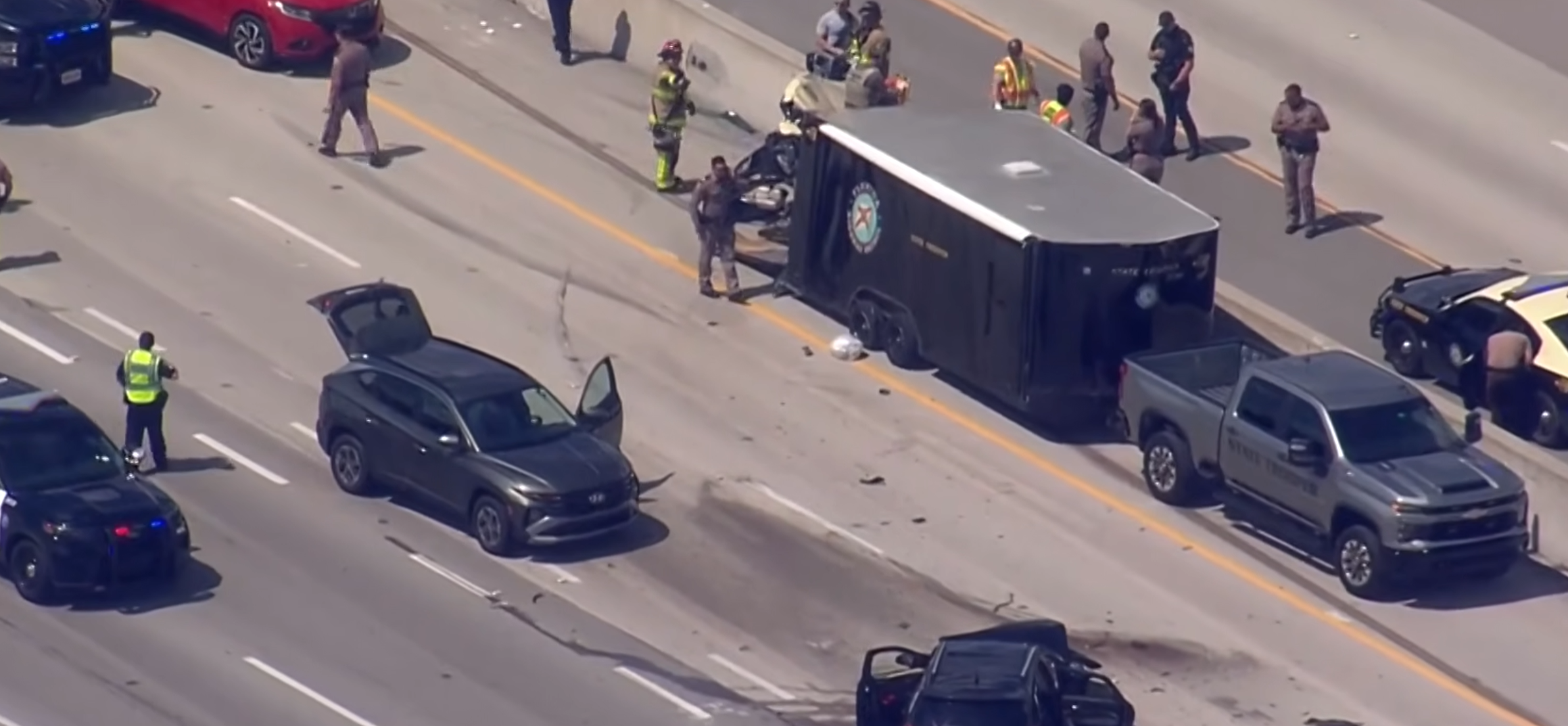
A six-vehicle pileup on one of South Florida’s busiest corridors put two law enforcement officers in the hospital and raised serious questions about who should and shouldn’t be behind the wheel. The crash unfolded on the northbound lanes of Florida’s Turnpike, also known as State Road 821, near NW 106th Street in the Doral area on June 15, 2026. Aerial footage captured by local news crews showed a Florida Highway Patrol vehicle wedged behind a trailer and compressed to a fraction of its original shape, with emergency crews swarming the scene on both sides of the guardrail.
The collision was triggered when a black SUV, driven by a man whose license had already been suspended, slammed into a parked FHP patrol car on the northbound Turnpike. That kind of detail tends to sharpen the conversation quickly. This wasn’t an unavoidable chain reaction or a weather-related incident. It was a situation that, by most measures, should never have happened at all.
FHP officials identified the two troopers as Sgt. Alexis Otano, 54, and Trooper Amaury Quinones, 32. Otano was driving the truck and was near the trailer at the time of impact, while Quinones was seated inside the patrol car when it was struck. Both suffered serious injuries but were expected to survive. Given what aerial footage showed of that patrol car, the fact that either of them walked away from it at all is worth noting.
Miami-Dade Fire Rescue confirmed two trauma alert patients were transported to a local hospital, and a Fire Rescue helicopter landed on the Turnpike to airlift at least one of the injured. The Turnpike was completely shut down at one point, sending traffic into the kind of gridlock that Doral commuters know all too well, and that no aerial traffic reporter enjoys narrating.
What the Scene Looked Like from Above
The aerial footage told most of the story before any official statements were released. Reporters described a black Cadillac near the front of the wreckage, a red car, at least one additional truck, and the remains of the FHP cruiser pinned at the rear behind a trailer. By their count, at least six vehicles were involved. Emergency personnel were actively treating someone on the far side of the guardrail, and the fact that no medevac helicopter had arrived in the initial minutes of coverage left reporters visibly uncertain about the severity of what they were looking at. One eventually did land.
The FHP patrol car, from what could be seen, was not recognizable as a vehicle in any conventional sense. That kind of structural collapse in a modern law enforcement vehicle, which is typically a full-size sedan or SUV built to more rigorous specs than a standard consumer car, says a great deal about the force involved in the impact.
The Suspended License Factor
This is where the story pivots from tragic to preventable. The driver behind the wheel of the black SUV that set this whole sequence in motion did not have a valid license. Driving on a suspended license is one of those violations that tends to get treated as a paperwork problem until something like this happens. Florida has consistently ranked among the states with the highest rates of unlicensed and suspended-license drivers on the road, and enforcement is uneven at best.
For context, the Florida Department of Highway Safety and Motor Vehicles processes hundreds of thousands of license suspensions annually, stemming from unpaid fines, DUI convictions, insurance lapses, and child support defaults, among other triggers. The suspension itself is not always the result of a driving-related offense, but the decision to get behind the wheel anyway is. That decision, in this case, put two troopers in trauma care.
Trooper Safety on Active Roadways
Sgt. Otano was reportedly near the trailer when the crash occurred, placing him in one of the most statistically dangerous positions a highway trooper can occupy: on foot, adjacent to moving traffic. The issue of roadside safety for law enforcement is not a new one, and Move Over laws exist in all 50 states specifically because of it. Florida’s version requires drivers to slow down and change lanes when approaching stopped emergency vehicles, a law that is still widely ignored despite stepped-up enforcement campaigns in recent years.
The sight of a crushed patrol car is a blunt reminder of what happens when a multi-thousand-pound vehicle strikes a stationary target at highway speeds. Modern patrol vehicles are not designed to absorb that kind of impact, and no amount of structural engineering fully compensates for a direct collision at speed.
Road Closure and Traffic Impact
All lanes of the Turnpike were closed following the crash, and the backup that resulted stretched well into the Doral area. Anyone who drives SR-821 regularly understands that it doesn’t take much to bring that corridor to a standstill under normal conditions. A scene of this scale, with multiple law enforcement vehicles, a medevac helicopter, and active medical treatment happening in the roadway, guarantees hours of disruption.
Doral sits at a convergence point for commercial traffic heading north out of Miami, airport traffic, and everyday commuters using the Turnpike as the fastest alternative to I-95. A full closure there ripples outward quickly.
As of the initial reporting, both Sgt. Otano and Trooper Quinones remained hospitalized in serious but stable condition. The investigation into the crash, including what charges the suspended-license driver may face, was ongoing.