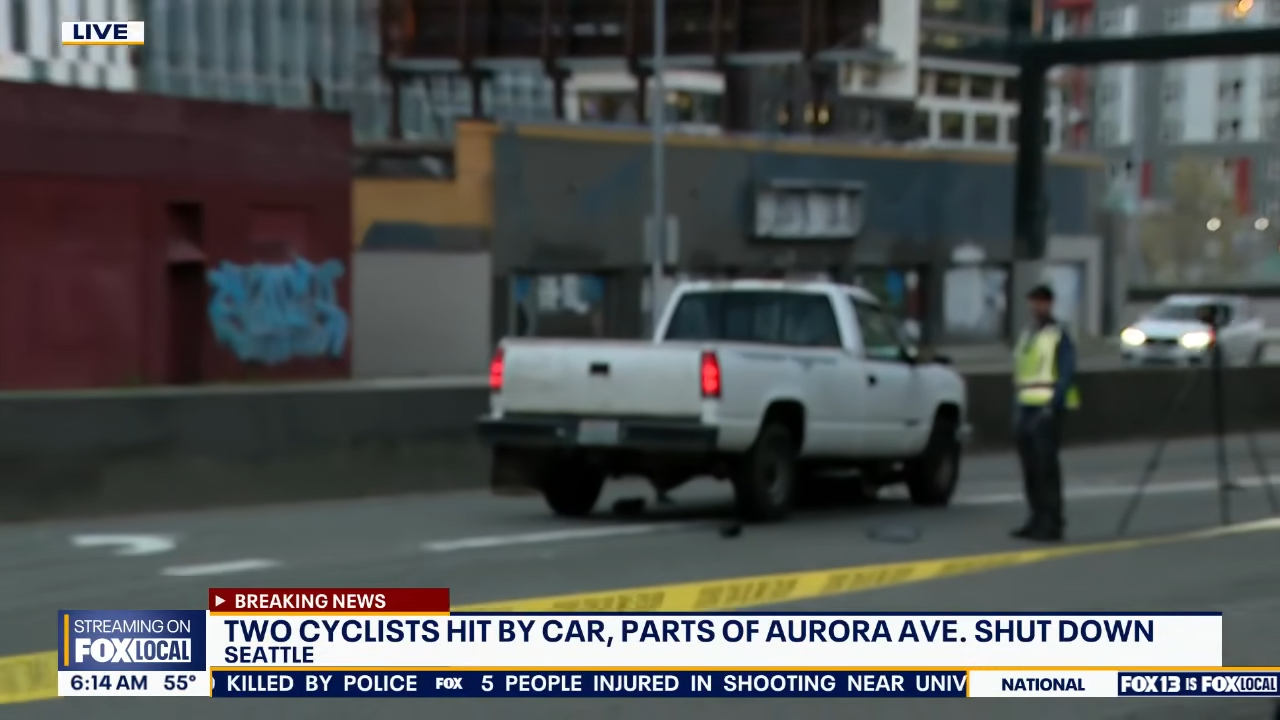
Early Monday morning in Seattle, a routine late-night bike ride turned into a life-threatening emergency when a truck collided with two cyclists sharing a single Lime bike near South Lake Union. The crash, which happened just after 4 a.m., left both riders in critical condition and has renewed questions about nighttime safety along one of the city’s busiest arterials.
According to Seattle Police Department Det. Brian Pritchard, the two cyclists were riding together on one Lime bike, heading eastbound on Roy Street. The third member of their group, riding a separate Lime bike, made a safe left turn onto the sidewalk. The injured pair, however, misjudged the intersection, crossing Aurora Avenue North when they intended to turn left. It was a costly navigation error, made worse by poor visibility and the unforgiving traffic of a major road at 4 in the morning.
A truck driver heading southbound on Aurora did not see the cyclists in time and struck them. Police confirmed the driver showed no signs of impairment and was not exceeding the speed limit. He was released at the scene, meaning no charges have been filed at this point. The incident appears to be a tragic combination of unfamiliarity with the area, darkness, and the unpredictable nature of sharing a road with fast-moving vehicles well before sunrise.
Both injured cyclists, estimated to be around 28 and 30 years old, were transported by medics to Harborview Medical Center in critical condition, according to the Seattle Fire Department. The third rider walked away without injury. As of the time of reporting, the conditions of the two hospitalized cyclists had not been publicly updated.
What We Know About the Crash
Seattle Fire Department crews responded to the collision in the southbound lanes of Aurora Avenue North at Roy Street at approximately 4:20 a.m. on Monday. Two patients were treated on scene before being rushed to Harborview.
Detective Pritchard noted the cyclists were unfamiliar with the area, which appears to have played a direct role in the wrong turn that put them in the path of oncoming traffic. The truck driver cooperated with authorities and was not taken into custody.
Aurora Avenue North Has a Long History of Dangerous Conditions
This stretch of road is no stranger to serious accidents. Aurora Avenue North, also known as State Route 99, cuts through Seattle as a high-speed arterial with limited pedestrian and cyclist infrastructure in several sections. The road has been the subject of ongoing safety discussions for years, particularly around the South Lake Union and Queen Anne areas where traffic volumes are high and crossing opportunities are limited.
Advocates have long pushed for additional protective infrastructure, better lighting, and redesigned intersections to reduce the risk for anyone outside of a vehicle.
Lime Bikes and Late-Night Riding: What Riders Should Know
Shared e-bikes and traditional dockless bikes like Lime have become a popular and convenient way to get around Seattle, but they come with real risks, especially at night and in unfamiliar parts of the city. Riders who are new to an area may not know which roads are safe to cross, where bike lanes are, or which intersections have traffic signals timed for bikes versus cars.
Riding two people on a single Lime bike, as in this case, is also against Lime’s terms of service, which is worth noting as it can affect handling and visibility. Late-night rides add another layer of danger, as driver visibility drops and some intersections that seem manageable during the day become far more hazardous after dark.
What This Incident Can Teach Us About Urban Cycling Safety

Crashes like this one offer a sobering reminder that urban cycling, particularly on or near high-speed roads, demands preparation and local knowledge. A few key takeaways stand out. First, if you are riding in an unfamiliar area, checking a map before heading out, not while on the move, can prevent life-altering mistakes at intersections.
Second, crossing a road like Aurora Avenue North outside of a designated signal is extremely risky at any hour, but especially so in the early hours of the morning when trucks and cars are moving fast with fewer visual cues to slow them down.
Third, reflective gear and bike lights are not optional accessories after dark; they are the difference between being seen and not. And finally, shared bikes are designed for single riders. Doubling up reduces the rider’s control and makes both people more vulnerable.
This was not a case of reckless driving. It was a preventable intersection mistake that cost two people dearly. The hope now is that both riders recover fully, and that this serves as