It is not every day that the police require you to give them space during morning walks in a designated walk zone.
However, one pedestrian learned about “situational awareness” the hard way after getting roasted by the Dallas police on the PA system.
In footage that is going viral on social media, the officer compared the walker to his dog in the roast, praising the furry four-legged companion while calling out the owner for a lack of awareness.
While vehicles are not allowed on walking paths, the police can drive their cruisers and patrol vehicles on them during emergencies.
Morning Walker Learns the Hard Way
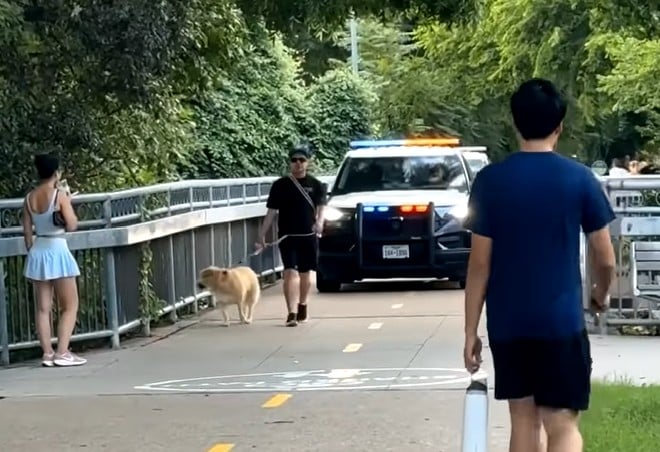
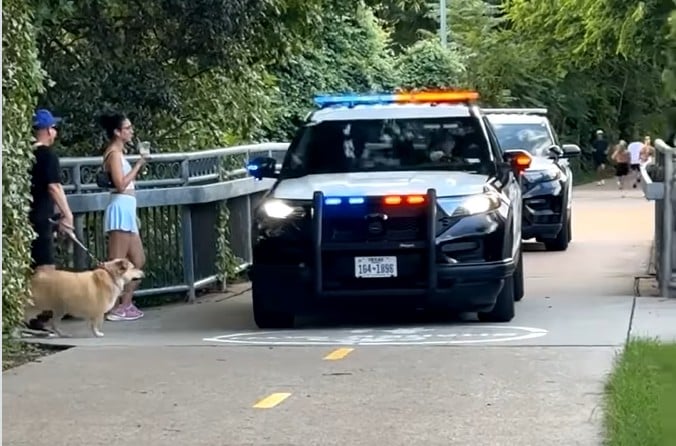
While the exact location of the incident is not known, the footage on Instagram posted by ABC News shows two police cars crawling down a walking path behind a dog walker.
Despite being in close proximity, the man was oblivious to the presence of police cars. The dog, however, can be seen looking back multiple times, acknowledging the cars behind it.
While the dog appeared to be in a hurry to move out of the way, its owner only realized after he was roasted the second time by the officer on the PA system. The officer said:
“Your dog has more situational awareness than you right now.”
Following the first statement, the walker seemed to turn his head, as if he heard something, but he still hadn’t realized two police cars were right behind him. Repeating his line, the officer said:
“The dog has more situational awareness.”
That was when the walker finally realized who was behind him, and moved to the side. Seeing him give way, the officer said on the PA system:
“Goood Booooy!”
The person recording the video burst into laughter as the police cars found a clear path to go forward.
“It’s the Dog Walking Him”
The viral video has received over 450,000 likes, and some of the comments are worth mentioning. They are listed below:
One user wrote:
“It’s the dog walking him”
Another user wrote:
“Cops with a sense of humor are the best”
Another user was more interested in the walker’s earphones:
“Whatever noise cancellation earphones he has on … I need me a pair”
One user pointed out:
“I mean, the cops is driving on a walking path. Why would he be worried about a car?” [sic]
A user thinks that the officer speaking on the PA system is a veteran:
“That cop was definitely a veteran”
One more user addressed a similar concern:
“Why are cars driving on a walking path?”
Another user pointed out:
“We go on these paths so that we DON’T have to worry about getting hit by a car.”
View this post on Instagram
NHTSA Reveals Startling Concerns Around Pedestrian Fatalities
The National Highway Traffic Safety Administration (NHTSA) has raised concerns surrounding pedestrian safety. Figures from 2024 show that one pedestrian was killed every 74 minutes in traffic crashes.
The report suggests that 7,080 pedestrians were killed and more than 71,000 pedestrians were injured nationwide in the same year. To spread awareness, the NHTSA has shared eight walking tips for pedestrians to remain safe on the road, which are as follows:
- Follow the rules of the road and obey signs and signals.
- Walk on sidewalks whenever they are available. If there is no sidewalk, walk facing traffic and as far from traffic as possible.
- Do not cross mid-block. Cross streets at crosswalks or intersections.
- If a crosswalk or intersection is not available, locate a well-lit area where you have the best view of traffic. Wait for a gap in traffic that allows enough time to cross safely; continue watching for traffic as you cross.
- Watch for cars entering or exiting driveways or backing up in parking lots.
- Embrace walking as a healthy form of transportation.
- When crossing the street, stay alert: check for signs, signals, and the actions of drivers, cyclists, and pedestrians around you.
- Do not rely on others to keep you safe; make eye contact with drivers when possible and wait for a clear, complete stop before crossing.
While these tips are not directly connected with the Instagram video shared earlier, they do emphasize the importance of remaining aware at all times so pedestrians can stay safe, even when they don’t expect the unexpected.