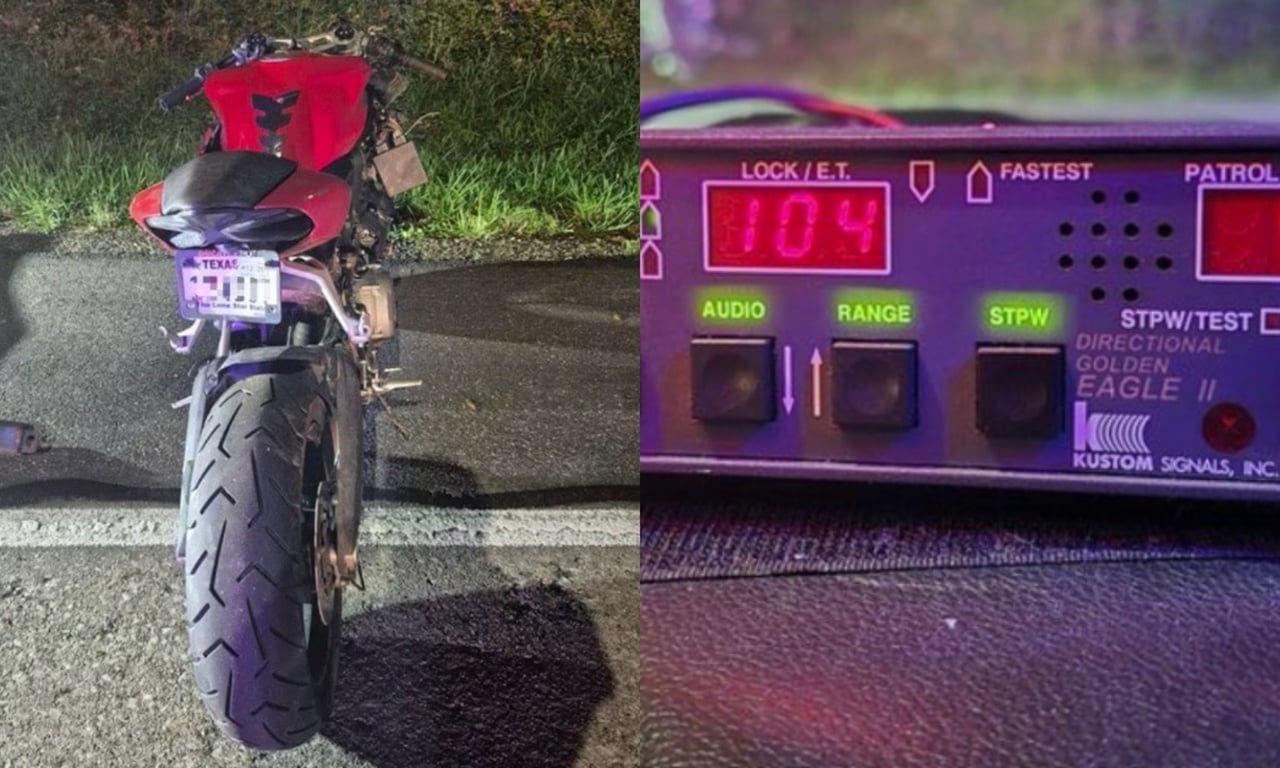
A Texas motorcycle rider learned the hard way that outrunning police and outwitting the law are two very different things. Officers with the Magnolia Police Department clocked a motorcyclist tearing down FM 1488 at more than double the posted speed limit before the rider decided to take his chances and bolt. He got caught. And then he said something that probably made the arresting officer’s day.
The incident unfolded on FM 1488, a busy Montgomery County corridor that cuts through a mix of residential and commercial stretches west of Houston. According to the department’s account, officers observed the motorcycle pass them at 104 miles per hour in a posted 50 mph zone. That’s not a slightly heavy foot on the throttle. That’s nearly twice the legal limit, the kind of speed where reaction time compresses and margin for error disappears. Officers signaled for the rider to stop. He did not comply.
Instead of pulling over, the rider led police on a pursuit that eventually wound through a neighborhood off TX-242 before coming to an end. Once in custody, the man offered up what may be the most confidently wrong explanation for a bad decision seen in recent memory: he said he ran because he didn’t think police were allowed to chase motorcycles.
It’s a belief that floats around in certain corners of riding culture, but it has no legal backing. Texas law is clear, consistent, and unsympathetic on the matter. Police can and do pursue motorcycles, and the consequences for running are steep regardless of what the suspect thinks the rules are.
The “Cops Can’t Chase Bikes” Myth Has Real Consequences
The idea that police will not or cannot pursue motorcycles is one of those half-truths that sounds plausible until someone actually tests it. Some departments do have pursuit policies that discourage high-speed chases when the risk to the public outweighs the benefit of apprehension.
But “department discretion” and “legal immunity for the rider” are two entirely separate concepts. Officers in this case chose to pursue, caught the rider, and the legal process moved forward without hesitation.
There is no statute in Texas, or any other state, that grants motorcyclists a free pass to flee a traffic stop. Thinking otherwise is a gamble with serious stakes.
What “Evading With a Motor Vehicle” Actually Means in Texas
Being charged with Evading Arrest or Detention with a Motor Vehicle is not a minor traffic citation. Under Texas Penal Code § 38.04, fleeing from law enforcement on a motorcycle falls squarely under the motor vehicle evading statute. The base offense is a third-degree felony, and that classification applies whether the pursuit lasted thirty seconds or thirty minutes.
If the evasion results in serious bodily injury or death, the charge escalates to a second-degree felony, carrying two to twenty years in prison. For a first-time offender without those aggravating factors, a conviction can still bring up to ten years in prison and a fine of up to $10,000. That is the price of a decision made in a fraction of a second based on a rumor.
Speeding Charges Are Still on the Table
The evading charge is the headline here, but it’s worth noting that doing 104 in a 50 doesn’t disappear from the conversation just because a pursuit followed. Texas takes reckless driving and excessive speeding seriously in their own right, and prosecutors don’t tend to view that kind of speed as a minor footnote when building a case.
Riding at that velocity through a populated corridor, near residential neighborhoods, is the kind of thing that gets a judge’s attention independent of what happened afterward.
FM 1488 is no desolate back road. It’s a well-traveled stretch that sees commuters, school traffic, and commercial activity throughout the day. Blasting through at triple-digit speeds is a genuine threat to anyone else sharing that road.
A Lesson Not Everyone Learns Before It Costs Them
This story would almost be funny if the circumstances weren’t so reckless. The rider apparently had enough confidence in his understanding of pursuit law to make a split-second decision to flee from officers, but not enough curiosity to actually verify whether that belief was accurate before acting on it. That’s a pattern that plays out in traffic stops across the country regularly.
Texas law does not require a suspect to agree with the stop, understand the reason for it, or even think it’s fair. When a police officer initiates a traffic stop in Texas, the driver is legally required to pull over at the nearest and safest location. That obligation applies whether you’re in a pickup truck, a sedan, or a sport bike running at 104 miles per hour.
The Magnolia Police Department shared this incident publicly, and it’s easy to see why. There’s a cautionary tale here that doesn’t require any embellishment. The rider’s own explanation does the work.