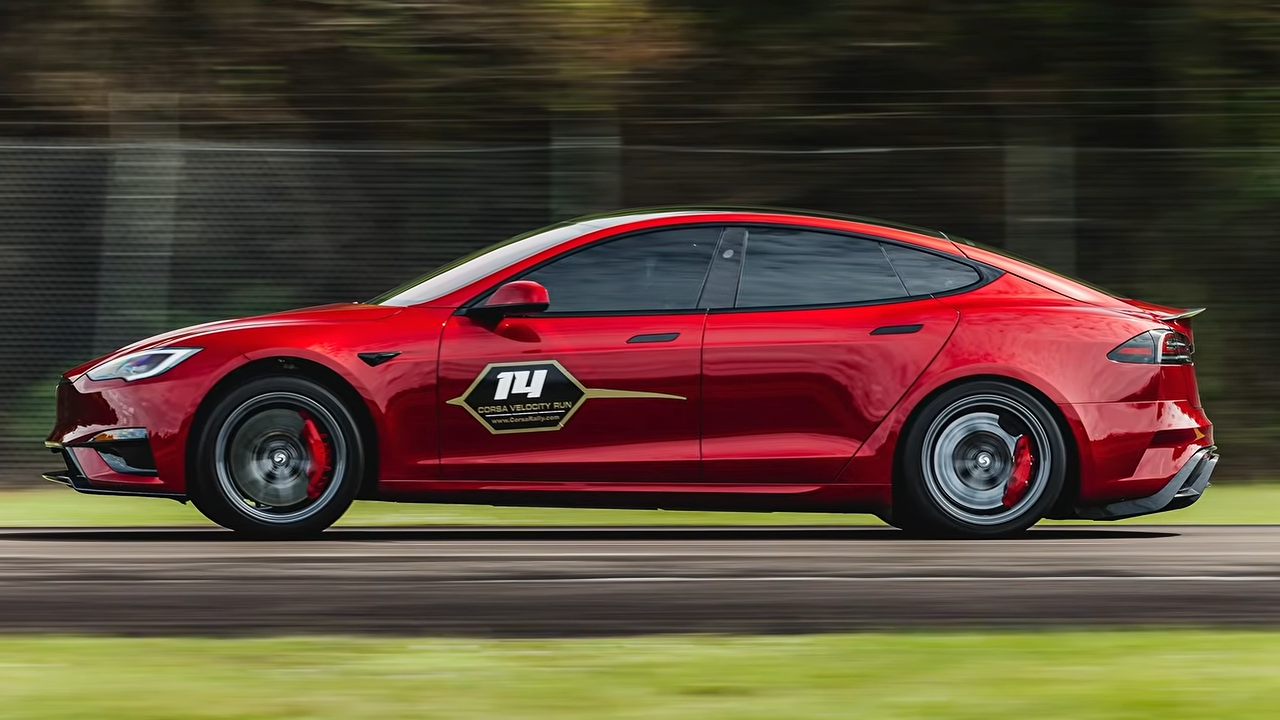
The Tesla Model S Plaid already produces more than 1,000 horsepower, but aftermarket tuners are finding ways to change how that performance is delivered. A demonstration by automotive YouTube channel DragTimes shows that the upgrades go beyond simply increasing the car’s output.
The video follows a 2026 Model S Plaid equipped with a SirHarrold tuning module, a compact device that connects to the car’s electronics and provides access to additional performance and suspension controls.
Unlike conventional engine tuning, which might involve adjusting fuel delivery, ignition timing, or turbocharger boost, this system modifies electronic commands that govern the electric vehicle’s existing hardware.
The result is a Plaid with customizable power settings, new burnout capabilities, and suspension functions that aren’t normally available through Tesla’s factory interface.
Inside the Tuning System
Embedded media follows; please allow a moment to load.
The tuning system demonstrated by DragTimes connects beneath an interior trim panel using an existing vehicle connector. Configuration is handled through a Windows application, with an optional physical button allowing the driver to activate specific features.
One of the more interesting functions is independent power adjustment for different driving modes. The driver can select different increases for Plaid, Drag Strip, and Track modes rather than applying one setting across the vehicle.
A separate scramble function temporarily activates additional power at the push of a button. The demonstration shows how its duration can be configured, allowing the driver to return automatically to the previously selected setting.
More Than Horsepower
The system also gives the driver considerably more control over the Plaid’s air suspension.
A stance setting lowers the vehicle while parked, then raises it to a configured driving height. The suspension can also respond to a customized steering-wheel command or an existing function in Tesla’s mobile application.
Another setting is intended to reduce front-end lift under hard acceleration. For drag racing, the module can retain the vehicle’s lowered launch position while the driver stages at the starting line.
That matters because Tesla’s factory launch preparation normally requires the suspension to settle into its Cheetah Stance. Keeping the car at that height can eliminate part of the waiting process between runs.
The module even introduces selectable front-wheel-drive, rear-wheel-drive, and all-wheel-drive burnout modes. DragTimes demonstrates the rear-wheel-drive setting, producing a burnout that would not normally be possible through the factory controls.
Testing the Changes
DragTimes also tested the performance effects with and without a 10% power increase enabled.
The quarter-mile time improved from 9.37 seconds to 9.24 seconds, while the half-mile time dropped from 14.9 seconds to 14.5 seconds. Half-mile trap speed increased from 180.3 mph to 185.7 mph.
The results demonstrate measurable acceleration gains, although they do not independently establish the precise horsepower increase.
At the longer testing distance, the vehicle approached its electronically limited top speed. The dashboard displayed approximately 204 mph, but the presenter reported an independently measured speed of approximately 198.5 mph.
Understanding the Limits
The SirHarrold Very Spicy tuning system advertises up to a 10% power increase for the Model S and Model X Plaid. Its features are sold in different configurations, so the complete collection of suspension and racing functions is not necessarily included with every purchase.
The tuning hardware also does not replace the safety equipment required for sustained high-speed operation. Tesla’s owner’s manual specifies carbon-ceramic brakes and appropriate tires for operation at 200 mph.
Near the end of the video, DragTimes mentions a more aggressive tuning option capable of a claimed 14% to 15% increase. That version requires more extensive installation and carries additional electrical-system risks, including the possibility of triggering the vehicle’s high-voltage pyrotechnic fuse.