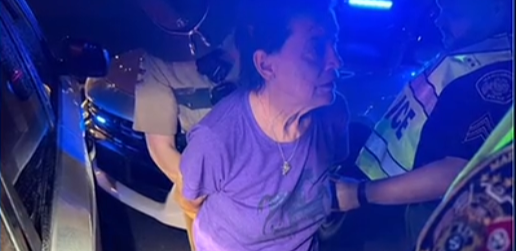
A Madisonville, Tennessee woman is facing a driving under the influence charge after police say she pulled directly into the path of an on-duty sergeant’s patrol vehicle late Friday night, triggering a head-on collision on US Highway 411. The incident, which unfolded near Patterson Street around 10 p.m., could have been significantly more serious had it not been for the responding officer’s quick reflexes behind the wheel.
Lynn Martin, 63, of Madisonville, was taken into custody by the Tennessee Highway Patrol following the crash. A trooper on scene located an open container of alcohol during the investigation, according to the Madisonville Police Department. Martin was subsequently transported to the Monroe County Jail on a DUI charge.
What makes this story worth paying attention to, beyond the obvious irony of someone hitting a cop car, is what the officer on the receiving end actually did. Sergeant Gunter, traveling southbound, had virtually no time to react when Martin’s vehicle pulled into the center median and blocked his lane of travel. He hit the brakes and executed a maneuver that police credit with reducing the severity of the impact. No injuries were reported on either side.
MPD Chief Danny Russell publicly recognized his sergeant’s composure, expressing gratitude that Gunter walked away unharmed and commending the Tennessee Highway Patrol for their prompt and professional handling of the scene. It is a reminder that the officer’s ability to manage the vehicle under pressure mattered enormously here, and that the gap between a fender-bender and a fatality can often come down to a fraction of a second and what the driver does with it.
What Happened on US Highway 411
US Highway 411 runs through Monroe County in East Tennessee, a corridor that sees steady traffic and is a familiar stretch to anyone in the Madisonville area. At 10 p.m. on a Friday, conditions were not unusual for that time of night. The sergeant was traveling southbound on routine duty when Martin allegedly failed to yield, pulling into the center median and directly into his path. The collision was head-on.
THP handled the investigation as a matter of standard protocol whenever a law enforcement officer is involved in a crash. During that investigation, the open container was discovered, which gave troopers cause to move forward with the DUI arrest. It is worth noting that in Tennessee, an open container in a vehicle is itself a separate infraction under state law, and its presence alongside a collision gave investigators straightforward grounds to act.
The Sergeant’s Response Deserves Attention
For people who pay close attention to vehicle dynamics and driver behavior, the detail buried in this story is Sergeant Gunter’s reaction. A head-on collision at highway speeds is among the most dangerous scenarios any driver can face, and the instinct for many is to jerk the wheel rather than brake deliberately. Police and driving instructors have long emphasized that controlled braking, when space allows, is often more effective than a panic swerve that can send a vehicle into a rollover or oncoming lanes.
The MPD’s official statement credited Gunter’s maneuver with reducing the severity of the crash. That is not a throwaway line. It suggests the impact was meaningfully less violent than it would have been, which in practical terms could mean the difference between a damaged front end and a genuinely catastrophic outcome. It is the kind of result that comes from both training and coolness under pressure, and it is the reason emergency vehicle operators receive advanced driving instruction.
Drunk Driving and Police Vehicle Collisions: A Persistent Problem
Incidents involving impaired drivers striking law enforcement vehicles are not as rare as they should be. Officers conducting traffic stops, roadside investigations, or simply driving patrol routes face exposure to impaired drivers at all hours, and the statistics on officer fatalities bear this out. According to the National Law Enforcement Officers Memorial Fund, vehicle-related incidents consistently rank among the leading causes of officer deaths in the United States each year, and a notable portion of those involve vehicles operated by impaired drivers.
Tennessee has a relatively active DUI enforcement framework. The state uses sobriety checkpoints, has implied consent laws requiring breath or blood testing, and imposes mandatory minimum penalties for first offenses that include fines, license suspension, and potential jail time. Whether Martin’s case proceeds to a conviction and what consequences follow will be a matter for the courts, but the charge itself reflects how seriously the state treats impaired driving, particularly when it results in a collision.
No Injuries, but the “What If” Is Hard to Ignore
Both drivers walked away from this without physical harm, which is the most important fact in this story. But anyone with a genuine understanding of vehicle physics and crash dynamics will spend a moment sitting with the alternative scenario. A fully loaded patrol vehicle and a passenger car meeting head-on, even at moderate speeds, produces forces that occupant protection systems can only partially absorb. Modern vehicles are far better at managing crash energy than they were twenty years ago, but there is no engineering solution that fully neutralizes a straight-on impact.
The outcome here was fortunate. Sergeant Gunter’s training helped. The speeds involved may have been relatively low. All of those factors contributed to both people going home without a trip to the hospital. That combination does not always line up so favorably, and that is precisely why DUI enforcement and officer safety protocols exist in the first place.