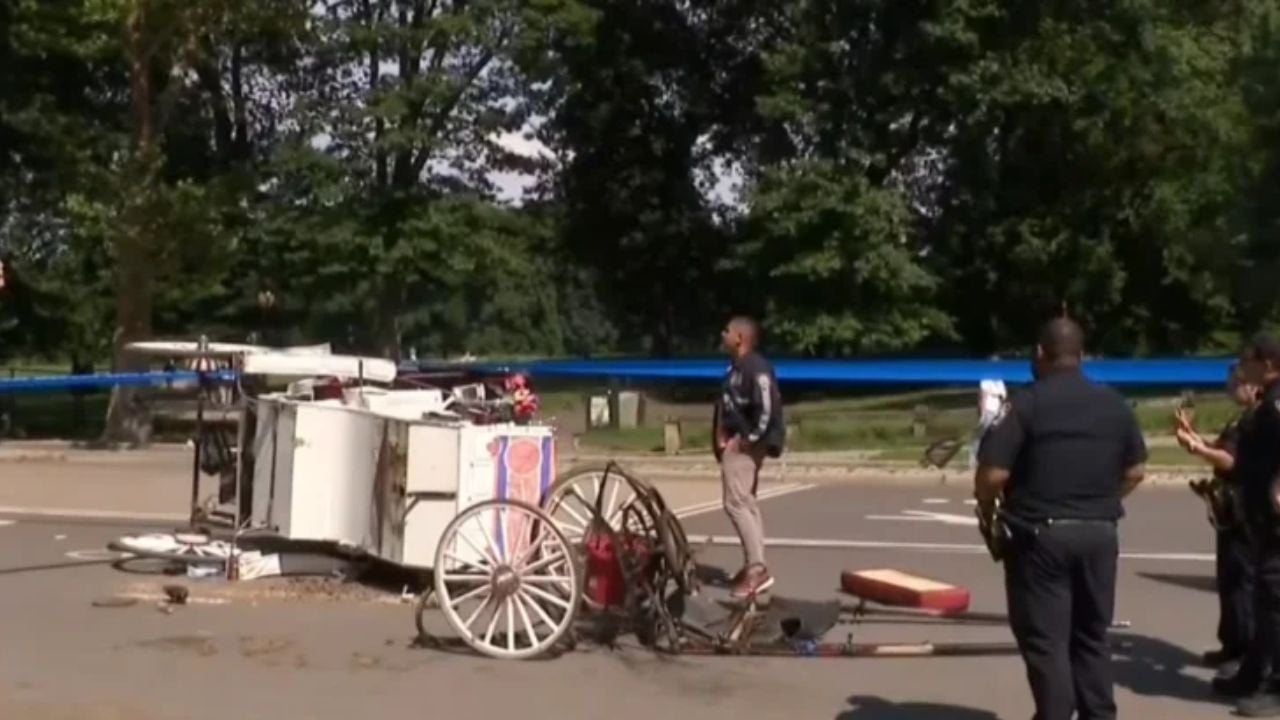
An 18-year-old visiting New York City from India is dead after a carriage horse broke loose in Central Park on Wednesday afternoon, sending the four-wheeled cab careening down the park’s loop road until it collided with another carriage and flipped over.
The victim, traveling with his family of four, was thrown from the carriage and suffered a fatal head injury. He was rushed to the hospital in critical condition and later died. The other three family members were not seriously hurt and declined medical treatment at the scene.
The incident unfolded around 2:45 p.m. near Tavern on the Green, a stretch of Central Park that sees heavy tourist foot traffic on any given afternoon. Cellphone video from bystanders captured the horse, a six-week newcomer to the park named Samsung, racing uncontrollably through the loop before clipping a second carriage and sending the cab tumbling.
It is the kind of footage that spreads quickly and lands with weight, and this time the consequences behind it are irreversible.
What makes the circumstances particularly hard to brush aside is how preventable the whole thing appears to have been. According to the Transport Workers Union, which represents carriage drivers, the driver had dismounted the carriage to take a photograph of his passengers when the horse bolted. The union’s own administrative vice president stated plainly: a driver is never supposed to leave the carriage to take photos, full stop.
The carriage owner has since suspended the driver indefinitely, and Samsung has been retired from service, though the union has confirmed the horse was uninjured.
This is not a story that exists in isolation. It lands in the middle of an already simmering public debate over whether horse-drawn carriages belong in Central Park at all, and Wednesday’s fatality has turned up the heat considerably.
A String of Incidents That Set the Stage
In the past year alone, a horse named Lady collapsed and died on 11th Avenue in August, a horse named Bambi spooked and ran off through Central Park in September with riders still in the carriage, and in January another horse bolted out of the park entirely and into a busy intersection, crashing into parked cars. Wednesday’s death is the most serious outcome yet in what advocates say is a pattern, not a run of bad luck.
Just eight days before Wednesday’s accident, a 16-year-old carriage horse named Deniz collapsed and died in Central Park near West Drive and 72nd Street, prompting city lawmakers to rally outside City Hall and call for the reintroduction of Ryder’s Law. The timing is difficult to overlook.
What Ryder’s Law Would Do
Ryder’s Law is named after a horse that collapsed on a Manhattan street in 2022 and eventually died. It was introduced as an effort to replace horse-drawn carriages with electric alternatives. The legislation aims to wind down the industry by ending the issuance of new horse-drawn cab licenses and eventually banning their operation altogether.
The bill failed to make it out of committee for a full council vote in November 2025, but lawmakers reintroduced it earlier this month following Deniz’s death. Wednesday’s fatality will almost certainly accelerate those conversations.
Mayor Zohran Mamdani has stated he supports removing horse carriages from Central Park, and the Central Park Conservancy, which manages the park, has already gone on record calling the industry incompatible with the park’s growing crowds and a risk to public safety.
The Union’s Position
The TWU is not dismissing what happened. The union called the driver’s decision to leave the carriage to take photos “unacceptable” and has supported a full investigation. The union also called for enhanced driver training, tougher licensing examinations with a practical component, rules governing the introduction of new horses into the business, and the installation of hitching posts throughout the park.
That said, the union has consistently opposed an outright ban, arguing it would eliminate roughly 200 blue-collar jobs. It is a real tension, and one that city officials will have to weigh as political pressure mounts.
A Tourism Staple With a Complicated Record
Horse-drawn carriage rides have been a fixture of the Central Park experience for well over a century. For many visitors, particularly those traveling from abroad, it is a bucket-list item. When startled, horses instinctively bolt, and blinders, which limit their field of vision, cannot protect them from horns, crowds, and the constant noise of a busy urban environment.
That is not a new observation, but it is one the industry has struggled to answer satisfactorily.
A family came from India to see one of the world’s most famous parks. One of them did not make it home. Whatever the outcome of the legislative debate, that is the fact at the center of this story, and it is not a small one.