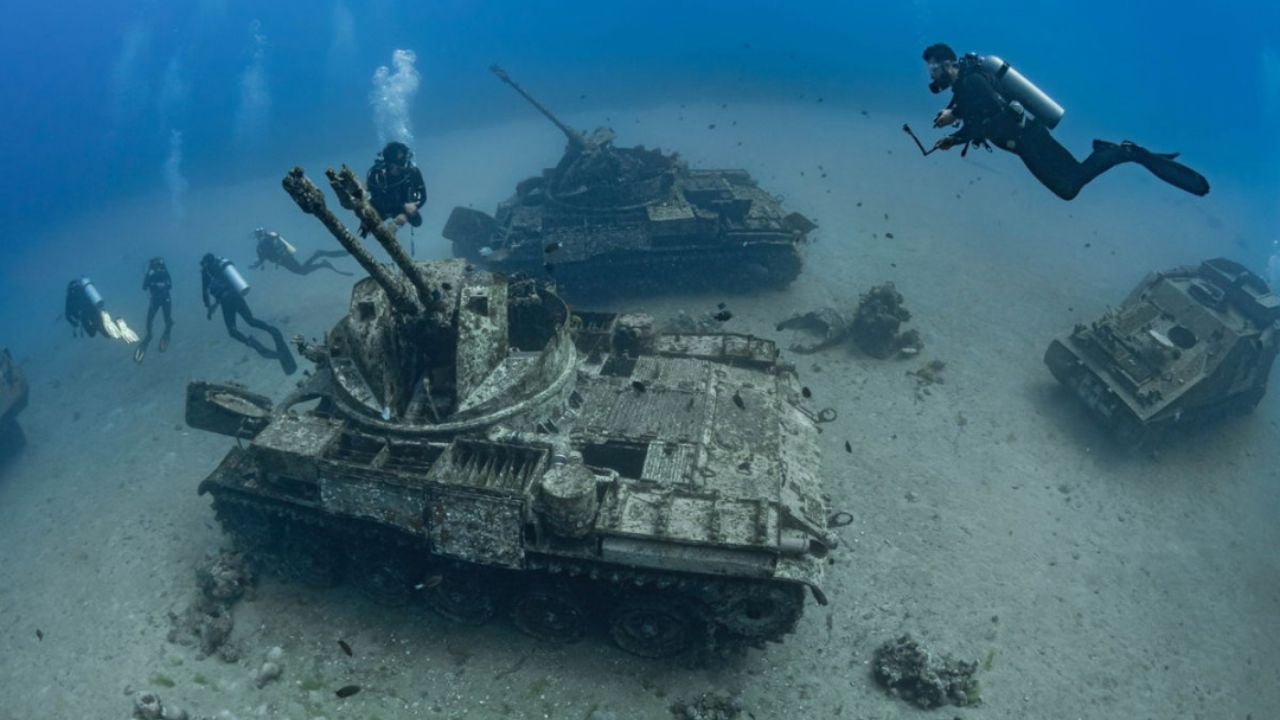

There’s something eerie about the idea of armored war machines resting silently beneath the sea. Steel giants built for destruction, now frozen in time, surrounded by coral and drifting fish.
It sounds like the aftermath of a forgotten battle. The reality is far more deliberate and, in its own way, just as fascinating.
As told on AOL by Far & Wide, there is indeed what looks like an “army” of tanks at the bottom of the Red Sea.
But this is no accident, no wartime loss, and certainly no mystery waiting to be solved. It is a carefully staged underwater attraction that blends military hardware with marine life in a way that feels almost cinematic.
Underwater Army Donated by the Royal Jordanian Army
Back in 2019, the country of Jordan decided that, instead of letting old military equipment sit idle or rust away on land, authorities sank dozens of decommissioned vehicles off the coast near Aqaba. That’s right; they were sunk on purpose.
The lineup is striking, though.
Tanks, armored personnel carriers, ambulances, even a helicopter were placed on the seabed in formation, creating what looks like a convoy caught mid-mission.
But the goal here was more than just spectacle for its own sake.
Jordan was building something unique. An underwater military museum designed to attract divers and snorkelers from around the world. And it worked. The site offers a rare mix of history, engineering, and nature, all in one place.
Picture descending into clear blue water and suddenly spotting the outline of a tank emerging from the depths. Its once-intimidating silhouette now softened by coral growth.
Fish weave through open hatches. Sunlight filters down, bouncing off metal surfaces that once rolled across desert terrain. It is a surreal collision of two worlds that were never meant to meet.
Out with the Old, In with the New
The tanks and vehicles sunk off Aqaba were not battlefield wrecks. They are decommissioned equipment from the Jordanian Armed Forces, deliberately placed in 2019 to create the world’s first Underwater Military Museum.
They’re not at the bottom of the sea because they were lost in combat. Instead, they represent decades of Jordan’s military history repurposed for tourism and marine conservation.
Speaking of Jordan’s military history, Jordan’s armed forces acquired much of this hardware during the Cold War era, often from Western suppliers. They were primarily used for training, border defense, and peacekeeping missions, rather than direct involvement in large-scale wars.
While Jordan fought in the 1967 Six-Day War and the 1973 Yom Kippur War, most of the equipment now underwater dates from later decades. By the 1980s–1990s, Jordan’s military role shifted toward internal security and regional stability, meaning many of these machines saw limited combat use.
Jordan modernized its forces in the 2000s, older vehicles became obsolete. Instead of scrapping them, the government chose to recycle them into a cultural and ecological project.
A Beautiful Transformation
View this post on Instagram
For automotive and military enthusiasts, there is something especially compelling here. These machines were built with purpose, engineered for durability, power, and survival in harsh environments.
Now they face a completely different test. Saltwater, pressure, and time. Yet even in this new setting, their presence remains commanding.
There is also a deeper layer to the story.
By sinking these vehicles, Jordan effectively gave them a second life. Instead of becoming scrap, they now serve as artificial reefs, supporting marine ecosystems.
Coral attaches to their surfaces. Small fish find shelter. Larger predators circle nearby. What was once designed for conflict now contributes to growth and biodiversity.
That contrast is hard to ignore. Weapons of war transformed into habitats for life. It is the kind of visual and symbolic shift that sticks with you long after you surface.
The arrangement itself adds to the drama.
The vehicles were positioned intentionally, almost like a paused scene from a war film. Tanks sit as if advancing. Transport vehicles follow behind. It creates the illusion of motion, even though everything is perfectly still.
Engineering Becomes Art
And that is where this story hits differently for an automotive audience. We often talk about machines in terms of performance, design, and innovation. Rarely do we see them recontextualized in such a dramatic way. Here, engineering becomes art. Utility becomes storytelling.
There is no engine noise, no tracks grinding against dirt, no urgency.
Just silence, broken only by the movement of water and marine life. Yet the presence of these machines still carries weight. They remind you of what they were built for, even as they serve a completely new purpose.
Sources: Far & Wide