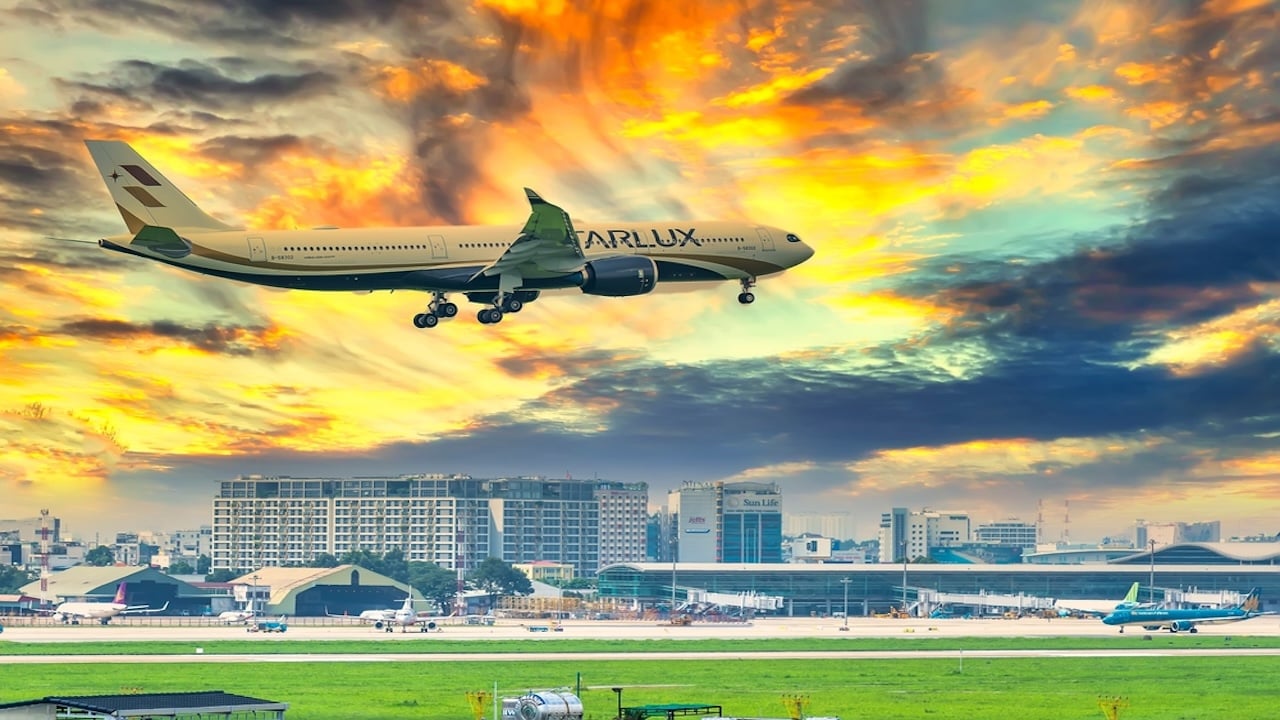
Taiwan’s premium carrier STARLUX Airlines has officially taken delivery of its first Airbus A350-1000, becoming the first Taiwanese airline to operate the world’s longest-range commercial aircraft and setting the stage for direct flights to Europe and the U.S. East Coast for the first time in the airline’s history.
Historic Delivery Marks New Chapter for Taiwan Aviation
STARLUX Airlines of Taiwan has taken delivery of its first of 18 A350-1000s, becoming the 11th global operator of the largest version of the A350. The aircraft, registered B-58551, arrived at Taipei’s Taoyuan International Airport on January 6th after being personally piloted from Airbus’s Toulouse facility by STARLUX Chairman K.W. Chang—himself a qualified pilot.
The arrival of its first A350-1000 sees the carrier inaugurate the type into its fleet for the first time, joining ten A350-900s already in service. The milestone delivery positions STARLUX ahead of its Taiwanese competitors EVA Air and China Airlines, both of which have ordered the A350-1000 but have yet to take delivery.
Game-Changing Range Opens New Possibilities
The A350-1000’s extended capabilities represent a quantum leap for STARLUX’s route network. With a range of up to 9,700 miles (15,600 km) and powered by a pair of Rolls-Royce XWB turbofans, the A350-1000 has been earmarked to play a key role in the airline’s expansion into North American and European markets.
STARLUX CEO Glenn Chai emphasized the aircraft’s strategic importance: “With extended range compared to the A350-900, this aircraft can reach the U.S. East Coast while delivering exceptional fuel efficiency and superior passenger comfort, allowing us to extend our signature service from Taipei to even more destinations across North America and Europe”.
Europe in the Crosshairs for 2026

The most significant development for travelers is STARLUX’s confirmed European expansion timeline. The airline plans to launch its initial European routes in the second half of 2026, with additional aircraft deliveries enabling future services to the U.S. East Coast.
This marks a historic moment for Taiwan’s aviation landscape, as STARLUX prepares to become the first new Taiwanese carrier to operate regular European services in decades. Chai added that STARLUX’s first European flights will begin in the second half of 2026, with additional U.S. markets to launch as the airline takes additional A350 deliveries.
Massive Fleet Expansion Underway
STARLUX’s A350-1000 delivery is just the beginning of an ambitious expansion plan. The airline expects to take delivery of all 18 A350-1000s by 2031, with the first batch of 10 originally ordered back in 2020 being delivered through 2027.
The airline expects to receive a further five A350-1000s this year, alongside seven A321neos and additional A330neos, as part of its aggressive growth strategy that will see the fleet expand to 48 passenger aircraft by 2027.
Distinctive New Look for the Flagship
To mark this milestone, STARLUX has unveiled a striking new livery that sets the A350-1000 apart from the rest of its fleet. The design integrates the airline’s signature visual elements with a carbon-fibre motif, representing the advanced composite materials integral to the aircraft’s construction.
A bold “1000” decal adorns the aircraft’s rear fuselage, underscoring the aircraft’s status as the largest member of the A350 family and STARLUX’s new long-haul flagship.
Premium Cabin Configuration Maintained
The A350-1000 features 350 seats in a four-class configuration with four first class seats, 40 business class seats, 36 premium economy seats, and 270 economy seats. This represents an increase of 44 seats over the A350-900, primarily through 14 additional business class seats and 30 extra economy seats.
The aircraft maintains STARLUX’s signature premium experience, featuring the acclaimed Collins Aerospace Element business class seats that have earned recognition as among the industry’s best, along with the airline’s unique first class offering.
Strategic Positioning Against Asian Giants
The A350-1000 delivery gives STARLUX a significant competitive advantage in the increasingly crowded Asia-Pacific market. The A350 family has more than 1,400 orders from 60 customers, with 157 ordered in 2025, and over 650 planes in service with 38 operators today.
STARLUX’s early commitment to the type, signing its original order at the 2018 Farnborough Airshow, has positioned the carrier ahead of regional competitors in securing delivery slots during a period of high demand for the aircraft.
Environmental Performance
The A350-1000’s environmental credentials align with STARLUX’s sustainability goals. Airbus notes that the A350 can already operate with up to 50% Sustainable Aviation Fuel (SAF) in its effort to further reduce emissions, even beyond the 25% lower fuel consumption levels already offered by the jet.
What’s Next
STARLUX is widely expected to announce a range of new routes to Europe and the US East Coast to be added to its network in the second half of 2026 once experience with the variant has been acquired.
With the airline currently serving five U.S. destinations, Los Angeles, Ontario, San Francisco, Seattle, and soon Phoenix, the A350-1000’s range opens possibilities for destinations like New York, Chicago, Dallas, and Washington D.C. on the East Coast, while European destinations such as London, Helsinki, and other major hubs become viable for the first time.
For travelers, this development represents a seismic shift in Pacific aviation. STARLUX’s premium service standards, combined with the A350-1000’s industry-leading comfort and efficiency, promise to bring a new level of luxury to trans-Pacific and future transatlantic travel from Taiwan. The airline’s rapid growth trajectory suggests that within just a few years, STARLUX could emerge as a major global player, offering travelers premium alternatives on some of the world’s longest routes.