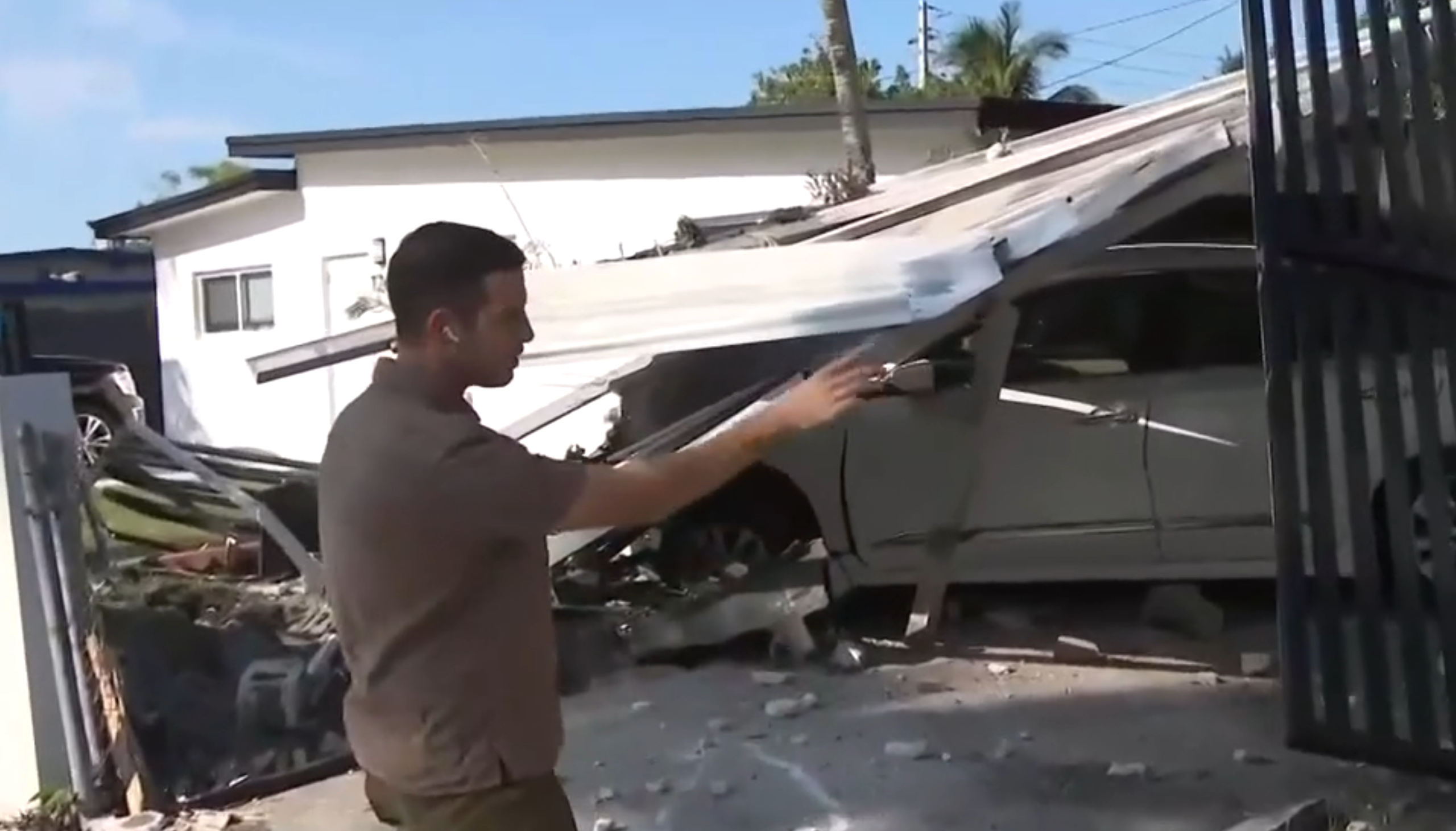
A Miami woman left her house early Saturday morning to pick up her kids for the start of summer vacation. She came back to find a car had plowed through her front yard, crushed the nose of her brand-new vehicle, and taken out part of her carport wall. The damage estimate came in at over $50,000. The driver walked away without accepting medical transport. And to top it off, he had no insurance.
This is the part of car culture nobody wants to talk about: the aftermath. Not the crash itself, not the police tape, but the homeowner standing in her driveway doing the math on repairs she never budgeted for, on a Saturday that was supposed to be the first day of a family vacation. The scenario is grimly familiar to anyone who has spent time around cars and the people who treat public roads like a private racetrack.
The incident occurred just before 8:20 a.m. on June 14 in the 12000 block of Northwest 22nd Avenue near Northwest 127th Street in Miami-Dade County. According to the homeowner, who has lived on the street for 14 years, excessive speed in the neighborhood is nothing new. She had seen it coming, in a sense. Most people who live on streets like hers have. The only question was always when and whose property would take the hit.
What makes this story worth paying attention to is not just the dollar figure or the dramatic images of a car embedded in a residential yard. It is the compounding effect of one driver’s recklessness on someone who did everything right: she owned her home, maintained her property, parked her new car legally in her own driveway, and was simply not there when a stranger’s speeding turned her front yard into a demolition site.
The Damage Was Thorough and Expensive
The vehicle tore through the property with enough force to destroy a portion of the boundary wall, collapse part of the carport structure, and crush the front end of a recently purchased car parked in the driveway. A second vehicle parked along the street was also struck during the sequence. The homeowner put the total damage figure at more than $50,000, and given the variety of structures and vehicles involved, that estimate is not hard to believe.
For context, carport reconstruction alone can run anywhere from $6,000 to $20,000 depending on materials and labor costs in South Florida, where construction prices have climbed steadily in recent years. Add structural wall repair, a totaled or heavily damaged newer vehicle, and incidental landscaping and concrete work, and $50,000 starts to look conservative.
Uninsured and Unaccountable
The driver refused transport by emergency responders, which means he was mobile enough to decline help on the scene. Whether he was cited, arrested, or charged with anything had not been confirmed by authorities as of the time of reporting. That uncertainty alone is frustrating for anyone who believes in basic accountability on the road.
The uninsured status is the real gut punch here. Florida has one of the highest rates of uninsured drivers in the country. According to the Insurance Research Council, roughly one in five Florida drivers carries no auto insurance at all, a figure that consistently ranks the state among the worst in the nation. When an uninsured driver causes a crash of this magnitude and walks away, the financial burden does not disappear. It transfers entirely to the victim and, if they carry uninsured motorist coverage, their own insurer.
Why Uninsured Motorist Coverage Matters More Than Ever
This crash is a textbook illustration of why automotive advocates and insurance professionals keep pushing drivers to add uninsured and underinsured motorist coverage to their policies. Standard liability insurance protects other people from you. Uninsured motorist coverage protects you from everyone else, and in Florida, “everyone else” increasingly includes a significant portion of the drivers on any given road.
The homeowner’s regular homeowners insurance may cover some of the structural damage, though policies vary widely on vehicle coverage and whether a car in a private driveway falls under an auto or home claim. Sorting out which carrier is responsible for what adds time, paperwork, and frustration to an already miserable situation.
Residential Speeding Is a Structural Problem, Not Just a Human One
The homeowner made a pointed comment in the aftermath of the crash: she hopes the city does something about speeding in the area, and noted she is not the only neighbor affected. That kind of statement, after fourteen years on the same block, carries weight. This was not a random fluke on an open highway. It was a predictable outcome on a residential street where drivers routinely exceed safe speeds.
Traffic engineers and road safety researchers have spent decades documenting the relationship between street design and driver behavior. Wide, straight residential streets with minimal visual friction tend to encourage higher speeds regardless of posted limits. Interventions like speed tables, curb extensions, and narrowed travel lanes have shown measurable results in reducing both speeds and crash severity. Whether the city of Miami-Dade responds to this incident with any of those tools remains to be seen, but the homeowner’s request is entirely reasonable and backed by established research.
No injuries were reported in the crash. The homeowner said she was grateful for that, even as she braces for a repair process that will take considerable time and money. She had already been working on improving the house before Saturday morning. Now that timeline has gotten considerably longer.