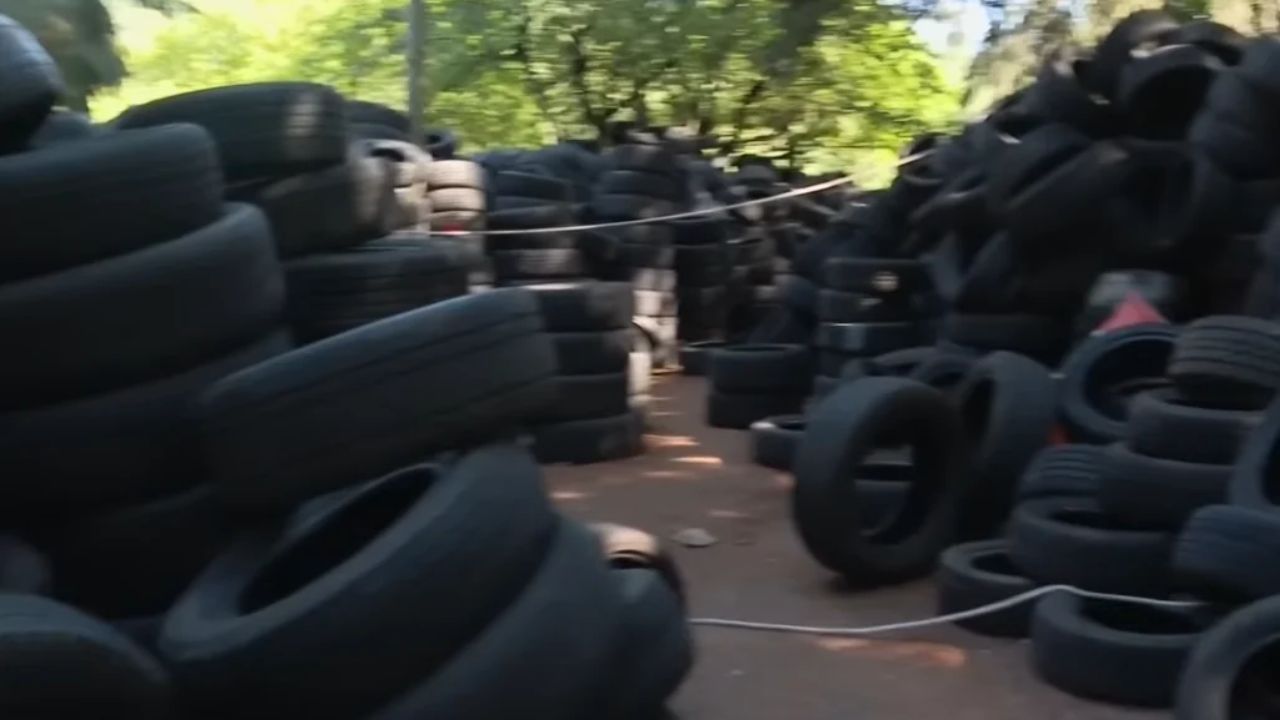
A Portland man bought a 1.2-acre lot in April with plans to build his family’s future home. What he got instead was a rubber nightmare stacked six feet high across nearly every inch of his property. When Khanh Tran returned to the land near Southeast 174th Avenue and Powell Boulevard in early June with a contractor in tow, he found roughly 75,000 discarded tires blanketing the site, turning his building plans into a waiting game with no clear end date.
At the time of purchase, there were maybe 50 tires on the property, enough that Tran had already agreed to deal with them as part of the sale. Nobody anticipated an ocean.
The math on 75,000 tires is worth sitting with for a moment. The property is 1.2 acres. That works out to more than a pound of rubber per square foot, assuming you could even walk across it, which Tran largely cannot.
Neighbors reported watching U-Haul trucks and cube vans pulling up over several days in May, dropping load after load and leaving. Jim Robertson, who lives next door, says he contacted the Multnomah County Sheriff’s Office and was told they could not intervene because the dumping was happening on private property. The trucks kept coming anyway.
Tran’s situation has since drawn in the Sheriff’s Office, Metro, the county health department, and the Oregon Department of Environmental Quality, all of whom are now investigating. The Multnomah County Sheriff’s Office confirmed it is treating the case as potential trespassing and what Oregon statutes call “offensive littering,” a term that considerably undersells 75,000 tires.
Oregon DEQ and the county health department are also looking into the environmental impact of the dump. Tran says the involvement of multiple agencies has given him some confidence, even as the tires remain exactly where they were left.
There is also a baby on the way. Tran and his wife are expecting their first child this month, which adds a particular edge to the situation. He has set up a GoFundMe to cover removal costs while investigators work the case, and he is holding out hope for some form of legal recourse once the responsible party is identified.
His attitude, given the circumstances, is almost disarming. He has said publicly that he thinks he might be the right person to take on this challenge, which is either remarkable optimism or what happens when you simply have no other option.
Portland’s Tire Dumping Problem Goes Well Beyond One Property
Since January, Metro crews have removed more than 14,000 illegally dumped tires from public areas across the Portland metro region, at taxpayers’ expense. 5,600 of those tires were collected in May alone. Those numbers reflect only public property.
Private properties like Tran’s are outside Metro’s jurisdiction under its RID Patrol program, meaning the agency can document and investigate but cannot physically intervene. The county has similarly stated it does not currently have the resources to clear the site.
What makes Tran’s case unusual is the sheer concentration of tires in one location. The regional numbers are staggering enough on their own, but 75,000 tires on a single 1.2-acre lot suggests something more organized than opportunistic littering.
Investigators have not confirmed a motive or identified a suspect, but the logistics involved, multiple trucks over multiple days, points to someone who was actively managing a tire collection operation and eventually ran out of somewhere legitimate to put the inventory.
Why Illegal Tire Dumping Is a National Problem, Not a Local One
Portland is not uniquely careless. Illegal tire dumping costs exceed $100 million annually across the United States, and the underlying economics make the problem predictable. Proper tire disposal fees range from under a dollar per tire in some states to $10 in others, which sounds manageable for a single set of four, but multiplies fast for anyone collecting or handling tires in volume.
A shop, a fleet operator, or anyone pulling tires from other businesses at scale faces real disposal costs that illegal dumping eliminates entirely, while shifting the burden onto property owners and local governments.
Forty-eight states have laws or regulations specifically addressing scrap tires, yet enforcement is difficult when dumping happens quickly, on private land, and often at night or across a few days in vehicles that blend into normal traffic.
The EPA classifies tires among the most commonly found materials at illegal dump sites nationwide. Once a site exists, it tends to attract more dumping, as whoever is responsible knows the location has already been used and apparently tolerated.
The Fire Hazard Nobody Wants to Think About
The Multnomah County Sheriff’s Office noted that the accumulation of waste tires presents a fire hazard and could violate Oregon’s waste tire regulations. This is not a trivial concern. Tire fires are notoriously difficult to extinguish and can burn for weeks or months, releasing dense black smoke loaded with toxic compounds including benzene, polycyclic aromatic hydrocarbons, and heavy metals into the surrounding air and soil. Water runoff from a burning tire pile contaminates ground and surface water, sometimes for years afterward.
Waste tire stockpiles can also create breeding grounds for mosquitoes and rodents, depressing property values and diminishing the livability of surrounding neighborhoods. Tran’s neighbors are right to be frustrated. The Robertsons described the property next door as once beautiful, and it is now a hazard with a GoFundMe attached to it, through no fault of the owner.
What Happens Next, and What You Can Do
Investigators across multiple agencies are working to identify whoever is responsible for the dumping. Oregon statutes covering offensive littering and trespassing carry financial penalties, though the scale of fines would need to be significant to make a dent in the cleanup costs here.
Tran has said publicly that whoever did this needs to be found and “deeply fined,” a sentiment his neighbor echoed almost word for word. Whether investigators can actually trace the trucks and drivers back to an identifiable party remains an open question.
In the meantime, Metro is asking residents across the Portland region to report illegal dump sites through an online form, including any tire dumping they observe on public or private property. The reports are straightforward to file and take only a few minutes.
Given that the Robertsons watched trucks coming and going for days before anything was officially documented, earlier reporting might have shortened the window considerably. If you see something that looks like a staged dumping operation, the time to call is before the fifth truckload, not after.