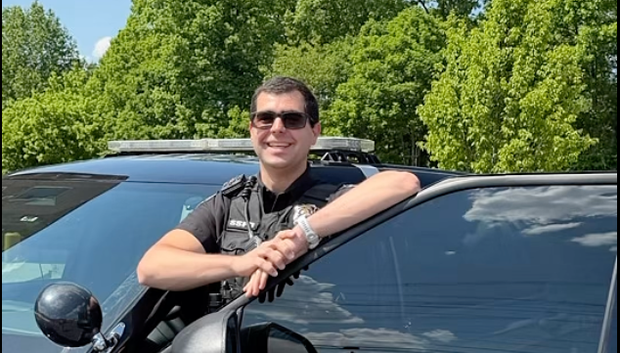
There are calls that officers respond to every single shift, so routine they become almost second nature. Traffic accidents, cone placement, redirecting drivers. It is the kind of work that feels unglamorous but necessary, and most of the time, it goes without incident. For Sandy Springs Officer Citta, one September night on SR-400 turned that routine moment into something he will never forget.
On the evening of September 20, Officer Citta was dispatched to a crash on SR-400, just north of Hammond Drive. He was doing exactly what officers are trained to do at an accident scene: placing traffic cones and keeping the area as safe as possible for everyone involved. What he could not have prepared for was what came next. A motorcycle traveling at a high rate of speed suddenly lost control, ejecting its driver and sending the now-unmanned bike careening directly into Citta and the vehicle already involved in the scene.
The collision was devastating. Multiple bones in Citta’s legs were broken, and the road to recovery was anything but quick. It took him eight full weeks before he could walk again. From there, months of physical therapy followed before he was cleared to return to the job he clearly loves.
After six months away from the badge, Citta is back. And if the way he talks about his first day back in uniform is any indication, the time away only deepened his commitment to the work.
The Emotional Weight of Putting the Uniform Back On
For anyone who has worked through a serious injury, that first day back is layered. It is excitement, yes, but also something harder to name. Citta described it as a combination of anxiety and excitement rolled into one, happy to be returning to the department but still carrying the weight of everything that happened on that highway.
That kind of honesty is worth sitting with. Officers are often expected to project strength and stoicism, but Citta’s transparency about his nerves reflects something more realistic and, frankly, more human. Serious physical trauma does not just heal in the body. It leaves marks in the mind too, and acknowledging that is part of a healthy recovery, not a weakness.
From Broken Bones to a 5K Finish Line
One of the most striking parts of Citta’s recovery story is not the return to work itself, it is what he did alongside it. Citta set a goal to run a 5K, a distance that might seem modest to some but carries enormous meaning for someone who spent eight weeks relearning how to walk. He did it, and he did not do it alone.
Sandy Springs Police Chief and fellow officers reportedly joined him for the run, which speaks to something important about the department culture. Recovery is not a solo effort, and moments like a community 5K are the kind of thing that can carry someone through the harder days of physical therapy and uncertainty.
What We Can Learn From This Incident
Officer Citta’s story is a reminder that first responders face physical danger not just in dramatic pursuits or confrontations, but in the most everyday tasks. Standing on a roadway is genuinely dangerous work, and crashes at active accident scenes are not rare. Studies from various transportation safety organizations have long noted that roadway workers and emergency responders are at elevated risk from secondary collisions, especially on high-speed roads like SR-400.
The driver responsible for the crash, identified as Riad I. Ahmed, is now facing charges including driving under the influence and reckless driving. That detail matters because it underscores just how preventable this kind of incident is. An officer doing his job was seriously injured because someone else chose to get behind a motorcycle impaired. The consequences rippled out in ways Ahmed likely never considered: months of pain for another person, a family’s worry, a community left without an officer, and a long road of rehabilitation that no one should have to walk.
For drivers, the takeaway is blunt. Slow down near accident scenes. Stay sober. Move over when you see emergency lights.
How Citta’s Advice Can Apply Beyond Law Enforcement
When asked what he would say to other officers recovering from on-the-job injuries, Citta kept it focused and practical. Push hard, stay within doctor’s orders, and give it everything you have. It is not complicated advice, but it is the kind that works, the kind built from lived experience rather than a pamphlet.
That message extends beyond the badge. Anyone pushing through a long physical recovery, whether from a workplace injury, a car accident, or surgery, can find something useful in that framing. Progress is not always visible day to day. Motivation fades. But having a goal, whether that is returning to work or crossing a 5K finish line, gives the hard days a reason.
Officer Citta found his reason. And by the looks of it, Sandy Springs is glad to have him back.