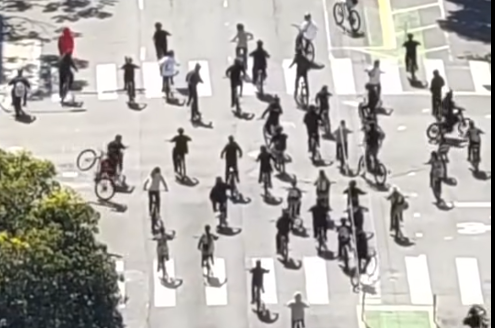
A planned takeover on the Bay Bridge didn’t just get shut down; it got completely boxed in.
According to a statement from the San Francisco Police Department and the California Highway Patrol, officers intercepted a large group attempting to take over the bridge on March 28. What followed was about as clean an enforcement outcome as you’ll see in a situation like this. Everyone was detained without incident, eighty-five citations were issued, and eighty-five bikes were taken and stored.
Online, people had a lot to say about it.
A Viral Moment With Strong Reactions
Embedded video follows, please allow a moment for it to load.
The video of the shutdown quickly took off, pulling in more than 78,000 likes and over 9,000 comments on Facebook alone. That kind of engagement usually means one thing: people aren’t just watching, they’ve picked a side.
For many viewers, this felt like a rare moment of coordination and follow-through. The idea that officers anticipated the takeover, positioned themselves, and effectively trapped the group on the bridge stood out. “They boxed themselves in… what did they think was gonna happen?” one commenter wrote. Another summed up the tone more bluntly: “Play stupid games, win stupid prizes.”
A steady stream of reactions focused on the outcome itself, not just the citations, but the bikes. “They rode in… and walked home,” one person joked. “That’s a long walk home,” another added. “Imagine losing a $3,000 e-bike for this.” The visual of dozens of riders suddenly without transportation became part of the story, and for many people, that was the punchline.
The Cyclist Label Doesn’t Really Fit
One thing that keeps coming up in coverage is the word “cyclists,” and it’s doing a lot of work here that probably doesn’t match what people actually saw.
This wasn’t a group training for a triathlon or logging miles for a weekend ride. It wasn’t a club ride or anything resembling organized cycling in the traditional sense. Based on the video and online reactions, this was largely teenagers and young adults riding in a large, loosely organized group, many on e-bikes, treating the roadway more like a stage than a route.
That distinction matters because when incidents like this get labeled broadly as “cyclists,” it tends to pull in an entirely different group of people who aren’t part of this kind of behavior at all. Some commenters picked up on that immediately. “As a cyclist, this kind of stunt makes it worse for everyone,” one person wrote. “They’re not representing actual cycling culture.” “There are ways to ride and advocate safely, this isn’t it.”
In other words, this wasn’t about endurance riding or even transportation. It was about the takeover itself, and the reaction reflects that people understood the difference.
What Happens to 85 Bikes?
One of the biggest threads running through the comments wasn’t about the citations; it was about what happens next.
Many people immediately jumped to the idea of impound-style penalties. “Impound fee plus storage fee plus citation equals $$$ for the city,” one comment read. “Give them 30 days like cars,” another suggested. “Make them pay to get them back, simple.”
Others took it in a different direction, arguing the bikes shouldn’t go back at all. “Donate them to kids who actually need bikes.” “Christmas came early for Toys for Tots.” “Recycle them and give the money to charity.”
There were also plenty of people eyeing a more practical angle. “So when’s the police auction?” “I’ll take one of those e-bikes for cheap.” That mix of reactions—punishment, redistribution, opportunism—pretty much captures where public sentiment is right now.
Accountability vs. Overreach
Beyond the jokes, there was a real debate underneath it all about what the right response should be when groups take over major infrastructure.
Some commenters pushed for tougher consequences. “Treat this the same as street racing.” “Community service cleaning streets would hit harder.” “Parents should be held responsible if they’re minors.”
Others framed it as a safety issue. “Blocking a bridge isn’t a protest, it’s a hazard.” “There’s a difference between demonstrating and shutting down infrastructure.”
At the same time, not everyone was on board with how it played out. “Didn’t realize they still enforce laws in San Francisco,” one person wrote. “Meanwhile, real crimes go ignored,” another added. “‘Stored’ is an interesting way to say seized.”
Even among critics, there wasn’t much defense of riding onto a bridge in a large group and stopping traffic. The disagreement centered more on priorities and consistency than the act itself.
The Bigger Picture
The reaction makes one thing clear: people are paying attention to how these situations are handled, and they’re forming opinions quickly.
Some see this as exactly what enforcement should look like—coordinated, controlled, and without escalation. Others see it as selective enforcement in a city that’s often criticized for going the other direction.
The combination of a highly visible location, a large group, and a clean police response turned this into more than just another local incident. It became a flashpoint for a broader conversation about safety, accountability, and where the line is between expression and disruption.
For the 85 riders who got caught in the middle of it, the outcome was simple.
They showed up on bikes. They left without them.