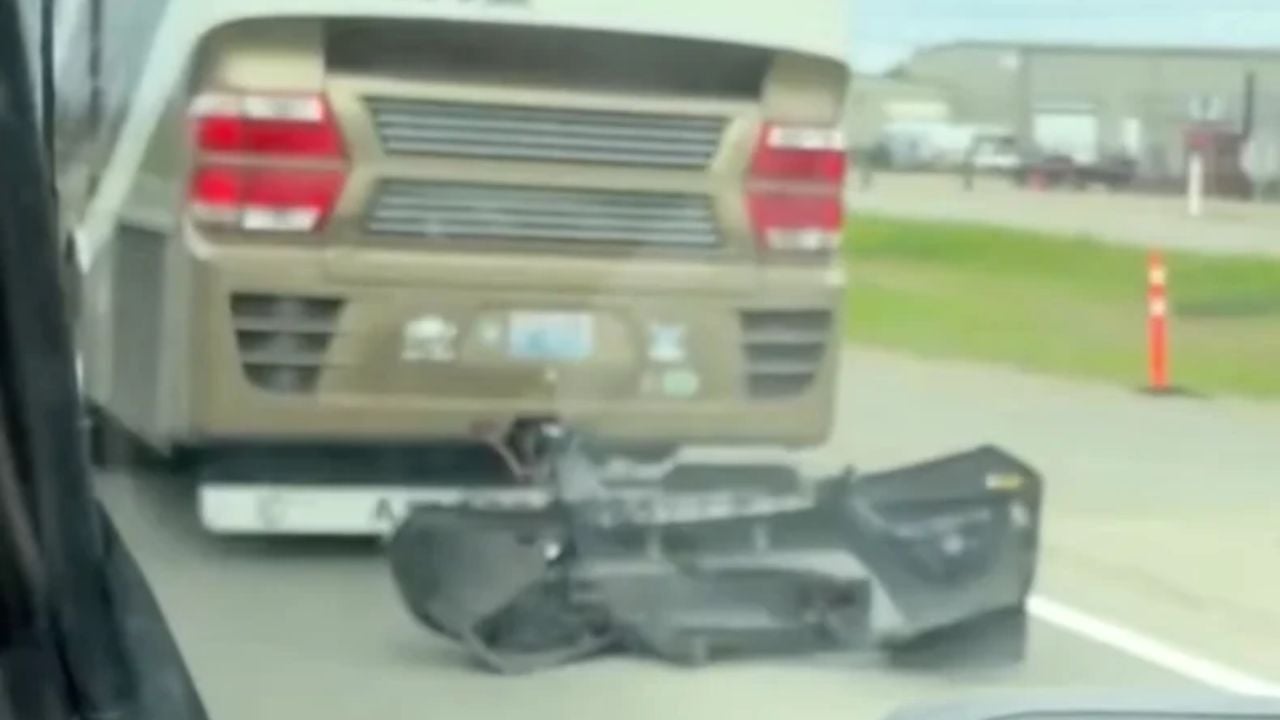
There is a particular kind of dread that comes with glancing in the rearview mirror and realizing something is missing. For David and Jennifer Sinclair, veteran full-time RV travelers, that something was most of the front end of their Chevy Colorado. It was sitting in the middle of a Canadian road, minding its own business, while their motorhome continued down the highway, blissfully unaware it had just deposited a truck’s worth of metal on the pavement.
The Sinclairs were en route to Alaska, fueled up in Fort St. John, British Columbia, and merging back onto the highway when the tow base plate connecting the Colorado to their Tiffin Allegro Bus Class A motorhome gave out. The front frame of the truck failed at the base plate connection point, separating the truck from the towing hardware and taking the bumper right along with it.
The good news: the motorhome happened to be stopped at an intersection when it happened, so the truck didn’t go careening into traffic. The less good news: the Sinclairs didn’t immediately notice and pulled away, dragging the detached bumper down the road behind them.
A bystander filmed the whole thing, posted it with the deadpan caption “I think you lost something,” and the internet did what the internet does. The video racked up millions of views. The Sinclairs, who have spent years sharing their North American travels through their Sinclair Trails blog and YouTube channel, found themselves going viral in a way they had not planned for. The kind stranger who filmed the clip also flagged them down to deliver the news in person, which, under the circumstances, was probably the more useful contribution.
The Sinclairs recovered the truck, drove both vehicles home separately to avoid any further drama, and are already talking about giving Alaska another shot in a year or two. Their Colorado, affectionately named “Samwise,” survived the ordeal. The motorhome, known as “Bill the Pony,” may be heading toward retirement.
The couple has been floating the idea of downsizing to a van or B+ class rig, and one imagines this incident did not make the case for keeping the current setup.
What Is a Tow Base Plate and Why Does It Matter So Much
I think you lost something. pic.twitter.com/83NfZnwF70
— Planet Of Memes (@PlanetOfMemes) June 7, 2026
For those outside the RV community, the tow base plate is a piece of hardware most people never think about until something like this happens. It is a vehicle-specific metal bracket bolted directly to the towed vehicle’s frame, serving as the hard connection point between the car and the tow bar running back to the motorhome.
The entire engineering premise of flat towing, where all four wheels of the towed vehicle stay on the ground, depends on that base plate doing its job under sustained road forces, vibration, and braking stress.
Industry guides are consistent on this point: base plates are engineered to transfer the stress of towing and braking more evenly, which is essential when flat towing so that the towed vehicle does not sustain damage. They bolt to the frame, not to the bumper itself, which is why a base plate failure can pull the bumper right off with it.
A safe flat towing setup is a complete system, not just a tow bar, requiring properly rated base plates, safety cables, electrical wiring, and a supplemental braking system, and each component must work together correctly. When one link in that chain fails, the consequences can range from cosmetic to catastrophic.
The Risks of Flat Towing That the RV World Tends to Understate
Flat towing is enormously popular among full-time RV travelers because it allows them to bring a second vehicle without the bulk of a tow dolly or trailer. Park the motorhome at the campsite, unhook the car, and suddenly you have something manageable enough to run into town. The tradeoff is a setup that carries real mechanical demands that are easy to overlook once it becomes routine.
Loose or improperly attached tow bars, base plates, or safety cables can lead to dangerous situations on the road, and even experienced RVers can make mistakes when flat towing. Frame flexing, road vibration over thousands of miles, and repeated hookup and unhookup cycles all put cumulative stress on base plate mounting hardware.
Flexing at the base plate installation points can adversely affect both the frame and suspension of the towed vehicle. What was a solid installation at the start of a trip may not look the same after several months of cross-country travel, particularly in a setup that sees the kind of mileage the Sinclairs log.
The Internet Responded the Way the Internet Usually Does
Sinclair has been direct about how the public reception has gone. The comment sections divided predictably into sympathy, misinformation, and what he described plainly as a lot of trolls showing a lack of empathy. He addressed the most common armchair critique head-on: no, they did not drag the truck for miles, they caught it within a minute.
No, not having eyes fixed on the rear camera during a highway merge is not negligence. And to the assumption that anyone living full-time in a luxury motorhome must be wealthy enough to absorb this casually, his response was three words: “We’re not rich Boomers.”
The Sinclairs sold a five-acre homestead with chickens, ducks, bees, and what Sinclair describes as feral cats to fund this lifestyle. Both work remotely while traveling, he as an app developer through his company Dejal, Jennifer as a technical writer. The Alaska trip represented a significant stretch of their ongoing journey across North America, one they have now postponed rather than abandoned.
Given that they have already crisscrossed the United States multiple times and took a separate campervan trip through New Zealand, a broken base plate in British Columbia is probably not going to keep them parked for long.
A Reminder About Pre-Trip Inspections That Every Tow Setup Owner Should Take Seriously
The Sinclair incident is a useful reminder that tow hardware requires inspection, not just at installation, but on an ongoing basis. Failing to secure tow connections properly is a frequent mistake, and the time to double-check every connection is before departure, not after something has already gone wrong.
For setups that see heavy mileage, spot-checking base plate hardware, looking for signs of frame stress around mounting points, and verifying that safety cables are in good condition and properly connected should be standard practice before any significant leg of a trip.
The safety cables are not just a formality. They exist precisely for scenarios like this one, to keep a disconnected toad from becoming a road hazard or worse. In the Sinclairs’ case, the failure happened at a stopped intersection rather than at highway speed, which was the difference between an expensive headache and a genuinely dangerous situation.
That margin of luck is not something worth counting on a second time. For anyone running a similar flat tow setup, the Sinclairs’ viral moment is a reasonably compelling argument for getting under the front end and taking a close look before the next long haul.