

Cars and rock music go together like premium gas and your wallet crying. For decades, musicians have been name-dropping specific makes and models in their songs, turning ordinary vehicles into cultural icons and giving car enthusiasts something to sing about while they’re elbow-deep in engine grease.
We wanted to celebrate some of our favorite tunes that don’t just mention cars in passing, but basically act as love songs to certain cars or even just the experience of being behind the wheel. These are tracks where the vehicle is practically a band member, complete with its own spotlight and probably better stage presence than the drummer.
When musicians bring specific makes and models into their lyrics, the songs take on even greater impact. Each mention ties the music to a cultural moment, linking melody with horsepower and rhythm with the road. Whether it’s a Chevrolet engine thundering down a drag strip or a Cadillac glowing under neon lights, these cars give the songs their shape and character, and in return, these songs give cars a reputation.
“Maybellene” – Chuck Berry
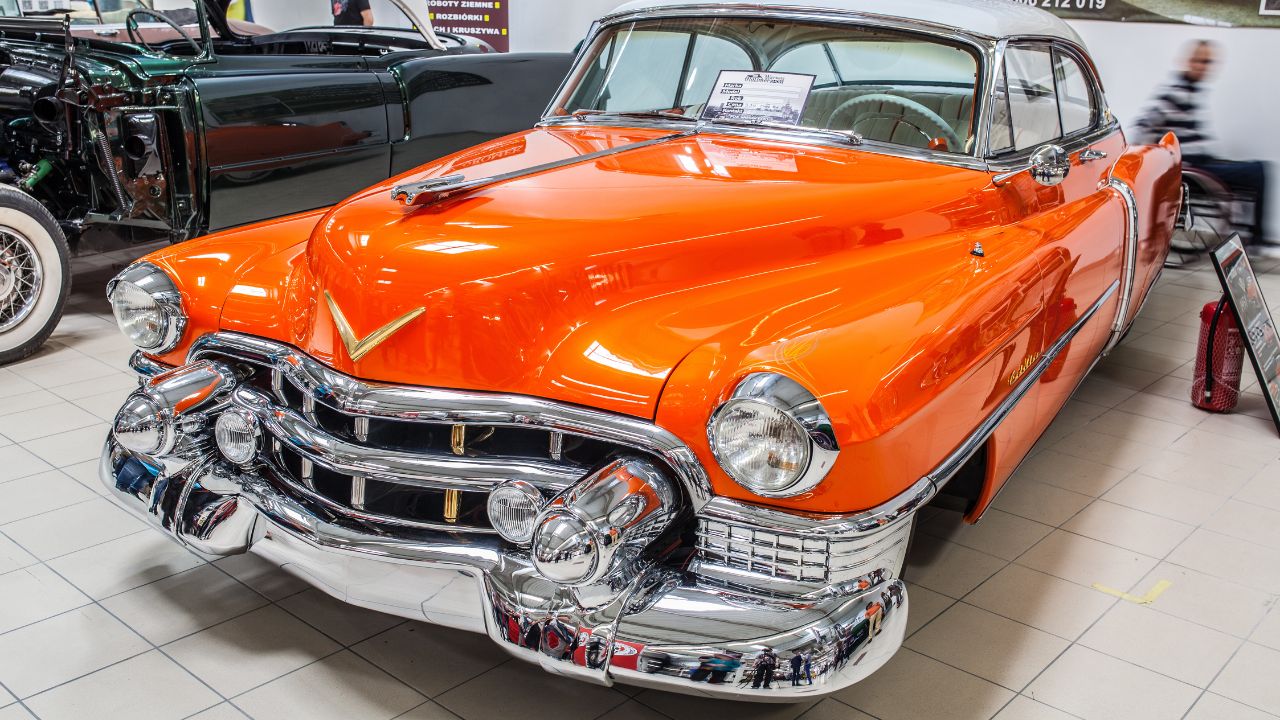
The Cars: Ford V8 vs. Cadillac Coupe DeVille
Chuck Berry practically invented rock ‘n’ roll with this track (okay, not really), and he had the good sense to make it about a car chase. Not just any cars, mind you: he pitted a working-class Ford V8 against a fancy Cadillac Coupe DeVille, creating what might be history’s first automotive class warfare set to music.
The Ford V8 in question was likely the flathead that powered everything from hot rods to farm trucks. With about 100 horsepower on a good day, it wasn’t exactly a tire-scorching monster, but it had heart. Meanwhile, the Cadillac Coupe DeVille was rolling on 331 cubic inches of overhead valve V8 goodness, pumping out around 160 horsepower; enough to make it the clear favorite in any straight-line battle.
Berry’s genius was understanding that this wasn’t really about the cars at all. The Ford represented the everyman, scrapping and fighting to keep up. The Cadillac was aspirational luxury, the car you bought when you’d “made it.” The fact that the Ford driver was chasing down his cheating girlfriend, Maybellene, just added emotional stakes to what was already a perfect automotive metaphor.
Berry originally called the song “Ida Red,” but his record label suggested changing it to avoid copyright issues. They probably didn’t realize they were helping create rock ‘n’ roll history; and definitely didn’t predict that 70 years later, car guys would still be debating Ford vs. Cadillac performance specs in YouTube comment sections.
“409” – The Beach Boys

The Car: 1961-1965 Chevrolet Impala SS with 409 cubic inch V8
The Beach Boys took a break from surfing to deliver what might be the nerdiest car song ever written — and somehow made it cool. “409” wasn’t just about any engine; it was specifically about Chevrolet’s 409 cubic inch V8, the motor that transformed the humble Impala into the SS model that dominated drag strips and teenage dreams alike.
Let’s talk numbers, because car guys love numbers almost as much as they love arguing about them. The 409 started life producing 360 hp in 1961, but by 1963, Chevy had boosted it to 425 hp with the right carburetor setup. For perspective, that was enough power to embarrass most European sports cars while carrying four people and their luggage in air-conditioned comfort.
The Impala SS wasn’t subtle about its intentions. With its distinctive SS badges, bucket seats, and optional four-speed manual transmission, it was Chevrolet’s not-so-subtle way of saying, “Hey kids, want to go fast?” The 409 engine was available with various carburetor configurations, from a mild single four-barrel to the legendary dual-quad setup that could make your neighbors question their life choices every time you fired it up.
The Beach Boys captured all of this mechanical poetry in three minutes of surf-rock harmony, complete with engine sound effects that probably convinced more than a few teenagers to blow their college funds on a used Impala. The song hit #76 on the Billboard charts, which might not sound impressive until you realize it was basically a three-minute Chevrolet commercial that people voluntarily listened to.
Bonus points to the Beach Boys for actually understanding what they were singing about. These weren’t posers; they knew their cars, and it shows in every rev of the engine sounds they worked into the track.
“Little Deuce Coupe” – The Beach Boys

The Car: 1932 Ford Model B Coupe (Modified)
Just when you thought the Beach Boys might run out of car knowledge, they dropped “Little Deuce Coupe,” proving they knew their way around a hot rod shop as well as they knew their way around a recording studio. The “deuce coupe” was hot rod slang for the 1932 Ford coupe, specifically the three-window Model B that had become the holy grail of street rodders.
Why the ’32 Ford? Simple economics and engineering. By 1963, these cars were old enough to be cheap but new enough to have decent frames and body panels. More importantly, Henry Ford’s engineers had given the ’32 a longer wheelbase than previous models, making it perfect for dropping in a later V8 engine, usually a small-block Chevy, because irony is delicious.
The song’s lyrics read like a parts catalog: “She’s got a competition clutch with four on the floor / And she purrs like a kitten ’til the lake pipes roar.” Translation for the non-gearheads: this car had been built for serious business. A competition clutch meant it could handle serious power. The four-speed manual transmission was the hot rodder’s choice for maximum performance, and lake pipes were straight-through exhaust pipes that dumped exhaust under the car for maximum noise and minimal impact on neighbors.
The Beach Boys weren’t just name-dropping parts for street cred: they were describing a very specific type of car that dominated Southern California’s car culture. These deuce coupes were everywhere, rumbling through drive-ins and lining up at drag strips, piloted by teenagers who’d rather spend their paychecks on speed equipment than anything sensible.
What makes the song timeless is how it captured the pride of ownership that every hot rodder understands. This wasn’t about having the most expensive car; it was about having the car that best expressed your personality, even if that personality was “loud and fast with questionable exhaust legality.”
“Little Red Corvette” – Prince

The Car: Chevrolet Corvette (C3 Generation, 1968-1982)
Prince took the Corvette and turned it into a metaphor so smooth it should have come with its own velvet interior. Released in 1982, “Little Red Corvette” hit the airwaves just as the C3 generation Corvette was coming to the end of its 15-year run, making it both a tribute and a fond farewell to one of America’s most distinctive sports cars.
The C3 Corvette was the epitome of 1970s automotive theater — all curves, chrome, and attitude. By 1982, however, it was running on fumes both literally and figuratively. Thanks to emissions regulations and the general malaise of late-1970s automotive engineering, the final C3 Corvettes were producing a whopping 200 hp from their 350 cubic-inch V8s. Modern Honda Accords make more power while getting better gas mileage and actually starting reliably in winter, but are they the subject of a Prince song?
Prince wasn’t concerned with quarter-mile times or EPA ratings. He understood that the Corvette had always been about image as much as it was about performance. The C3’s long hood, flared fenders, and distinctive coke-bottle shape made it instantly recognizable and undeniably sensual: perfect for a song that used automotive metaphors to discuss relationships with the subtlety of a straight-pipe exhaust system.
The timing was perfect, too. The C4 Corvette was on the horizon (though it wouldn’t arrive until 1984), and car enthusiasts were already nostalgic for the C3’s unrestrained styling. Prince’s song captured that moment of transition, celebrating a car that represented an era of American automotive excess that was rapidly disappearing.
The song’s success helped solidify the Corvette’s status as a cultural icon, extending beyond the realm of car enthusiasts. It didn’t matter if your Corvette made 200 horsepower or 400: if Prince sang about it, it was cool. And let’s be honest, most Corvette owners cared more about looking good at the country club than winning races anyway.
“G.T.O.” – Ronny & The Daytonas
The Car: 1964 Pontiac GTO
In 1964, Pontiac pulled off one of the greatest automotive con jobs in history by stuffing its biggest engine into a mid-size car and calling it the GTO (or Grand Turismo Omologato), which was Ferrari’s designation for its race-bred road cars. It was automotive cultural appropriation at its finest, and somehow it worked perfectly.
Ronny & The Daytonas jumped on the GTO bandwagon with both feet, releasing a song that was less musical artistry and more like the world’s most successful commercial jingle. The track hit #4 on the Billboard charts, which was impressive considering it was basically three minutes of “Hey, look at this cool car Pontiac makes!”
But here’s the thing: the car actually deserved the hype. The 1964 GTO came standard with a 389 cubic-inch V8, producing 325 hp, which was serious business in 1964. For comparison, that was more power than most full-size luxury cars were making, wrapped up in a package that weighed 500 pounds less. Pontiac had essentially created the template for every subsequent muscle car.
The distinctive split grille, hood scoops, and subtle GTO badging announced your intentions without being obnoxious about it. Well, until you mashed the gas pedal and the 389 announced your intentions for you with the subtlety of a jet engine.
Ronny & The Daytonas captured the excitement perfectly, singing about “three deuces and a four-speed” (translation: three two-barrel carburetors and a manual transmission) with the enthusiasm of teenagers who’d just discovered that cars could be both fast and affordable. The song became the unofficial anthem of the muscle car era, playing at every car show and cruise night for the next 60 years.
The timing couldn’t have been better. The GTO arrived just as the baby boomers were hitting driving age with money to spend and a need for speed. Ronny & The Daytonas provided them with a soundtrack to accompany their horsepower addiction, and both the song and the car became legends.
The Final Verse: Cars With Rock & Roll Spirit

These songs work because they understand something fundamental about car culture: specificity matters. It’s not enough to sing about “a fast car” or “a cool ride” – you need to know the difference between a 409 and a 427, between a Coupe DeVille and an Eldorado, between a GTO and a Grand Prix.
The musicians who wrote these tracks weren’t just name-dropping cars for authenticity points. They were speaking the language of their audience, people who could tell a flathead Ford from a small-block Chevy by the sound alone, who knew that “four on the floor” meant business, and who understood that the right car could be as important to your identity as your choice of music.
These songs endure because they captured specific moments in automotive history when these cars represented something larger than transportation. They were symbols of freedom, rebellion, performance, and style: everything that rock ‘n’ roll was trying to capture in musical form.
Plus, let’s be honest: they gave car guys something to sing along to when they were working on their rides, which was probably the real secret to their success. Nothing makes rebuilding a carburetor more enjoyable than having the perfect soundtrack, even if your neighbors might disagree with your musical timing at 2 AM.
The marriage of cars and rock music continues today, although modern songs tend to focus more on brands than specific models (probably because today’s model names sound more like they were generated by algorithms than inspired by human creativity). But these classic tracks remain the gold standard for automotive rock anthems, proof that the right song can make any car legendary — and the right car can make any song unforgettable.