The United States has only asked its automakers to stop making cars and start making weapons of war exactly once before. That was World War II. Now, according to a new report, history might be knocking on Detroit’s door again.
Reuters is reporting that the Trump administration and Pentagon officials have been in talks with Ford, General Motors, and other major American manufacturers about converting a portion of their civilian production capacity toward weapons and military supplies. The backdrop for these conversations is the ongoing U.S. conflict with Iran, which has reportedly burned through an enormous amount of America’s weapons inventory in a short amount of time.
The talks reportedly began even before the Iran conflict started, as Defense Secretary Pete Hegseth pushed a more aggressive posture for U.S. military operations. That included airstrikes on alleged drug trafficking vessels in the Caribbean, continued involvement in the Ukraine war, and support for Israel’s military campaign in Gaza. The combination of all those operations, the report suggests, has drained billions of dollars worth of munitions and hardware that the military now needs to replenish quickly.
This is not a small ask. The Trump administration and Pentagon are reportedly looking well beyond the kind of military vehicle and parts production that companies like GM already do through dedicated defense divisions. They want automakers to potentially start producing the kind of weapons that are normally handled by specialized defense contractors. That is a very different business from assembling pickup trucks.
GM Has a Military Arm Already, But This Goes Much Further
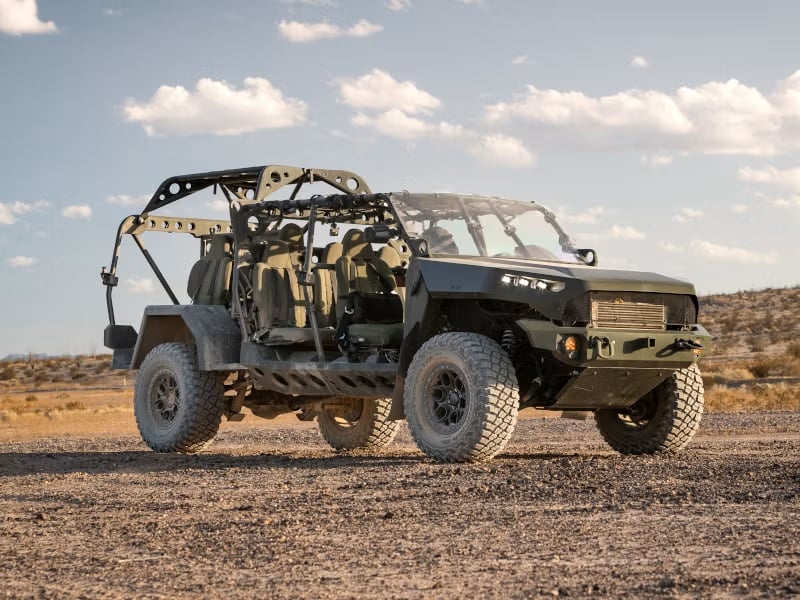
General Motors is not a complete stranger to the defense world. The company operates GM Defense, a division specifically focused on military vehicle production. One of its products is the Infantry Squad Vehicle, a light tactical transport designed for the Army.
But there is a significant gap between building troop transports and manufacturing missiles or heavy artillery. Auto plants are precision manufacturing environments, but they are optimized for very specific processes. Retooling a facility that builds Chevy Tahoes to produce rockets or munitions systems is not a weekend project. It can take months and cost enormous sums of money, which raises real questions about whether the automakers could even meet whatever timeline the Pentagon has in mind.
Reuters noted that it was unable to independently confirm Ford and GM’s involvement. When MotorTrend reached out to GM for comment, a spokesperson offered a carefully worded response, noting the company’s long history of supporting American security while declining to comment on speculation. Ford had not responded at the time of the report.
Where Is Stellantis in All of This?
One name that stands out for being missing from the Reuters report is Stellantis, the parent company of Jeep, one of the most iconic military vehicles in American history. The original Willys Jeep essentially defined utility vehicle design for generations and played a central role in World War II.
Yet Stellantis was not mentioned alongside Ford, GM, Oshkosh, and GE Aerospace in the reporting. That absence is worth noting. Stellantis is headquartered in Europe, led by a European CEO, and has close ties to EU member nations including Italy. Several of those countries have publicly condemned the U.S. military operation in Iran. Italian Prime Minister Giorgia Meloni’s government has been among the voices of dissent.
That political reality may explain why the conversations with manufacturers did not extend to Stellantis.
What Happens to Car Prices If This Goes Through?
If American automakers do shift meaningful portions of their production toward military manufacturing, everyday car buyers are going to feel it. Less civilian vehicle output means tighter inventory, and tighter inventory means higher prices. Anyone who lived through the COVID-19 pandemic knows exactly how that plays out. During the 2020 production shutdowns, new vehicle inventory collapsed and used car prices went to levels that seemed almost fictional at the time.
The silver lining in this scenario, at least compared to COVID-era shutdowns, is that factory workers would likely stay employed. Plants converting to military production would still need labor. But the ripple effects across the broader auto industry would still be significant, especially for the sprawling network of parts suppliers that depend on steady civilian vehicle demand.
What We Can Learn From This Situation
There are a few important takeaways here that go beyond the immediate headlines. First, the speed at which modern military operations consume weapons and supplies is genuinely staggering. The fact that multiple conflicts involving the U.S. military simultaneously could deplete stockpiles to the point of reaching out to car companies is a signal about how resource-intensive these operations are.
Second, this moment is a reminder of just how interconnected industrial capacity and national security can be. The U.S. learned that lesson comprehensively during World War II, which is the last time the auto industry was asked to make this kind of pivot. The fact that the question is being raised again underscores how that relationship between manufacturing and military readiness never really went away, it just moved to the background during peacetime.
Third, for consumers and industry watchers, this is a signal to pay close attention to production numbers and inventory levels in the coming months. If these talks progress into actual agreements, the effects on vehicle availability and pricing will not take long to show up on dealership lots.